Apple's iPhone faces a $190 memory problem Tobi Opeyemi Amure, Robert Davey Mon, November 2, 2026 at 12:03 PM EST 5 min read AAPL -2.13% Trade Apple on Coinbase Trading disclosure Trading disclosure The above button links to Coinbase. Yahoo Finance is not a broker-dealer or investment adviser and does not offer securities or cryptocurrencies for sale or facilitate trading. Coinbase pays us for certain activity generated through this link. Prices displayed are informational.
Most people don't think about what's inside their phone. They think about the price on the box and whether the upgrade is worth it, and that's usually where the story ends.
Apple has always made that math work in its favor. It charges premium prices, and it keeps a fat slice of every sale.
I'm clearly not alone in relying on an iPhone every day. Apple (AAPL) has a customer base of more than 2.5 billion active devices, and its June-quarter revenue rose 16% to $109.4 billion, according to its July 30 earnings call.
"This is the most powerful and most popular iPhone lineup we've ever had," said Tim Cook on that call, his last as CEO, as Six Colors reported in the transcript.
However, a subtle shift has emerged inside the iPhone itself. The chips that store your photos and run your apps have gotten far more expensive.
According to a Bank of America research report shared with TheStreet, rising memory costs could push Apple's gross margins well below what Wall Street expects, just as the company prepares to report earnings after the close on Monday, Nov. 2.
Apple already flagged the problem. Gross margin was 50.1% in the June quarter, including about two percentage points from tariff refunds.
For the September quarter, Apple guided gross margin to "between 47 percent and 48 percent," said CFO Kevan Parekh.
That includes about one point from tariff refunds. He said the drop to roughly 46.5% excluding tariff refunds "is really driven by memory."
Cook was blunter. He called it "a hundred-year flood on the memory pricing" and said Apple "reluctantly raised prices."
Bank of America analyst Wamsi Mohan put numbers on Cook's "flood" in an Oct. 30 note titled "Is consensus mis-modeling the staggered launch and risk to gross margins?"
In his model, memory in an iPhone will cost about $245 in 2027, up from about $55. That's roughly 4.5 times as much, by my math.
Related: MKBHD drops a blunt verdict on Apple's touchscreen MacBook Pro
"We see a gross 900bps impact from memory on iPhone GMs which is netted down to a negative impact of 500bps based on price, mix, and cost actions," wrote Mohan.
A basis point is one-hundredth of a percentage point, so 500 basis points is 5 points.
By March, Mohan estimates total company gross margin at 43.6% to 44.6%, "much lower than current St. ests [Street estimates] (47.7%)."
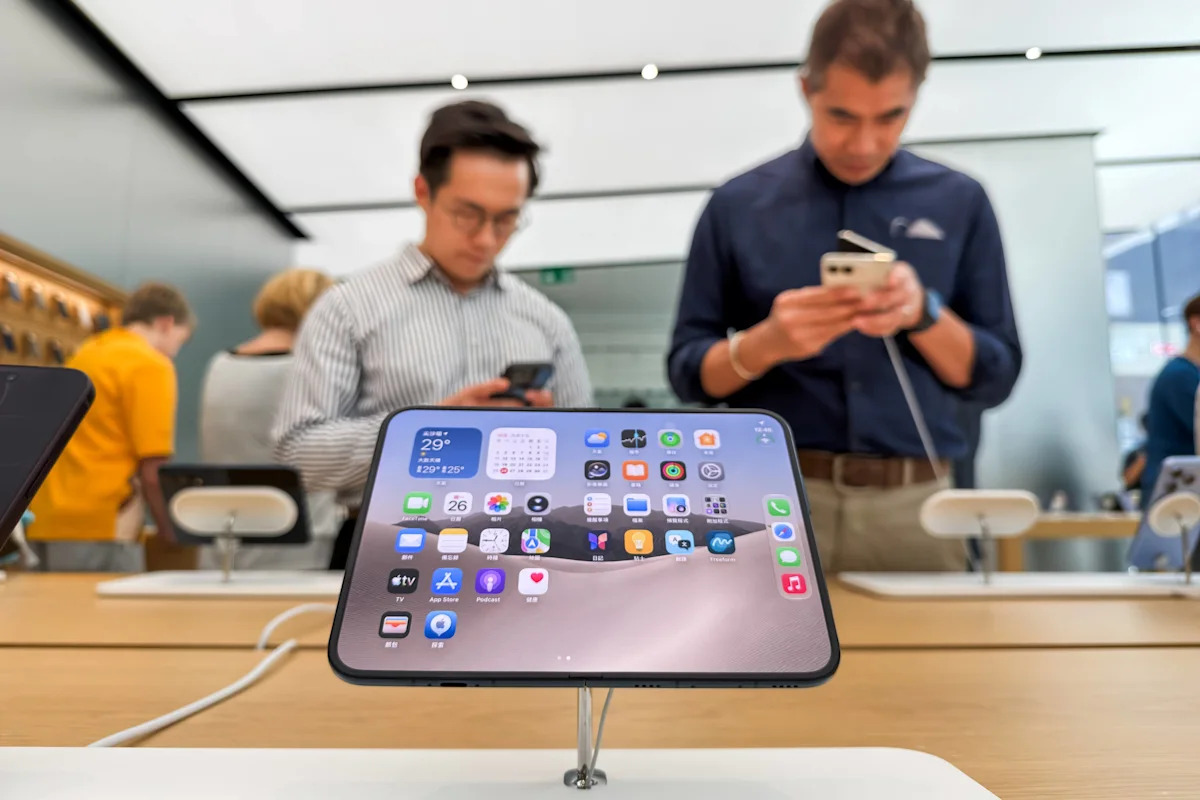
MKBHD drops a blunt verdict on Apple's $1,999 iPhone Duo
Apple's $1,999 iPhone Duo appears to have an app problem
Apple cuts iPhone 18 Pro orders as AI raises the bill
Memory makers have shifted production toward chips for AI data centers. That has left less supply for phones and PCs.
PC DRAM contract prices kept rising in the fourth quarter, though gains are narrowing, as suppliers cut PC memory output in favor of servers, according to TrendForce.
TrendForce forecast that conventional DRAM contract prices would rise 10% to 15% in the fourth quarter from the third, Tech Insider reported.
Apple has already passed some of that on to you. The base iPhone 17 now costs $899, up from $799, and the iPhone 17e, iPhone Air and iPhone 16 also rose $100, WhistleOut reported.
Given that backdrop, it's easy to understand why Mohan thinks the Street is too optimistic. Even after those price hikes, his math says Apple can't fully offset the memory bill.
Cook said in July that "primarily the DRAM market has three suppliers," which leaves even a buyer as big as Apple with limited bargaining power.
Mohan's bigger call is about timing. Apple launched the iPhone 18 Pro, Pro Max and Duo in September, but the base iPhone 18 and next iPhone Air won't arrive until early 2027.
He expects that staggered launch to shift sales out of the holiday quarter. Mohan models December-quarter revenue of $135.7 billion, versus the $153 billion analysts expect.
That's about $17 billion, or 11%, below consensus, by my math. A year ago, Apple's December quarter brought in $143.8 billion.
"Customers would defer purchasing the base iPhone 17 (if they can) and either buy Pro… or wait for the iPhone 18 base model launch in 1H2027," wrote Mohan.
He also flagged a slowdown in services. App Store revenue grew just 1.8% year over year in the September quarter, down from 3.8% in the June quarter, according to his note.
Here's how Mohan's December-quarter estimates compare with Wall Street's, according to the note:
Revenue: $135.7 billion vs. $153 billion
iPhone revenue: $69.9 billion vs. $88.9 billion
Earnings per share: $2.59 vs. $2.93
Much will likely depend, however, on how fast memory prices cool and how many buyers wait for the cheaper iPhone 18. Mohan himself said his December numbers "could prove conservative."
If that $190 hit applied to all 247 million iPhones Mohan expects Apple to sell in fiscal 2027, it would add about $47 billion in costs before price hikes and savings.
I'd treat that as a ceiling, not a forecast. But it shows why a few points of margin matter so much at Apple's scale.
Mohan still rates the stock a Buy with a $370 price target, about 6% above its $348.91 close on Oct. 30.
"We view margin pressure as transitory and model higher margins starting end of F27 into F28," wrote Mohan.
Related: Bank of America finds a quicker path to Apple's iPhone Duo
This story was originally published by TheStreet on Nov 2, 2026, where it first appeared in the Technology section. Add TheStreet as a Preferred Source by clicking here.