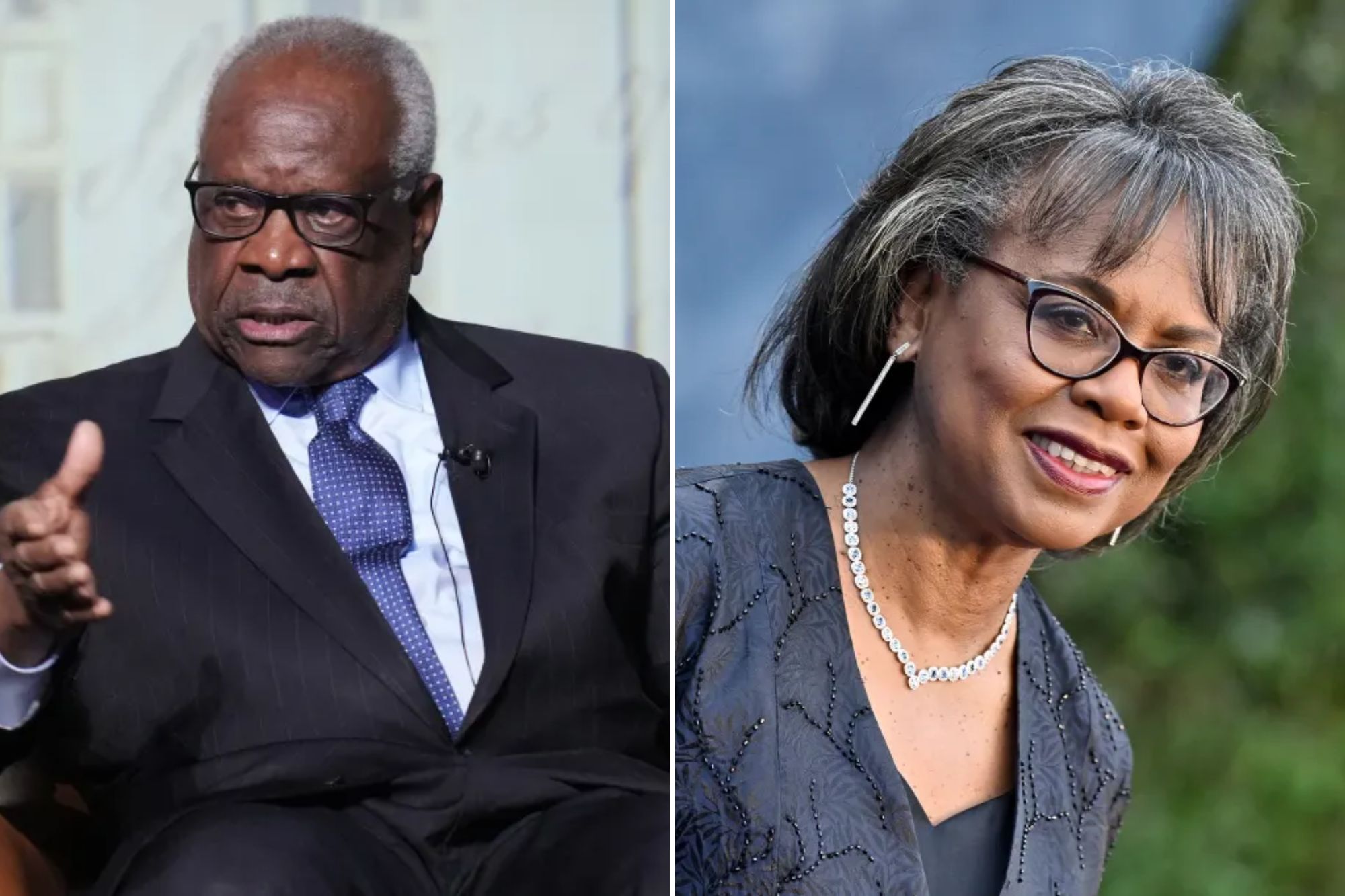
Supreme Court Justice Clarence Thomas recently argued that modern progressivism has abandoned the principles of equal natural rights in the Declaration of Independence in favor of a politics of state-managed grievance.
Hollywood proves his point: Grievance becomes victimhood, and victimhood becomes a substitute for power.
Since Harvey Weinstein became Hollywood’s sacrificial villain in 2017, the industry has largely treated women’s inequality as a story of harm — something to expose, manage, monetize, and symbolically repair.
But #MeToo’s central message — you’re a victim, and I’m a victim, too — has done little to advance the equality of women’s voices and perspectives in film and television production.
Hollywood has an unhealthy obsession with victimization. And it goes back to 1991, when Professor Anita Hill’s testimony against then-Judge Clarence Thomas made sexual harassment the dominant national framework for understanding women’s workplace inequality.
Awareness surged, including in Hollywood, and sexual harassment policies followed.
Women directors had briefly gained ground in the late 1980s and early 1990s, after six women directors, “The Original Six,” pushed for legal action through the Directors Guild of America, helping force the industry toward change. The percentage of female directors rose from 0.5% to 16% in ten years.
Then, in the wake of Anita Hill’s 1991 sexual-harassment testimony against Clarence Thomas, the numbers began to fall again, and stayed low for nearly two decades.
By 2012 and 2013, when I began bringing the issue of discrimination against women directors to the attention of the Equal Employment Opportunity Commission (EEOC) and the American Civil Liberties Union (ACLU), women still directed only about 13 percent of episodic TV and roughly four percent of studio feature films.
Why? Because victimhood does not change hiring. And Hollywood runs on who gets the next job.
The industry’s system of informal networks, insider hiring, and concentrated gatekeeping does not respond to moral pressure. It responds to accountability.
That is why the real breakthrough came in 2015, when the exclusion of women directors was treated not as a cultural problem, but as a civil rights issue tied to employment law. That year, the ACLU called on the EEOC to launch an industry-wide investigation into systemic discrimination against women directors.
Once legal pressure entered the picture, hiring shifted. Amidst federal industrywide settlements starting in 2017, female director numbers rose again, reaching historic highs by 2019.
But after Weinstein and #MeToo, Hollywood went back to what it knows best: managing the narrative. Once again, sexual harassment and victimhood became the frame.
The problem is not that harassment does not matter. It matters profoundly.
The problem is that harassment became the dominant story while employment discrimination — the structure that produces the power imbalance in the first place — disappeared from view.
To bring it full circle, Steven Spielberg’s longtime producing partner, Kathleen Kennedy, helped bring in Anita Hill to lead the newly created Hollywood Commission, an industry-led effort to address misconduct as the industry moved away from federal enforcement.
The Commission was formed in December 2017, just months after #MeToo, founded by Kennedy and entertainment lawyer Nina Shaw, supported by major entertainment entities, and chaired by Hill.
At the same time came Time’s Up, the Inclusion Rider, and industry-friendly statistics machinery such as the USC Annenberg Inclusion Initiative — all helping show the world Hollywood had changed its ways.
And once again, the focus shifted away from hiring and enforcement, and back to awareness, testimony, and symbolic repair.
The result? The numbers have now fallen yet again.
California Post News: Facebook, Instagram, TikTok, X, YouTube, WhatsApp, LinkedInCalifornia Post Sports Facebook, Instagram, TikTok, YouTube, XCalifornia Post Opinion California Post Newsletters: Sign up here!California Post App: Download here!Home delivery: Sign up here!Page Six Hollywood: Sign up here!
Even USC Annenberg’s latest report, after years of statistics often cited to suggest that Hollywood could police itself, found that women directed only 8.1% of the top 100 box-office films in 2025, down from 13.4% in 2024 — the weakest showing since 2018.
This is not complicated. When inequality is treated as an employment problem, tied to jobs and enforceable rights, women advance.
When it is treated as a victimhood problem — something to be discussed, managed, and symbolically addressed — the system absorbs the pressure and keeps functioning as it always has.
That is the victimhood trap embedded in modern progressivism. That is the point Thomas is pressing.
Sexual harassment and abuse in the workplace are the result of power imbalances rooted in employment and economic injustice.
The victimhood ethos offers recognition without power. And in Hollywood, power means one thing: Who gets hired to tell the story.
Maria Giese is an American film director, screenwriter, and longtime advocate for equity for women directors in Hollywood. She writes on Substack at The Vault.