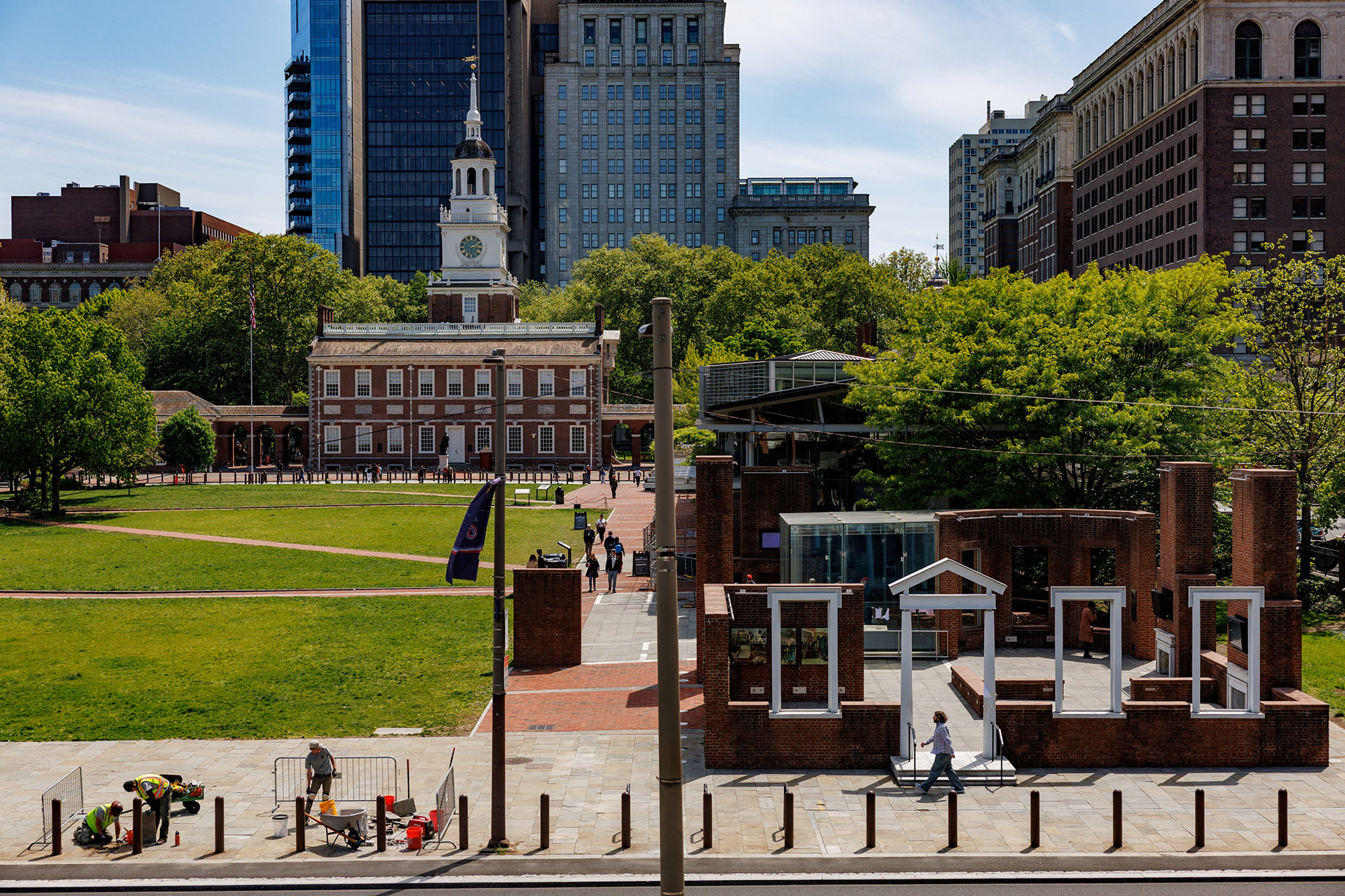
People walk past the President's House Site in Philadelphia, Pennsylvania, May 1, 2026. REUTERS When the National Park Service removed signs that had made George Washington the most heavily criticized individual at Philadelphia’s Independence Park, critics accused President Donald Trump of “censorship.”
Now that NPS has unveiled replacement signs, the administration stands accused of “whitewashing” and “sanitizing” history.
In truth, Trump is rescuing a prominent historical site from radical activists and presenting American history in a much more accurate, nuanced and informative way — just in time for the 250th anniversary of American independence.
A block north of Independence Hall, the President’s House Site features ruins of the house where Presidents Washington and John Adams lived from 1790 to 1800.
In January, the city of Philadelphia sued in federal court after NPS took down displays at the site that focused myopically on slavery.
When the site opened in 2010 during President Barack Obama’s administration, New York Times critic Edward Rothstein wrote that its presentation “overturns the idea of history, making it subservient to the claims of contemporary identity politics.”
The house, he noted, was presented “almost as if it were the Slave Market of Charleston” — because Washington brought nine slaves north with him to Philadelphia from his Virginia plantation.
Indeed, 25 of the site’s 30 signs focused on slavery or race relations, as I found during an August 2025 visit.
Washington and other founders stood accused of “injustice” and “immorality.”
Headings read “Washington’s Deceit” and “Washington’s Death and a New Hope for Freedom.”
The biggest hero of the American Revolution was portrayed as Independence Park’s chief villain.
The new signs, which are posted on the Park Service’s website but still await judicial approval to be hung, mark a vast improvement.
Far from neglecting slavery, they present it with the complexity and nuance that those seeking to disparage America’s history and heroes champion in speech, but eschew in practice.
The new signs refer to slavery as “an odious and pernicious affront to the glorious rule of liberty proclaimed in the Declaration of Independence” — which is how most of the Founders, including Washington, viewed it.
The previous signs didn’t even mention the Civil War on their “Slavery Timeline.”
The new ones observe that it “took Lincoln and a bloody Civil War to finish the work that the Founders had begun and end slavery in the United States once and for all.”
These signs highlight Harriet Tubman and the Underground Railroad, Frederick Douglass and his belief in the “saving principles” of the Declaration of Independence, and the 13th Amendment’s abolition of slavery.
Whereas the old signs described Washington’s actions as “deplorable” and “profoundly disturbing,” and as having “mocked the nation’s pretense to be a beacon of liberty,” the new ones offer balance and insights on Washington and slavery.
They observe that he “often expressed discomfort with the institution and a desire to see it abolished,” yet “his wealth and livelihood were deeply tied to it.”
They note that he “helped draft the Fairfax Resolves at Mount Vernon,” which called for putting (in the Resolves’ words) “an entire Stop” to the “wicked” slave trade.
They highlight that he “signed legislation that both upheld and limited slavery,” including banning it in the Northwest Territory (the current Midwest).
They note, “Among all of the Founders, Washington carried out the largest manumission of enslaved people,” through his will.
These new signs also observe, “Slaves living in the President’s House experienced a greater modicum of autonomy” than one might presume — as they were at times “able to explore the city and sometimes even attend the theater, with Washington buying the tickets.”
They make clear that while slavery was egregiously at odds with the right to liberty, the lives and living conditions of slaves varied greatly.
The new signs also provide information on the nine slaves who lived in the house and whose names remain carved into the site’s walls.
In addition, the replacement panels add a wealth of rich detail about the site itself, noting that British Gen. William Howe made the house his headquarters while Washington and his army suffered at Valley Forge; that Washington was owner Robert Morris’ guest there throughout the Constitutional Convention; and that Benedict Arnold lived there in 1778 as the military commandant of Philadelphia, courting Loyalist Peggy Shippen.
Oral arguments at the Third Circuit Court in Philadelphia’s lawsuit are scheduled for June 2, one month before visitors flock to Independence Park for the July 4 anniversary of the Declaration of Independence.
If the Trump administration gets the court’s green light to hang these exemplary new signs, reclaiming the President’s House Site for the American people will rank as a signature accomplishment during the Quarter-Millennial celebration of our independence.
Jeffrey H. Anderson is president of the American Main Street Initiative. Adapted from RealClear Politics.