The election outcome allows Prime Minister Narendra Modi's Bharatiya Janata Party to further expand its political dominance.
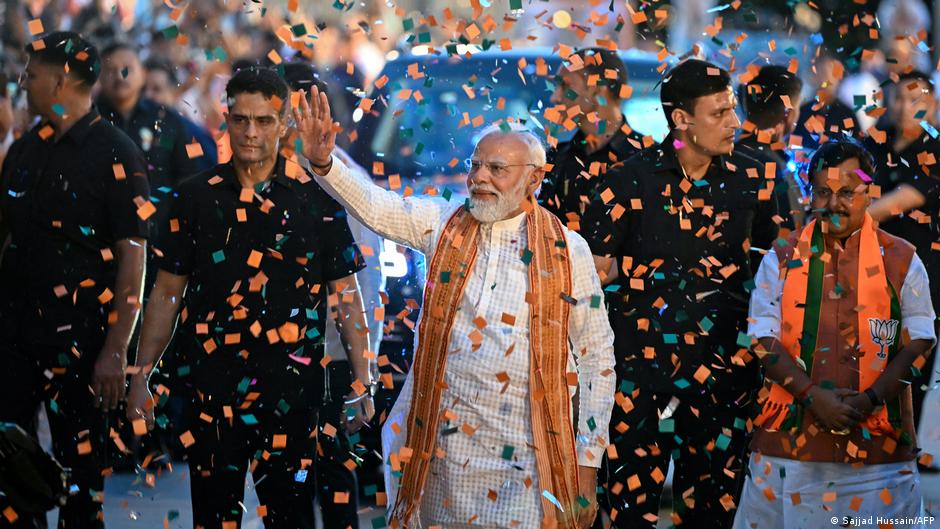
https://p.dw.com/p/5DKKOModi campaigned heavily in West Bengal and promised economic development, employment for the youth and expanded welfare benefitsImage: Sajjad Hussain/AFPAdvertisementIndian Prime Minister Narendra Modi's Bharatiya Janata Party (BJP) won a decisive election victory in opposition-held West Bengal, a key eastern state of more than 100 million people, marking a dramatic shift in a state long seen as resistant to the party's rise.
According to results announced Monday, the BJP secured 206 of the 294 assembly seats.
The result allows the BJP to expand its political dominance beyond the Hindi-speaking heartland of northern and central India.
West Bengal, a largely Bengali-speaking state, had been ruled by a regional party, the All India Trinamool Congress (TMC), since 2011. The party's leader Mamata Banerjee has been a fierce critic of Modi.
But the latest election marked a steep downfall for the three-term chief minister, with Mamata losing her own seat. Experts say she was voted out largely on anti-incumbency sentiments over mounting criticism of corruption and lack of economic opportunities in the state.
"Victories and defeats are part of democracy and am proud that we fought the good fight," Sagarika Ghose, a member of Parliament from the TMC party, told DW. "Contrary to the media stereotypes, Mamata Banerjee was an excellent chief minister and delivered a safe, developing and plural Bengal," she added.
For decades, West Bengal resisted the kind of majoritarian politics that powered the BJP's rise across much of India, with the state's strong regional identity and linguistic pride appearing to insulate it, say experts.
To win the state, Modi campaigned heavily and promised economic development, employment for the youth and expanded welfare benefits. The victory therefore gives a huge boost to Modi and the BJP.
"We have crossed the Rubicon. West Bengal has been breached," BJP spokesperson Shazia Ilmi told DW. "The verdict demonstrates that the BJP's core formula — religious identity combined with welfare delivery, nationalism, and a disciplined grassroots organization — can travel further than previously assumed," said Ilmi.
She pointed out that governing a border state also allows the BJP to align state administration with central security priorities along one of India's most sensitive corridors linking the northeastern states to the rest of the country.
Winning a state with a substantial religious minority population — Muslims, for instance, account for over a quarter of West Bengal's 100-million-plus population — also points to a significant consolidation of Hindu voters across caste and class lines, observers say.
The West Bengal election outcome shows that "a targeted communal polarization strategy pays off in the long run and trumps all other forms of political mobilization," Gilles Verniers, a political scientist and researcher at Sciences Po's Center for International Studies (CERI), told DW.
Other election results announced on Monday gave the BJP a major win in the northeastern state of Assam and another term in power in the small southern coastal territory of Puducherry.
In the southern state of Tamil Nadu, popular movie star Joseph Vijay, who launched the Tamilaga Vettri Kazhagam party only two years ago, ousted the ruling DMK party.
In neighboring Kerala state, the Indian National Congress-led opposition defeated the ruling communist government, ending leftist rule in one of its last remaining strongholds.
The election results further bolster the BJP-led National Democratic Alliance (NDA) coalition's position, and leave its opponents weakened, even in southern India, said Verniers.
"The BJP's march to the south has started already, but it will be incremental, like it was for West Bengal," he underlined. "A lot depends on the capacity of regional parties to reinvent themselves. They tend to calcify when they remain in power for too long and become vulnerable the moment the BJP turns into the main opposition."
Arun Behuria, a psephologist and political researcher, shares a similar view. The BJP's victory in West Bengal "puts every regional incumbent on notice," he said.
"If Mamata, one of India's most formidable opposition leaders, can be defeated on home turf, no state is structurally safe from this BJP machine," Behuria told DW.
The election in West Bengal was overshadowed by debates over the revision of electoral rolls.
The exercise was formally intended to remove duplicate or ineligible voters and address other discrepancies. It led to the removal of millions of names from the electoral rolls.
Opposition parties and other critics have alleged that the exercise disproportionately affected minority voters and their strongholds.
"An unhelpful Election Commission went to great lengths to make the voter lists inaccessible," Amrita Johri, a transparency activist, told DW. "It is clear that Muslim names have been deleted in disproportionately large numbers. This potentially impacted the Bengal election results," she added.
On Tuesday, TMC chief Banerjee accused the Election Commission of being "biased" and that about 100 seats were "forcibly taken" from her party.
"I will not resign, I did not lose... officially, through the Election Commission, they (the BJP) can defeat us, but morally, we won the election," she told a news briefing.
The Election Commission, however, has rejected the allegations, with West Bengal's Chief Electoral Officer Manoj Kumar Agarwal terming them "baseless."