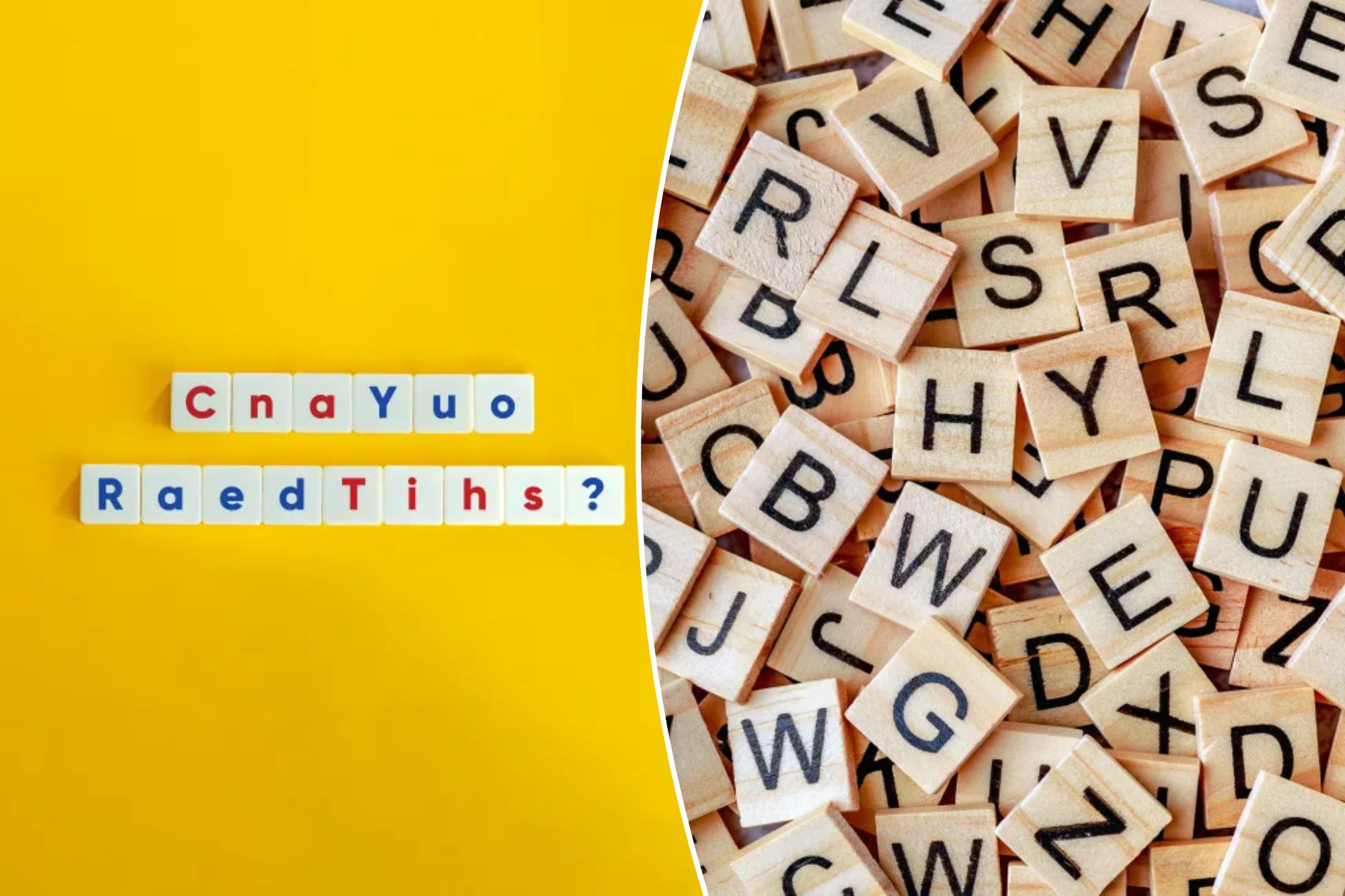
You’ve probably seen it — a paragraph that looks totally mangled, yet somehow you’re able to read it correctly.
Those scrambled letters that shouldn’t make sense, but your brain doesn’t notice. This oddly satisfying phenomenon is called typoglycemia, a viral sensation online where jumbled letters are still coherent. And according to science, there is a real reason humans can process them.
“Aoccdrnig to a rseearch at Cmabridge Uinervtisy, it deos not mttaer in what oredr the ltteers in a wrod are, the olny iprmoatnt tihng is taht the frist and lsat ltteer be in the rghit pclae.”
That is known as the “Cambridge University Effect,” a meme that circulates on the internet that says as long as the first letter and the last letter of the word are in the correct spot, you can still comprehend the word.
Studies show that this phenomenon has caveats, such as the length of the word. Surprisingly, results showed that the more a jumbled word resembled its correct spelling, the longer it took people to categorize it. For example, PENICL took longer than EPNCIL,” for many participants.
What influences the challenge is the pattern of the word, which our minds are always scanning for. Rather than decoding every single letter, we look for familiar shapes and, even more so, the context of the sentence, according to research at the University of Colorado Boulder.
Our brains are designed to predict what is likely to come next, and then check those predictions against the visual input, which can explain why we so often miss typos in our own writing. And the more minimal the swap, the easier it is to miss, especially when the letters are next to each other— like “jugde” for “judge.”
“We don’t see what’s actually on the page; we see what we expect to be there,” said Karen Stollznow, a linguistics professor at Boulder. “The same principle helps us make sense of jumbled words. Even when letters are out of order, enough of the structure remains for the brain to make an educated guess.”
Basically, our minds are built to make sense of a little chaos, but not total abolishment.
But there are limitations. Texting in alternating caps can be more difficult for our brains to process, according to Stollznow. It doesn’t follow a familiar pattern and distorts our learned understanding of the word’s “visual contour.”
Although we humans understand that we can make sense of these word salads, the trend continues to go viral and shock people because it almost feels like a glitch in the way we’re hardwired. But really, reading is one of the most complex things our brains can do, blending a host of different processes and inputs.
“The idea persists because it captures a genuine insight in a catchy way,” says Stollznow. “It reveals that reading is not a simple, letter-by-letter process, but a dynamic interaction between perception and expectation.”