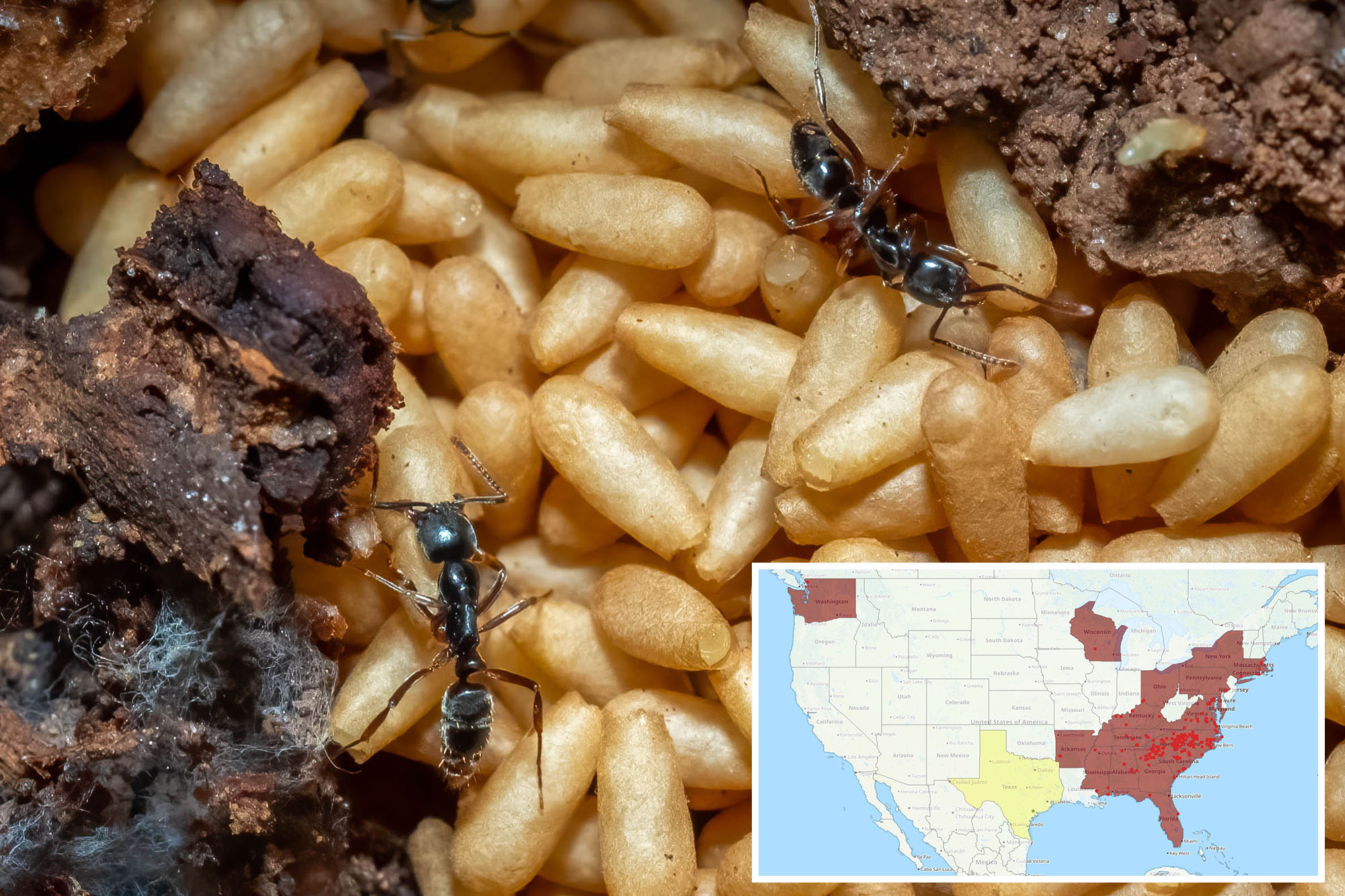
The US is being taken over by the invasive needle ant from East Asia, whose sting can cause excruciating pain and even a deadly allergic reaction. Chris Hartley / Missouri Botanical Garden Another deadly Asian superbug is invading the US.
Officials are raising the alarm as invasive ants from Asia are sweeping their way across the US, threatening people with their potentially deadly sting.
Originally hailing from China, these social insects were first discovered in the US in 1932, when they cropped up in Georgia — although officials suspected the bugs were present stateside before then.
Since then, the population has swarmed across 20 states with the highest concentrations reported in North Carolina, South Carolina, Georgia and Alabama, according to Antmaps.org.
However, there have also been significant surges in Tennessee, Virginia, Kentucky, Wisconsin and even New York.
The needle ant also reared its antenna’d head in Texas, where bioscience expert Scott Egan said told Click2Houston that it’s “important to be aware of this new invader, but we need to learn more.”
These ants are especially insidious as they resemble many other species, making these chameleonic critters difficult to distinguish from their local counterparts.
According to researchers, they’re generally mottled brown or black with long, slender bodies that measure between 1/4 and 1.8 of an inch long.
Perhaps their most notable attribute is their giant stinger, which was earned them the Japanese moniker Oo-hari-ari, meaning “giant needle ant,” USA Today reported.
Getting stung is excruciating. “Imagine somebody inserting a needle directly into your flesh,” said Benoit Guénard, an entomology professor at the University of Hong Kong who studied needle ants in North Carolina. “It’s a very sharp, acute pain, but it’s quite local.”
Meanwhile, the US Department of Agriculture reports that the pain comes and goes “over the course of several hours.”
To make matters worse, envenomation can result in a host of symptoms, ranging from redness at the sting site to hives and even anaphylaxis — a potentially deadly allergic reaction marked by respiratory problems, swelling in the throat and a rapid heartbeat.
In 2024, three people in Georgia died from this condition after getting tagged by their stinger, which is reportedly sharp enough to pierce clothing.
Along with threatening human health, they also pose a risk to the environment as well. Asian needle ants outcompete species that are crucial for seed dispersal, which can cause ecological mayhem.
“Thus, this invasive species could have dramatic, long-term negative effects on forest understory,” the U.S. Department of Agriculture said.
Unfortunately, getting rid of these Asian invaders could be an uphill battle, as among other characteristics, they’re extremely hard to detect. Unlike invasive South American fire ants, which erect obvious dome-like mounds, needle ants prefer to reside beneath stones or in rotting wood.
They also don’t form visible foraging trails or march in obvious columns, making them doubly difficult to spot.
In addition, experts haven’t outlined a formal method of eradicating these invaders. While protein-based pesticide baits seem to be most effective, according to North Carolina State University, they generally only mitigate the threat rather than eliminating it entirely.
“Unfortunately, as with many invasive species, it appears Asian needle ants are here to stay,” the USDA stated.
Fortunately, experts say we could learn to live in harmony with these stinging critters, just as we have with the other invaders.
“They’re not aggressive, they don’t swarm the way fire ants do,” said Andrew Johnston, an insect diagnostician at Purdue University’s Department of Entomology. “Wear gloves and pay attention to what you’re grabbing.”