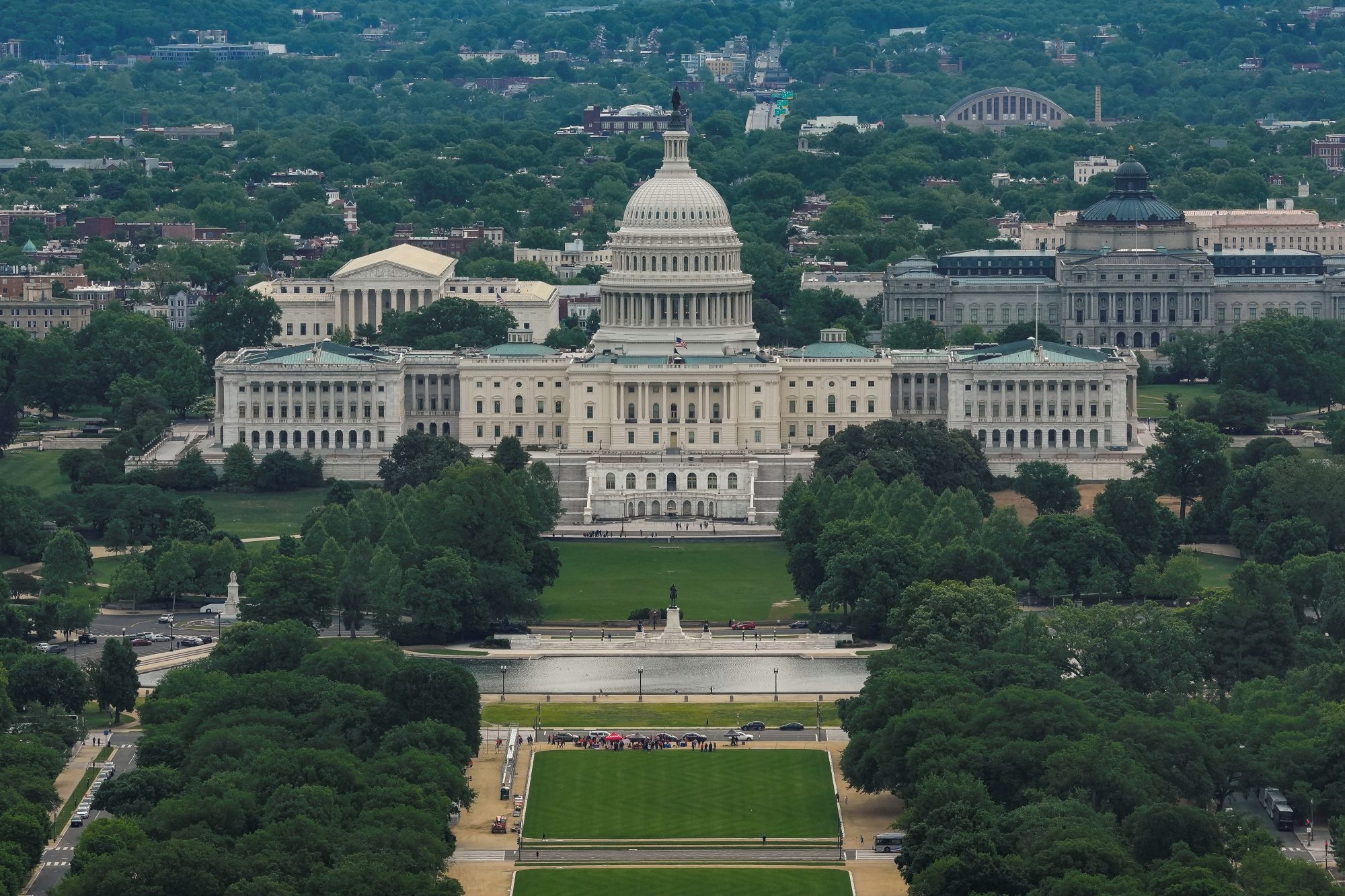
US national debt, at $31.27 trillion, now surpasses the nation's GDP, hitting a 100.2% ratio. REUTERS Last week’s grim news about America’s publicly traded debt should be a blaring emergency siren — and a wake-up call.
Data from the Bureau of Economic Analysis shows the debt, at $31.27 trillion, is now higher than the entire nation’s gross domestic product of $31.22 trillion.
The annual interest expense for carrying this debt exceeds $1 trillion — that’s $1,000,000,000,000, with 12 zeroes.
What a legacy to leave for our children and grandchildren.
Start with the reality that the federal budgeting process is a farce and an abomination.
No rules, restraints or restrictions keep Congress from spending willy-nilly on everything from food stamps to day-care centers to health insurance to farm subsidies.
And both parties are in on the game: Republicans call themselves fiscal conservatives, but the results don’t support that label.
Republicans control the presidency, the House and the Senate — and they’re spending at record levels.
But the Democrats aren’t helping matters; their only solution is to soak the rich.
Good luck with that: Federal tax receipts are already at an all-time high.
I’m reminded of Ronald Reagan’s quip when asked whether he would support a tax increase: “Never give an alcoholic another drink.”
We’re on a bipartisan spending spree, and we’re not paying the bills, just charging them to the world’s largest credit card — with no borrowing limit but a debt “ceiling” that keeps getting extended.
This is called a “buy now, pay later” scheme, and we should have learned by now that those never turn out well.
Now Republicans are about to blow another hole in the budget by passing a $200 billion military “supplemental” spending bill — without any offsetting savings.
That should officially end the masquerade of Republican fiscal responsibility.
One of Congress’ few true anti-big-government voices, Sen. Rand Paul of Kentucky, notes that if we had simply held spending since 2019 to the rate of inflation, we’d be close to a balanced budget this year.
But spending exploded during the COVID-19 pandemic, and we never stopped the splurge.
Instead of draining out all the excessive COVID spending, we made it permanent.
Three times in the last 40 years, Congress agreed to impose controls on how much it can spend each year.
First came the 1986 Gramm-Rudman-Hollings deficit caps, which required automatic across-the-board sequesters if the cap was violated.
Then came the hard spending caps of the Clinton-Gingrich budget deal of 1995-96.
Finally, in 2011, the underrated Budget Control Act negotiated by then-Speaker John Boehner and President Barack Obama instituted hard “pay-as-you-go” ceilings on domestic and defense spending.
All three times spending fell as a share of GDP, and so did the deficit.
After the Clinton-Gingrich negotiations, we saw one of the largest federal spending reductions ever, and the only balanced budgets in half a century — with almost $500 billion in surpluses.
Each time, a later Congress repealed the budget caps, and spending and red ink soared — such as when the Republicans idiotically blew off 2011’s hard spending caps to shower more money on the Pentagon.
Spending caps, when in effect, have held the growth of federal outlays to 2.7%, according to a new Brookings Institute study.
Without spending caps, we’ve had unsustainable 6.4% growth in the federal budget.
So it’s obvious we need “pay as you go” spending caps — starting right now.
If Republicans want $200 billion more for defense, they must include across-the-board cuts of 5% to 10% to all other programs to pay for it.
The GOP’s own studies have found rampant waste, fraud, abuse and outright theft in federal programs — more than $1 trillion worth.
So this time we need to include within the cap out-of-control “entitlement” programs like Medicare, Medicaid, pensions, food stamps, day-care subsidies and the like.
Why not, for example, require retired millionaires to purchase their own health insurance?
A new study uncovered many cases of food-stamp recipients driving Ferraris and Porsches.
Just ending the fraud and overpayments in these programs would save $200 billion a year.
If Congress won’t even make these easy and commonsense reforms, our debt burden will continue to soar.
Stephen Moore is co-founder of Unleash Prosperity and is a senior fellow at America First Policy Institute.