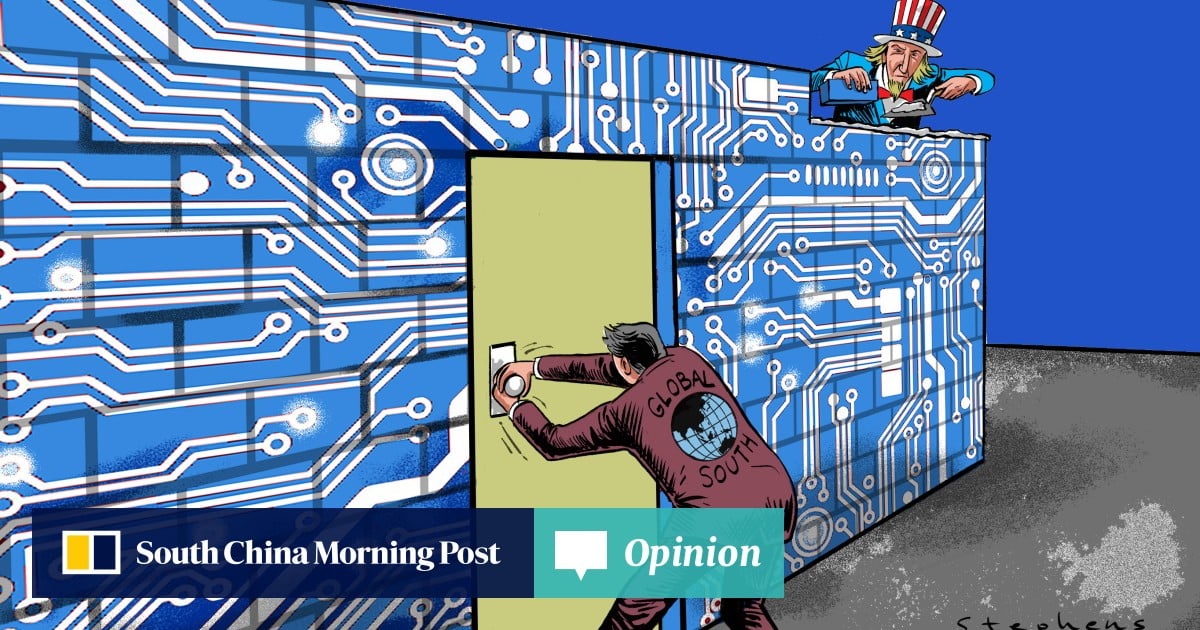
The world deserves better than a monopoly that builds walls and hobbles development
3-MIN READ3-MIN ListenZhou XiaomingZhou Xiaoming is a senior fellow at the Centre for China and Globalisation in Beijing and a former deputy representative of China’s Permanent Mission to the United Nations Office in Geneva. Published: 5:30am, 5 May 2026In global discourse, a script has been handed to us: the United States and China are locked in a “tech race”. But this is really a misnomer. True competition requires a level playing field. When one runner trips the other to ensure victory, it’s not a competition; it’s cheating.So, when Washington deploys an arsenal of sanctions, export controls and diplomatic strong-arming to hamstring China’s technological ascent, it is not competing. It is an act of suppression.This reflects a deliberate strategy to preserve American supremacy in the technologies of the future. Take 6G for example. Washington’s intent is clear: by bundling development with “trusted” supply chains and alliance politics, it is working to build a new global regime centred on US-led standards and closed loops, rather than a universal, open-access model.AdvertisementThe US obsession with retaining its crown is not rooted in advancing humanity’s collective interests; it is about preserving a monopoly. The US has used patent barriers, export bans and price gouging to act as the gatekeeper of modernisation.
As a result, the spread of technology is channelled through a system of sluice gates. This systematic hindrance builds a high wall, shutting out the Global South and locking developing nations permanently at the bottom of the global value chain.
The impact on the Global South is a daily reality of exclusion. Nowhere is this more visible than in agriculture.