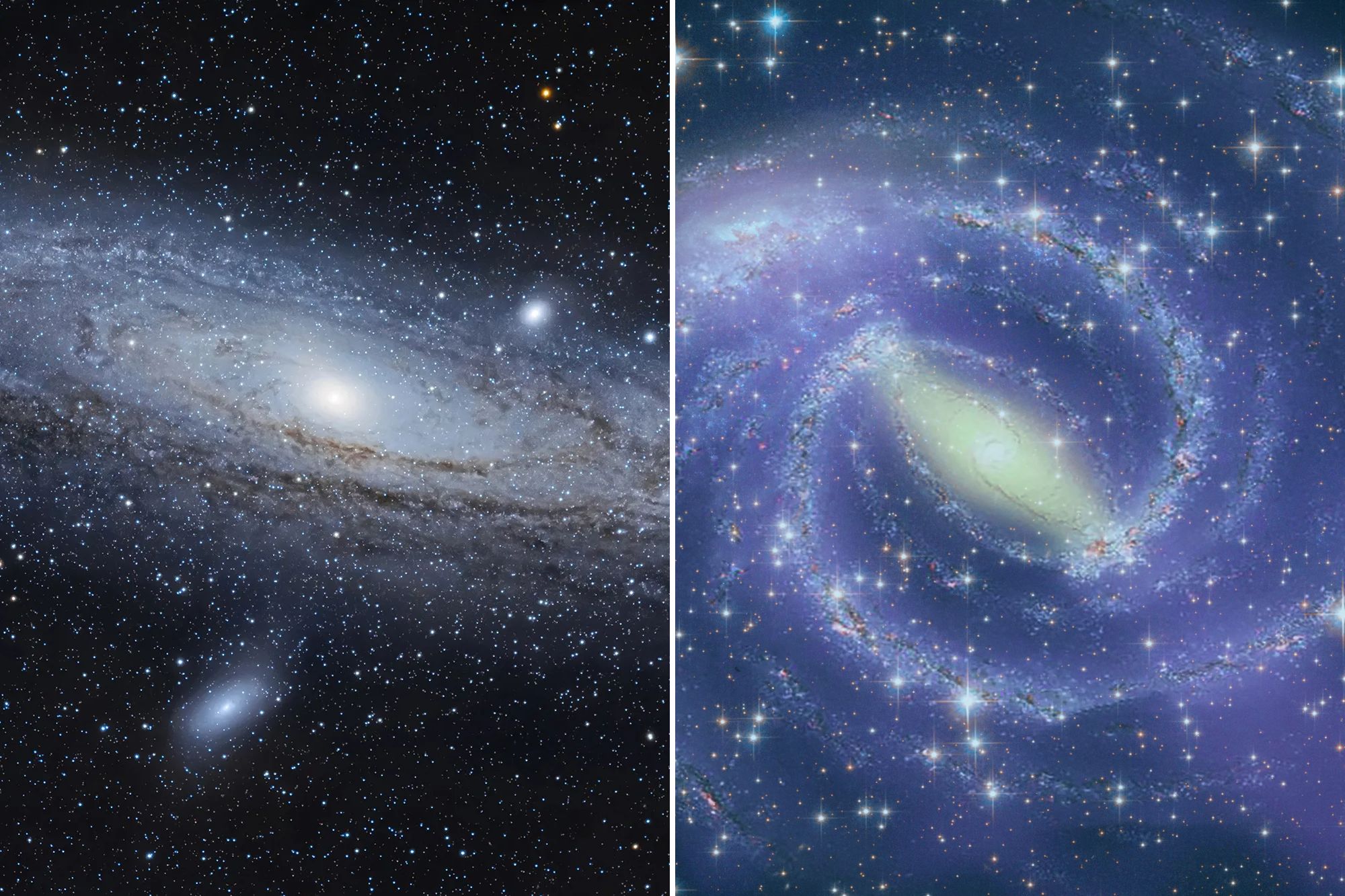
Scientists found potential remnants of a smaller galaxy that our Milky Way gobbled during its younger years. They’re like galactic Russian dolls.
Our solar system had a galaxy-sized appetite in its younger years. The Milky Way likely grew to its current size by gobbling up smaller solar systems, including a dwarf galaxy whose remnants were absorbed into our own, per a study in the journal Monthly Notices of the Royal Astronomical Society.
In other words, it’s literally a galaxy inside a galaxy.
The researchers deduced that the Milky Way likely gobbled up the smaller galaxy during its wonder years. wowinside – stock.adobe.com Like a cosmic hungry caterpillar, this particular star system — dubbed Loki after the Norse god of trickery — was consumed by our own solar system billions of years ago when our celestial neighborhood was expanding in size, Futurism reported.
Believed to be a dwarf galaxy, this galactic precursor consists of billions of stars.
Despite this grand scale, the fun-size star system pales in comparison to the hundreds of billions that comprise mature versions such as the Milky Way.
The researchers discovered our solar system’s intergalactic ingestion by studying a sample of 20 metal-poor stars on its galactic plane, the flat, halo-like region on which most of the stars reside.
Artist’s depiction of the Norse god Loki with his net. Pictures From History/Universal Images Group via Getty Images Metal-poor stars are objects that formed early in cosmic history and retain the chemical DNA of the environments in which they were born.
“These building blocks merged together at early epochs, dispersing their stellar, gaseous, and dark matter content into the forming proto-galaxy,” the researchers wrote.
They found that the compositions and orbital behavior of these particular stars differed from that of the region’s other metal-deficient stars.
These interlopers harbored traces of cosmic explosions that discharged heavy elements, including supernovas and neutron star mergers, the Daily Galaxy reported.
However, said stars didn’t possess any evidence of a White Dwarf — the remnants left after a star the size of our sun runs out of fuel and shed its outer layers.
Because white dwarfs take billions of years to form, researchers deduced that the 20 undigested remnants originated from an extremely short-lived dwarf galaxy, in this case, Loki.
As the sample size is relatively small, researchers would need larger datasets before confirming Loki’s existence and mapping its structure.