Many children of North Korean elites are "addicted to smuggled South Korean pop culture and American action movies," an expert told DW. Under Kim Jong Un, watching this content could put one's life at risk.
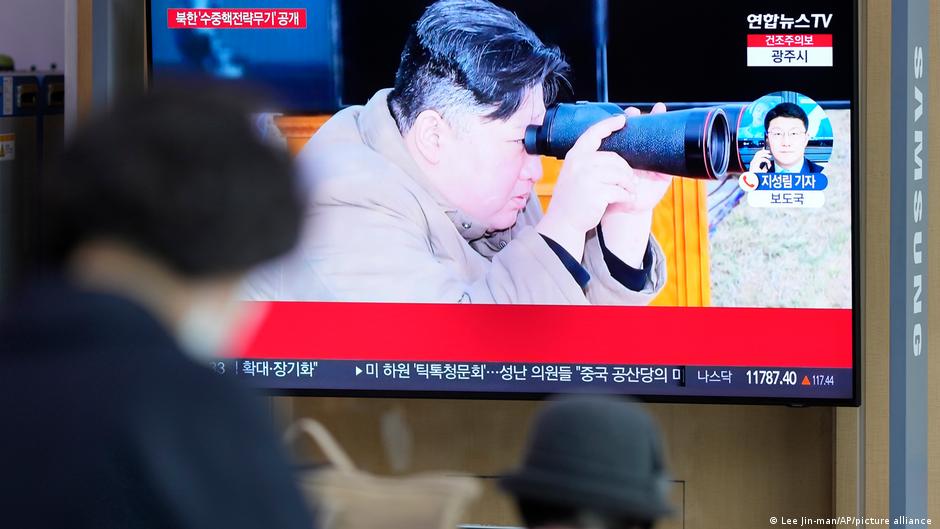
https://p.dw.com/p/5DF0NThe Kim Jong Un regime is using death penalty to clamp down on entertainment smuggled from abroadImage: Lee Jin-man/AP/picture alliance AdvertisementA new report by a Seoul-based human rights group has indicated a sharp spike in executions over foreign culture, religion and "superstition" in North Korea.
The Transnational Justice Working Group (TJWG) investigated executions in North Korea before and after the border closure in January 2020, which the country's dictator Kim Jong Un ostensibly ordered to protect the country from the COVID-19 virus. As part of their research, they interviewed 880 defectors from the Kim dictatorship.
They found 153 people were condemned to death in North Korea between January 2020 and mid-December 2024 on various charges. This marks a jump of nearly 250% compared to the equivalent time period before the January 2020 closure.
However, the jump is even more pronounced when it comes to death sentences related to culture, religion (including owning a Bible) and "superstition." Their data shows 38 people were condemned to death over these offenses in less than five years following January 2020, compared to seven people in the same length of time before that.
How North Korea uses Christianity to protect Kim dynastyTo view this video please enable JavaScript, and consider upgrading to a web browser that supports HTML5 video
"Prior to the border closure, murder was the most frequently cited capital offense," the activists said. In more recent years, "the focus shifted toward offenses involving foreign culture and information, such as South Korean movies, dramas, and music" in addition to charges relating to religion and superstition.
The shift shows an increasing willingness on the part of Kim Jong Un's regime to use lethal force to ensure loyalty and subdue any hints of discontent, experts say. Even with the deadly crackdown, however, large amounts of foreign media are already circulating within North Korea.
"It is already too late for the North Korean regime to put this genie back into the bottle," said Greg Scarlatoiu, executive director of the Washington DC-based Committee for Human Rights in North Korea.
"In North Korea, the crackdown always gets harsher," he said. "The number of true believers in the regime is dwindling dramatically. Rather than ideological indoctrination, violence is becoming the regime's preferred option."
Scarlatoiu says the TJWG statistics are "consistent" with the findings of his rights organization.
"The young sons and daughters of North Korean elites dwelling in urban areas are addicted to smuggled South Korean pop culture and American action movies," he said. "They will risk their lives to access such information."
At one point, even Kim Jong Un seemed sympathetic to the South Korean culture, attending a concert by South Korean stars in 2018. The time of K-pop diplomacy, however, seems to be well and truly over.
In January 2022, for example, a woman in her 20s and her boyfriend were publicly executed in South Pyongan Province for watching and sharing South Korean films, soap operas and other television programs, according to the Seoul-based Daily NK news site.
The executed woman was the daughter of a senior member of North Korea's Ministry of State Security. Even that, however, was not enough to save her life, the Daily NK said quoting sources inside North Korea. The rest of the woman's family were sent to a political prison camp.
Some 300 local residents were ordered to attend the execution, with around 20 people accused of borrowing or sharing the unnamed woman's music and films forced to sit in the front row as the sentence was carried out. They were all then arrested.
"It's appalling but, I have to say, not really a surprise," said Song Young-Chae, a South Korean academic and activist with the Worldwide Coalition to Stop Genocide in North Korea. "These are the methods the regime uses to exercise control over the people and if they sense they are losing that control as more and more North Koreans see movies from beyond their borders, then the only tool they have is more violence."
"Kim Jong Un's regime fears music videos and television shows because he knows it is giving his people a glimpse of the world beyond the North's borders and it exposes the lie that they live in a paradise," he said. "The last thing he wants is images of outside igniting free-thinking and the pursuit of freedom and happiness."
A lot of this foreign content entered the country thanks to activists who would save the material on USB sticks and then send them across the border attached to balloons. Last year, South Korea's government passed legislation banning the practice, with President Lee Jae-myung hoping to improve ties with Pyongyang.
"This was one of the main demands of the government in Pyongyang so it is clear that giving the people there access to information alarms the regime," he said. "If we really want to help the people of North Korea, then we have to give them access to more information.”
North Korean defector: 'We are not traitors'To view this video please enable JavaScript, and consider upgrading to a web browser that supports HTML5 video
Talking to DW, Scarlatiou also described he South Korean decision as a "mistake of epic proportions.”
"I was born and raised in communist Romania," he said. "I understand the power of information from the outside world. Up to 80% of Romanians did not trust regime propaganda and we got our news from Deutsche Welle, the BBC, Voice of America and Radio Free Europe. All of these radio stations played a crucial role during the downfall of the regime of Nicolae Ceausescu in December 1989."
"North Koreans must hear the story of prosperous, free, democratic South Korea," he said. "That can only come through balloon leaflets and other fairly limited means of delivering information to their country."