play Live Sign upShow navigation menuplay Live Click here to searchsearchSign upNews|Russia-Ukraine warHow to escape Russia’s army: Soldiers serving in Ukraine seek a way outRussia’s army faces a desertion crisis as it continues to use waves of soldiers to attack Ukraine’s defensive positions.
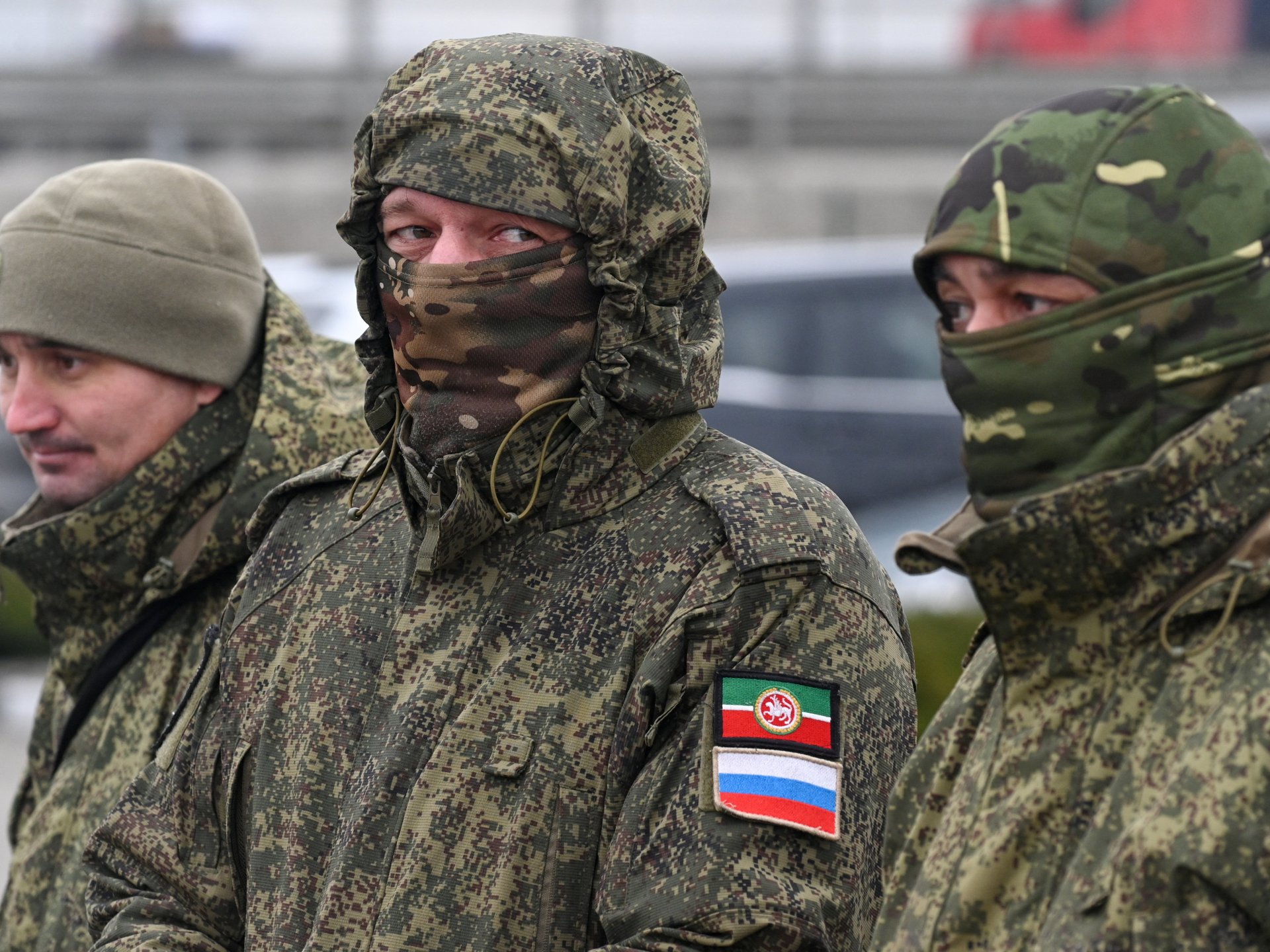
xwhatsapp-strokecopylinkgoogleAdd Al Jazeera on GoogleinfoRussian soldiers in a ceremonial handover of humanitarian aid in Rostov-on-Don in February [Sergey Pivovarov/Reuters]By Mansur MirovalevPublished On 4 May 20264 May 2026Warning: This story contains references to suicide and self harm, which some may find distressing.
Oleg, a 24-year-old who grew up in the western Russian city of Ufa, thought he was signing up to work as a security guard at the Zaporizhzhia nuclear power plant in the occupied part of southeastern Ukraine.
To secure the job, with a salary of 200,000 rubles ($2,660), he took a train in December from Moscow to a conscription office in the city of Ryazan, 200 kilometres (125 miles) southeast.
He knew the job was being arranged through the army, but did not imagine having to serve on the frontlines.
He arrived at the office on a gloomy evening, sleepy and with a splitting headache.
And he then signed away his civilian life “in a hurry, without reading, without comprehending, and that was it”, he told Al Jazeera.
The officer who handed him the contract at 11pm had asked Oleg to sign an “appendix” that turned out to be an agreement to become a drone pilot, he said.
Oleg withheld his last name and current location for security reasons, as he has since deserted the army and fled Russia.
The Kremlin does not release data on the number of soldiers who have deserted or gone absent without official leave.
Last June, the independent Mediazona publication claimed that almost 21,000 Russian servicemen were convicted for refusing to serve, adding that even more deserters were taken back to their military units without being prosecuted.
The United Nations’ special rapporteur on human rights said in September that at least 50,000 Russian soldiers, or about one in 10 servicemen fighting in Ukraine, had deserted since 2022.
At least 3,000, including Oleg, did so with the help of a group aptly named “Idite Lesom”. The phrase means “go through the forest,” but is used idiomatically for “get lost!”
Oleg travelled by bus to a military unit in the western town of Kovrov, where, he said, a drill sergeant bellowed to him and other future soldiers, mostly men below 35: “You’re nobody now, you belong to the army”.
No drill sergeant listened to his complaints about the allegedly forced enlistment, even though Oleg had been diagnosed with schizophrenia and was therefore barred from handling weapons.
“I was told, ‘To hell with you, no one will find out [about the diagnosis] stop squealing’.”
After failing a drone pilot’s test, he was told he would become a driver. But his three-month training was mostly “sitting on a stool,” he said.
Desperate and traumatised by thoughts about ending his life, by March he was taken to the western region of Voronezh that borders Ukraine and serves as a springboard for Russian forces.
“I lost myself emotionally and physically, and began cutting my hands,” Oleg said.
At the time of publication, Russian authorities had not responded to Al Jazeera’s request for comment.
Idite Lesom’s spokesman, Ivan Chuvilyaev, said Russia’s mobilisation effort “keeps mutating”.
In 2022, Moscow began an unpopular “partial” mobilisation, while large numbers of prisoners were promised pardons and died in droves during attempted assaults on Ukrainian positions.
Volunteers were offered signup bonuses of tens of thousands of dollars – and their families received sizeable “coffin” payments.
Most recently, economic migrants, university students and arrested men awaiting trial have become a new source of soldiers.
Some new soldiers, such as Oleg, are recruited through false promises of “safe” civilian jobs behind the frontline, or are duped into signing up, said Chuvilyaev, a former film critic who left Russia in 2022 because of his anti-war stance.
“This meat grinder keeps rolling non-stop,” he said.
His group operates online, receiving requests and vetting people who want to leave the army by checking their documents and details of service.
Sixty percent of deserters remain in Russia, living off the grid. The group instructs them to stop using their bank cards and SIM cards, and rent apartments.
In late March, he fled to Moscow, then to the western city of Belgorod, and then went south to cross into Georgia only to find out that he was barred from leaving Russia.
He felt fortunate not to have been detained at the border checkpoint.
Friends told him that police visited the apartment in Ufa where he was registered.
Idite Lesom instructed Oleg to follow a tried-and-tested evacuation route – travel by land to Minsk, the capital of former Soviet state Belarus, whose border with Russia is barely guarded, and then fly to Armenia.
He spent a whole day at Minsk airport thinking he had to be apprehended. It was only after landing in the Armenian capital, Yerevan, that his anxiety “went away”.
Oleg relocated to another country and awaits a humanitarian visa to a country in the European Union.
In Ukraine, the desertion crisis is even more severe.
Defence Minister Mykhailo Fyodorov said in January that more than 200,000 soldiers, or more than 20 percent of active servicemen, have gone AWOL or deserted, and more than two million are evading the draft.
“For Ukrainian forces, this is a real crisis, and for the Russian army, it isn’t,” Nikolay Mitrokhin of Germany’s Bremen University told Al Jazeera.
Ukrainian conscription officers often resort to violence to round up men of fighting age – and have been implicated dozens of times in corruption schemes.
Ukrainians may remember their President Volodymyr Zelenskyy mostly in connection with the “clumsy and corrupt conscription system that became one of his biggest and most obvious failures”, Mitrokhin said.
Deserters cite mistreatment by officers, bad conditions and slow rotation of servicemen.
In mid-April, officers of the 14th Special Mechanised Brigade were fired after the publication of photos of emaciated soldiers who had not left their isolated frontline positions near the eastern town of Kupiansk for a year, drank melted snow, and nearly starved because food was infrequently delivered by drones.
For some servicemen, it is a case of desertion over likely death.
Olena, a 29-year-old mother of two, said her 31-year-old husband Arseny fled the army in February after eight months of service.
She said his friend was killed after receiving a “suicidal” mission order from a commanding officer he had argued with.
“He didn’t want to be the next to die for nothing.”