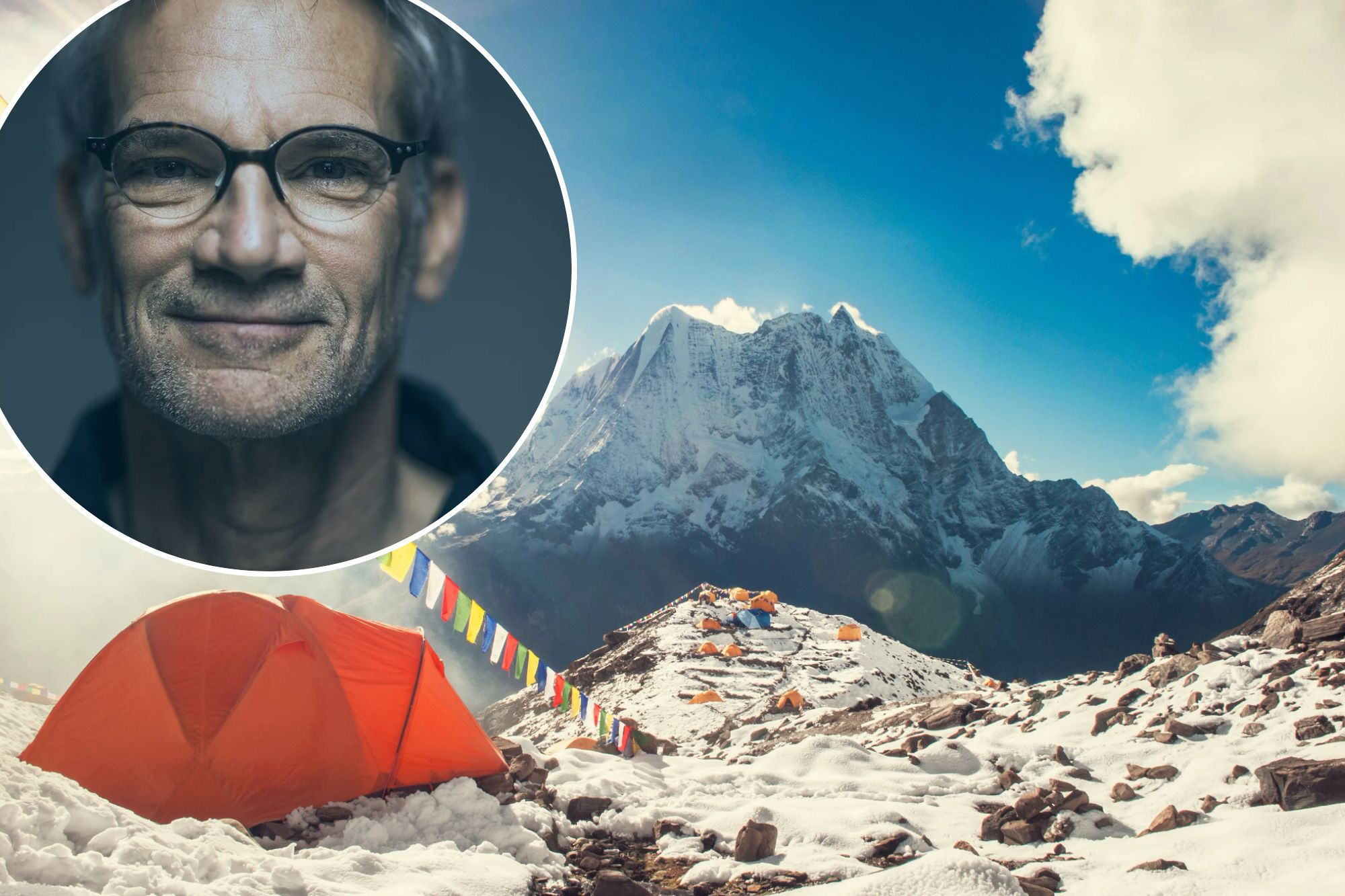
Jon Krakauer, 30 years after surviving Everest’s deadliest day, still worries about the climbing season. Everest’s season is off to a “terrible start” due to a Khumbu Icefall closure, delaying acclimatization. Krakauer’s bestselling memoir, “Into Thin Air,” about the 1996 tragedy, has a new edition. It’s been 30 years since Jon Krakauer survived one of the worst disasters on Mount Everest. But every spring, when climbing season on the world’s tallest peak hits, he still worries.
“I get this knot in my stomach. It sort of hit its peak around May 10,” he told The Post in an exclusive interview. “This year it’s worse than ever . . . Everest season has gotten off to a terrible start.”
He’s been following the conditions, as he does every year. He’s worried about a massive ice column that closed the Khumbu Icefall — a notoriously treacherous route towards the beginning of the journey up Everest that climbers typically traverse several times as they acclimatize — for weeks. This past Tuesday, rope-fixing teams were able to complete a path through the icefall, opening it up to climbers, but the knock-on effect of the closure will have consequences.
“They’re 15 days behind schedule for acclimatization,” Krakauer noted. “That means when people go for the summit in late May, they’re not going to be well acclimatized. And it also means that [the crowds are] not going to be spread out.”
The 72-year-old knows all too well how a confluence of factors can add up to deadly consequences on the mountain. In 1996, he was part of an ill-fated expedition that saw four people perish amidst a blizzard and a series of poor decisions and tragic mishaps that have been debated for decades. Four climbers from other groups also died, making it one of the single most fatal days on Everest.
“I still have PTSD,” Krakauer said. “You never get over it.”
Krakauer chronicled the tragedy in a bestselling memoir, “Into Thin Air,” a new edition of which has just been released.
In March 1995, when Outside magazine offered him an assignment to join a guided Everest expedition— with the magazine taking care of the $65,000 fee — Krakauer didn’t hesitate, despite ongoing tension with his wife around his climbing.
“I said yes without even pausing to catch my breath,” he writes in “Into Thin Air.”
The next spring, he ducked out of the book tour for his first book, “Into the Wild,” early and headed to the Himalayas.
He had 33 years of climbing experience, but he’d never been above 17,200 feet and felt ill-prepared for the reality of the so-called death zone above 8,000 meters (26,247 feet).
On summit day, May 10, 1996, he was one of the first to reach the top. It was hardly an euphoric moment.
“Now that I was finally here, actually standing on the summit of Mount Everest, I just couldn’t summon the energy to care,” he writes. “I hadn’t slept in 57 hours. The only food I’d been able to force down over the preceding three days was a bowl of ramen soup and a handful of peanut M&Ms. Weeks of violent coughing had left me with two separated ribs that made ordinary breathing an excruciating trial. At 29,032 feet up in the troposphere, so little oxygen was reaching my brain that my mental capacity was that of a slow child. Under the circumstances, I was incapable of feeling much of anything except cold and tired.”
Then disaster followed. By the time Krakauer reached basecamp, eight climbers from four different expedition groups had died. Among them were two of the men he was closest to on his team, Andy Harris, an enthusiastic young guide from New Zealand on his first Everest expedition, and Doug Hansen, a 46-year-old American postal worker who had financed his trip by working the night shift and construction jobs.
Hansen had attempted to summit in 1995, but group leader Rob Hall had turned him back just before from the top for safety reasons. (Guides typically abide by a strict 2 p.m. cutoff on summit day, turning clients back no matter how close they are to the top, to increase the chance of a safe descent.) Krakauer still questions why Hall didn’t turn Hansen around in 1996 but instead urged him to keep going, even though it was late in the afternoon.
Hall, who also died on the expedition, “was [usually] so careful and conscientious and organized,” he said.
A photo of himself, Harris and Hansen — smiling happily at the traditional Puja ceremony before their expedition — hangs above Krakauer’s desk.
“I think about those guys all the time,” he said.
On May 19, 1996, after hiking out of base camp and then getting a helicopter to Kathmandu, Krakauer returned home to Seattle, where he rushed to conduct interviews and pen a 17,000-word piece for Outside by the end of July, mistakenly thinking that writing about the disaster would be cathartic.
“I was angry when I got back. And confused. And mostly I had survivor’s guilt,” he said.
The story was expanded into the roughly 90,000-word “Into Thin Air” which quickly became a bestseller.
His survivor’s guilt — which largely stems from the belief that Hall made uncharacteristically poor decisions in an attempt to have more clients summit for the sake of the magazine article — was compounded, he said, by the success of the book.
“I got f–king rich off this tragedy.”
For years, Krakauer had unrelenting PTSD. He was frustrated, depressed and quick to anger; “My wife suffered the most from that,” he said.
Then, in 2006, he spent months embedded with combat troops and special forces in Afghanistan to research his 2009 bestseller “Where Men Win Glory: The Odyssey of Pat Tillman.”
The servicemen he met, and the sacrifice they and their families made, left an impression. When Krakauer returned to Boulder, Colo., where he had moved and still resides, he befriended a group of veterans who had served in Vietnam, Iraq and Afghanistan. They suggested he could benefit from the weekly group therapy sessions they attended.
“I was like, ‘F–k you, I’m fine. I don’t need group therapy.’ You know, when I was in Afghanistan, I wasn’t traumatized. Yeah, I saw a lot of bad stuff. I was close to it. But I didn’t shoot anybody. I didn’t come close to getting killed,” he recalled. “And they said, ‘We’re not talking about Afghanistan, Jon. We read your f–king book and you are f–ked up from that. We know PTSD when we see it, and you’ve got it.’ “
They bugged Krakauer for two years before he agreed to check out a few therapy sessions. He ended up going for seven years.
“It really, really helped me. It was the thing that got me started into therapy in general,” said Krakauer, who also does couples counseling with wife Linda Moore. “It’s kind of a miracle. I’m not sure how it works. I mean, for the first six months, I didn’t say a word. I just sat there and listened and watched.”
“Into Thin Air” led to a series of ongoing debates about Krakauer, his actions on the mountain and his portrayal of the tragedy. After the initial Outside article came out, he was horrified to learn he got some of the details wrong, necessitating a retraction.
Disoriented from a lack of oxygen, he had confused a climber from another team for Harris and thought he’d safely descended to the tents. The next morning, when he realized wasn’t in the tents, he saw tracks that led him to believe he’d fallen to his death on the Lhotse face. After conducting further interviews, he learned that Harris had died on the South Summit trying to help Hall and Hansen.
In just the past few years, a YouTuber named Michael Tracy has gone on a crusade against Krakauer, posting numerous detailed videos attacking the author’s account and attracting thousands of views.
Krakauer said he and his publisher initially planned to just ignore Tracy, but on the advice of a savvy “millennial friend, he created a series of video rebuttals.
With each edition of the book, Krakauer has made changes and corrections. The most recent has an updated altitude for Everest — 29,032 feet — and, he believes, is more slightly more sympathetic to Sandy Pittman, a New York socialite and media figure who was part of another expedition group and making her third attempt at Everest. She has been pilloried for her climbing skills, as well as allegedly bringing an espresso machine on the trip and taxing the sherpas by having them haul heavy electronic gear (she was supposed to make the first internet connection from Everest) that left them less able to help others.
“You can’t blame her for Lopsang [a sherpa] being exhausted because he hauled up all that electronic gear,” Krakauer said. He believes that decision was on Scott Fischer, the leader of Pittman’s expedition group who was among those that died.
The ever-so-slight mellowing towards Pittman — whom Krakauer said initially threatened to sue him when she got her well-manicured hands on an advanced copy of “Into Thin Air” — is surprising.
Krakauer is known for being prickly and outspoken, criticizing weekend warriors and some of the guides that profit from their attempted endeavors. He declared the 2015 Hollywood movie “Everest” total bull. And while filming the 2003 NOVA documentary “Mountain of Ice,” Krakauer notoriously suggested he and the expert climbers summit Antarctica’s tallest peak, Mount Vinson, without some of the less experienced members of the film crew in order to take a more technically challenging route that he believed was safer.
“I come across as the a–hole I am sometimes, ” he said.
But, with time, he said, “I’ve softened a lot.”
And yet — when asked about the recent Tahoe avalanche that killed nine, he quickly declared it a “complete malpractice.”
Krakauer expected “Into Thin Air” to discourage people from wanting to climb Everest. Instead, it did the opposite. In recent decades, tourism on the mountain has exploded.
The new edition’s introduction notes that he was the 631st person to summit. In the years since, more than 13,000 have reached Earth’s tallest point. It’s become easier and safer to make the climb thanks to a number of factors: better weather forecasts, improved training for sherpas, new acclimatizing strategies, the prophylactic use of the steroid dexamethasone for high-altitude sickness, clients being able to purchase unlimited supplemental oxygen and a 1:1 sherpa-to-client ratio.
The popularity of the mountain has also brought with it trash and long lines of crowds waiting to summit, like people desperate to check out the latest TikTok food trend — but in Arctic gear.
“The commodification of the mountain has stripped away much of what once made climbing Everest such a uniquely profound experience,” Krakauer says in the intro to the new edition.
After penning that introduction, Krakauer took a long road trip and listened to an old recording of himself reading “Into Thin Air” for six hours.
“It was one of the weirdest experiences of my life,” he said. “It gave me a fresh perspective on this book . . . it was very cathartic.”
He rarely takes on writing assignments or plans to write any more books — though he does still climb several days a week. But he agreed to adapt an excerpt of the new introduction for the Atlantic.
Krakauer changed the ending to note that, after what he experienced, he can’t fault the privileged masses looking to “reach the summit with as little effort and risk as possible, by whatever means offer the greatest probability of success.”
“I was bitter, I think, for many years after Everest,” he said, “but I haven’t been bitter for a while, and that feels good.”