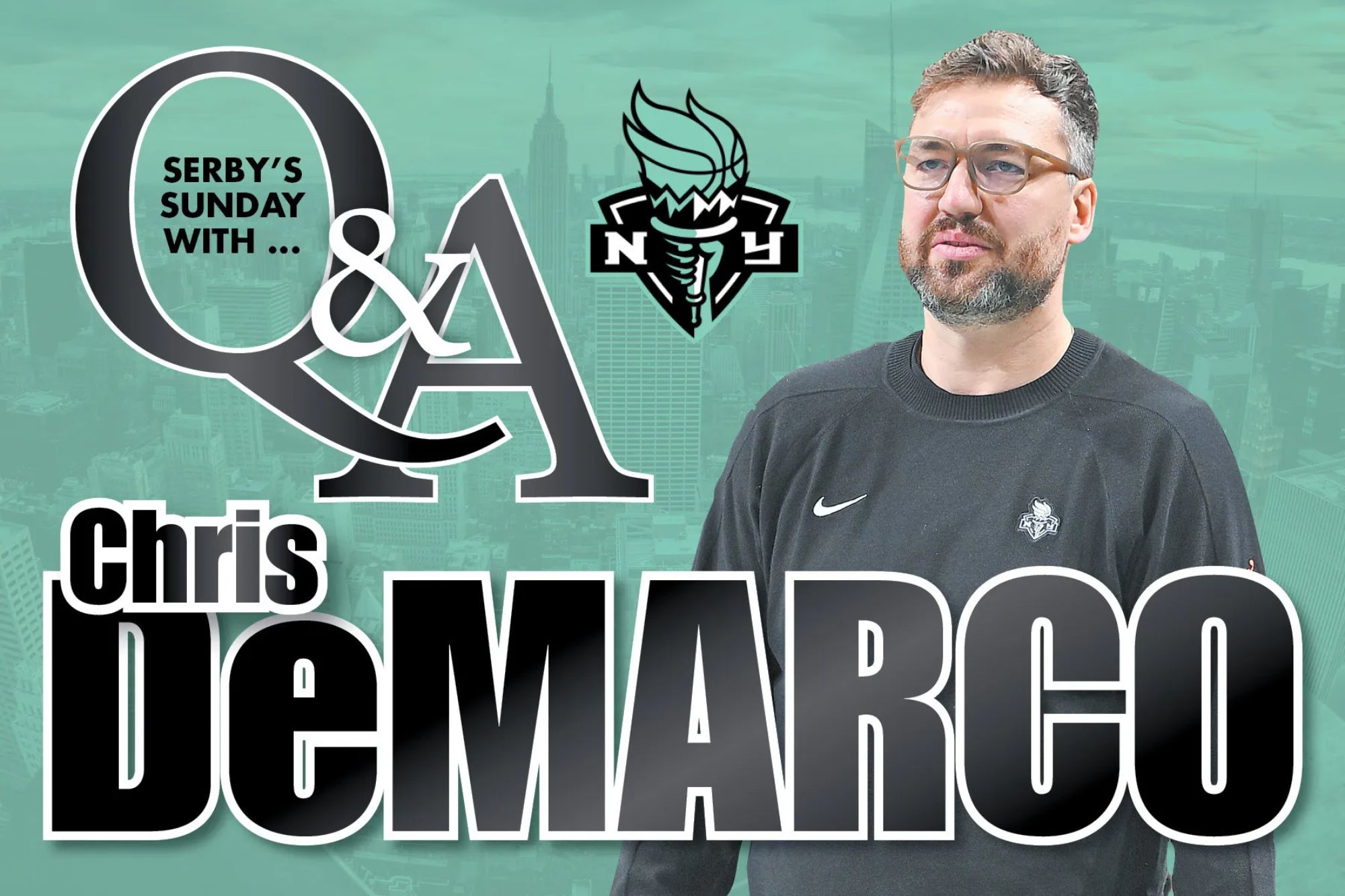
First-year Liberty coach Chris DeMarco takes a timeout for some Q&A with Post columnist Steve Serby, before the WNBA season tips off later this week.
Q: How would you describe your leadership style?
We’ve got you covered on the Liberty beat Join Post Sports+ for exciting subscriber-only features, including real-time texting with Madeline Kenney about all things Liberty and WNBA.
A: I would say connected. I want my staff connected. I want my players connected on the floor. It’s big for me to build relationships, to build trust. I’ve really tried to bring our words to life in terms of when we’re talking value, culture, identity, really explain what those mean. If the players understand that I care about them and I care about their careers, and they understand that our staff does, then anything we’ll do is to get them better and get this team better, right? We’re not just going to have you go through 20, 30 minutes of some individual work that isn’t going to fit into what we’re doing offensively or defensively. I want to elevate all of our players, and I want to play a lot of people, and I believe in this roster and I believe in the talent and more than anything I believe in the people that they are and their character. It’s in front of ’em. I’m honest. I will say what’s on my mind. I will correct if I need to correct. I would rather have the conversation now than later where we want to get ahead of conflict and all that stuff.
Q: Longtime Golden State Warrior Draymond Green once said of you: “He’s not afraid of confrontation.”
A: Draymond said that (laugh)? We spent a long time together.
Q: Why aren’t you afraid of confrontation?
A: We’re all trying to win. If you keep the ultimate goal in mind, all that other stuff shouldn’t matter. We’re all trying to win, we’re all trying to get better, we’re all trying to accomplish something. And if there’s a disagreement that’s going to happen it’s not supposed to be smooth. People don’t watch sports because it’s smooth. They watch it because it’s unpredictable. And on your way to doing something special, there’s going to be confrontation. There’s going to be these difficult conversations. And if you sidestep those, everyone’s going to feel it. And then the next thing that comes up there’s going to be like, “Oh, we’re not going to address that head-on, we let that other thing go.” It’s all I know, it’s the way I played, it’s the way I coached. We [Warriors] went to six Finals and won four championships and there was confrontation. It’s a competitive league, these are the best players in the world. It’s going to happen.
A: I don’t think a lot of players need these motivational tactics at times. I think you want to motivate the team as a whole when it could be like you have a back-to-back and people are tired and how are we going to find a way to win this game? Or it’s like things aren’t going your way second, third quarter, are we going to be able to turn this thing around? I think those are like motivational moments more than it is everyday like rah rah, this has to be the best day of our lives, right? The players have gotten here, they’ve obviously been motivated to be the best in the world. And so I think for us as a staff and me personally, the motivation comes in, alright, maybe the energy’s not right today, how are we going to get it right? And maybe that’s shifting the rotation in a game. Maybe that’s playing a different way. Maybe motivating them is giving them a clearer picture of how they can succeed.
A: The non-negotiables? I hate anybody being late. I’m a be-on-time guy. I think the energy piece is important, we want positive energy. I’ve talked to [Nets coach] Jordi Fernandez about this, about the two types of energy, positive or negative, there isn’t a third. The third non-negotiable, it’s the competition piece. That’s why we’re all here. If you want to be out there on the floor, if you want to earn minutes, it’s about competing for those minutes and competing for those opportunities.
Q: The traits of the ideal Chris DeMarco basketball player.
A: I’ll give you what I want our identity to be. I want our identity first and foremost, we have to compete. Secondly, we have to be unselfish. Then lastly we have to be connected. Those are the three things, that’s the type of player I would want to play with.
Q: Have you spoken to WNBA coaches of the challenge of coaching women?
A: I’ve talked to a lot of different current women’s coaches or former. … I’ve gotten good advice. The majority have said it’s basketball, right? I even had one coach, I’m not going to name their name, said she had gone from a men’s professional league to then a women’s college team, and she had said it wasn’t men and women for her. The hardest thing for her was pro-college. And that stuck with me because I’m going pro-pro. I’ve obviously taken advice from everybody and I’ve listened to a lot of people, including like our Liberty legends and everything, but so far for camp it feels like any camp I’ve been a part of as a coach, but I’m just moving from that assistant coaching chair and now the head coach, right?
Q: What do you like best about your team?
A: I like the versatility second-best. I like the championship pedigree first (laugh). I was a part of that Warriors team where we hadn’t gotten over the hump before, and I remember how hard it was to get over the hump, and when we did, what that finally meant for us going forward. You’ve felt it, you’ve seen it, you know what it takes, and we have some of that in the locker room. If it hasn’t been at the WNBA level, we’ve had a lot of that internationally, we’ve had a lot of that at the college level. We have players here who’ve won.
Q: And with that come great expectations.
A: Embrace ’em, right? The biggest thing for me is just finding that consistency each year of giving us a chance the right way through our identity, through the daily grind of competing for a championship. That’s all you can ask for is that we play hard every night, our fans recognize it, our opponents feel it and then we’re in the mix every year to try to win.
Q: Whatever comes to mind about some of your players: Breanna Stewart.
Q: What is the most invaluable piece of coaching you took from Steve Kerr?
A: Having spent 13 seasons with him, almost 14, his messaging was so good. He understood the build of a season, breaking the season into different parts and making sure that we understood it was a marathon, right? I think the culture of being able to come in the building wanting to be there every day, whether it’s from the staff or the players, it was a really, really competitive environment. … But it was also joyful and compassionate. Whether it was the team dinners, whether it was bringing different people in to speak, whether it was just in between the practice and the lifting and the treatment, it felt like a family all the time. And then lastly, just his ability to adjust. He would always do what was best for the team.
A: There’s too many. I don’t want to disrespect anybody (laugh). I spent time around a lot of future head coaches. Mark Jackson had a very large influence on me in my first two seasons. Mark gave me a platform to be able to have a voice even in my early years that gave me the confidence to think I could become a head coach, right? I’m doing my first-year intern and he’s asking me who I feel are the top five point guards in the league, and I’m telling him who the five are and he’ll challenge it, and what do I do, is I have to do my research to make sure that I have the right evidence behind what I’m saying. … If he’s staying at the facility all day, so at 9 o’clock we have League Pass on and I can ask him basketball questions. … We had a lot of head coaches come through — Michael Malone was on that early staff, Luke Walton, Mike Brown, Willie Green, Kenny Atkinson.
Q: What do you recall about Mike Brown?
A: Mike’s very detailed and he really knows the game. The players really respect him.
Q: Describe your one-on-ones in practice with Kevin Durant.
A: You’re young, you’re coming up, the cool part of the job is still being able to compete against the best in the world. I’m one of many who’ve tried to defend him in practice. Really they just needed a body and I happen to be 6-[foot]-6 and I tried to be physical, that’s all that was.
A: His skill, and who he is as a person just touched so many people in that organization. Gave a lot of people, not just myself, opportunities. And not just him, obviously Klay [Thompson], Draymond, [Andre] Iguodala, you mentioned K.D., all these players, their greatness allowed so many people in the organization these incredible opportunities to be in basketball and grow in basketball. Like to see their performances, what it did for the Bay Area and those fans.
Covering the Liberty like never before Sign up for Madeline Kenney's Inside the Liberty, a weekly Sports+ newsletter.
Q: Who are coaches outside of basketball who you admire?
A: I spent some time with Brandon Staley, who’s defensive coordinator with the Saints. I was there for their training camp when he was with the Chargers. I learned a lot from that training camp, some of the stuff I still use today. It’s such a long list of people.
Q: Were you a Packers fan growing up?
A: My dad is from Long Island, I lived on Long Island before I moved to [Appleton] Wisconsin. Some of the more popular things — ice fishing, hunting, the Packers — because I went to a lot of sporting events with my father, I didn’t gravitate toward that. If the Buffalo Bills got bounced, then I’d support the Packers. My dad was a Bills fan. I liked what he liked.
Q: Describe the influence your father Sal had on you.
A: My father was my best friend. He was a coach himself. I had two older brothers, and they wanted to play football, baseball, basketball, so he would get VHS tapes, and he’d watch those tapes and he taught himself how to coach. And he was a youth coach for not just my brothers and my younger sister and myself, but for the entire community in Appleton, Wisconsin, for about 15 years. He coached baseball, he coached basketball, he coached football. … He was so demanding in-game. He was vocal in what he wanted, but he cared so much about the kids that he was able to coach them hard because they knew he cared.
Q: Could imagine how proud he is of you right now?
A: It’s obviously not the only reason why this means so much to me coming back to New York, being the head coach of this incredible organization and franchise. New York was in my heart my whole life, and fortunately, I was able to FaceTime him when we won in ’15 with the Warriors, which was a really cool moment. I was able to share in some of the successes of me becoming a coach with him still. … I was thinking about my family and the sacrifices that they made for me to get there. I was just so thankful to them to allow me to have been in this position.
Q: Describe coaching the Bahamas National Team.
A: Pride. From where we started to having a chance to go to the [Paris] Olympics in the fourth quarter, and just the grind and sacrifice it took from everybody who was a part of that. When you’re talking about resources, it’s not the same as some of these other teams that we had to compete against. We’re talking about a country of 400,000 people. Just so proud. And proud of our NBA players and NCAA players to be a part of something that meant so much to the country, and for the players before them, the Mykal Thompsons, Bahamians and Rick Fox that didn’t get a chance to play for the Bahamas because there wasn’t a team. I feel like there’s an incredible opportunity going forward of sustained success for the Bahamas National Team on the men’s side, and obviously Jonquel being here.
Q: Was your boyhood dream to play in the NBA?
A: Probably, but realistically I wanted to go to Europe and play. … You just always want to keep playing at the next level, and that was always my dream. Honestly, I didn’t know it coaching was a part of that, but the second I started coaching I realized it was in me, and shoutout to my father obviously, and my mother by the way, she was at all the games, she used to keep the box scores. She’s very knowledgeable about the game.
Q: Edgewood College and Dominican University.
A: I made a lot of lifelong friends at Edgewood, some of my best friends to this day. And then at Dominican, I found my love of basketball again. I lived next to Dominican the past six years. Marin County’s home for me.
Q: How long did you spend at Isilon?
A: Isilon was a data storage company that EMC bought and it was a company out of Seattle. And really, if it wasn’t for my boss Tara Dezao. I wouldn’t even be here right now because at the time, I could barely afford to live my first year at the Warriors, and Tara allowed me to still do all this work at home. I had the internship at the Warriors, I did however many hours a week for Isilon and then I bartended to get through that first year.
A: I’m passionate. There’s nothing like still being able to compete. There’s nothing like it.
A: As a player I had back surgery at 18. I ruptured a disc. In life, off the court, it was the passing of my father 10 years ago.
Q: Aside from going to Jones Beach, any Long Island memories?
A: Besides seeing family and estimated pizza and bagels, not really. … I’ve gone to Wo Hop, 17 Mott Street, my whole life. And then there’s that outdoor court like a block away, there’s always people hooping out there.
A: I’m just a massive fan of comedy in general. I like improv and I like going to see comedians.
A: Aji de gallena, it’s a Peruvian dish, it’s pretty classic.
Q: What’s so great about Brooklyn?
A: The community. … It just feels like a family.
A: I understand what this means to the community. I understand what this means to the fans. We have the best fans in the WNBA. I can’t wait for the games to start.