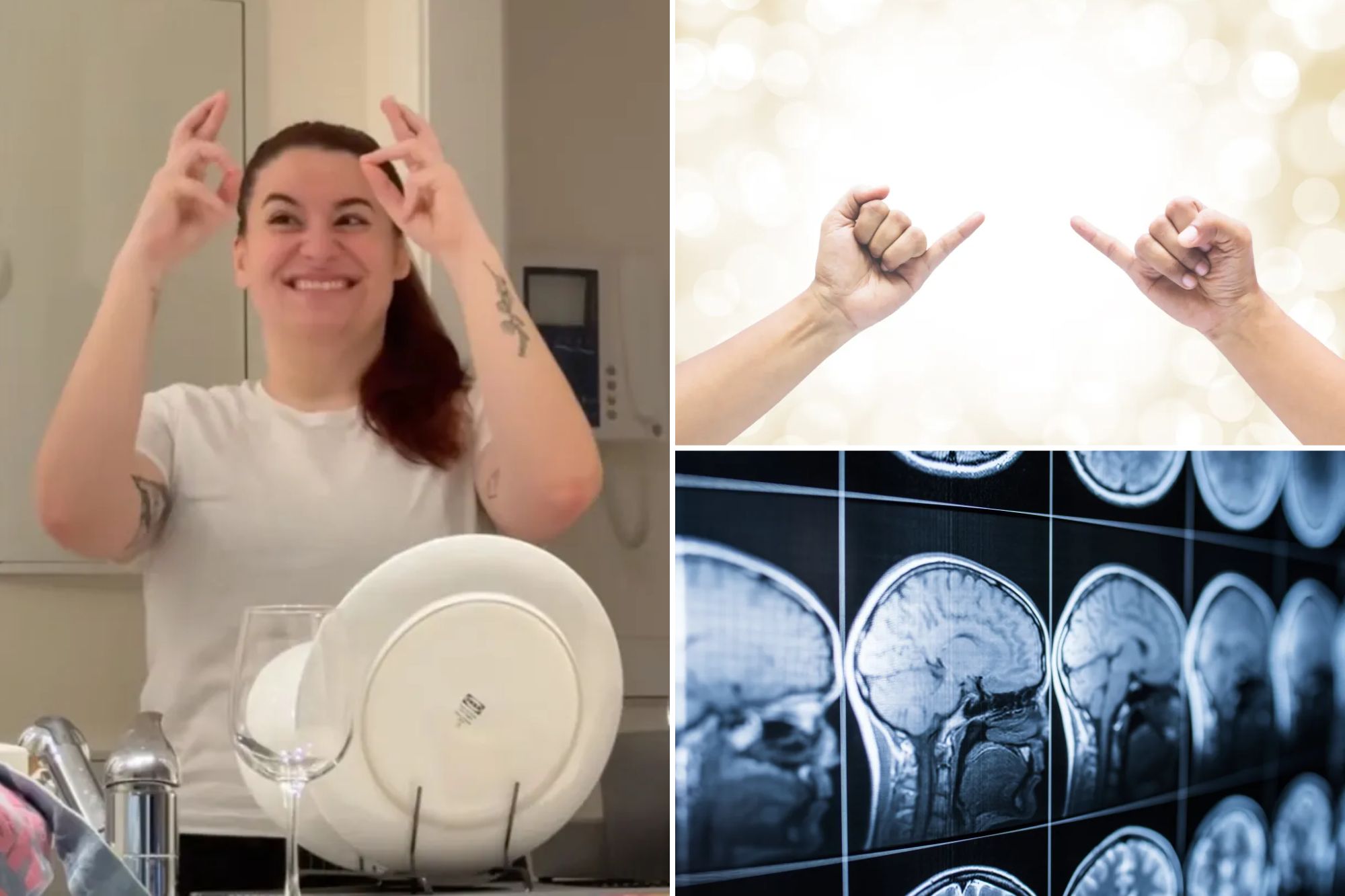
A TikTok demonstrating “pinky time” has gone viral with the promise that this simple daily digit exercise can stave off cognitive decline.
In the clip, creator Daniela Paez-Pumar films herself and friends as they wrap their middle and pointer fingers together, touch their ring fingers to their thumbs and move their pinkies up and down for several seconds.
Paez-Pumar shared that she observes “pinky time” every night at 7:45 p.m.
“No one is exempt from pinky time — we keep that brain HEALTHY,” she wrote in the caption.
As the caption indicates, “pinky time” is thought to slow cognitive decline, and experts are cosigning the craze.
“When you pause, concentrate and try a new movement that your body isn’t used to, like wiggling your pinky, it lights up your motor cortex, cerebellum and other areas of your noggin,” Dr. Kelly Gonderman, a licensed clinical psychologist, told Bustle.
She notes that pinky time falls into the category of fine motor tasks, one that requires coordination between muscles and joints and becomes more challenging with age-related mental decline.
“That cross-hemisphere coordination is genuinely good for the brain,” said Gonderman.
While pinky-wiggling alone is unlikely to prevent cognitive decline, it belongs to a broader set of behaviors that can keep the mind sharp.
“Ten seconds of finger movement a day isn’t going to prevent Alzheimer’s on its own, but activities that challenge the brain through novelty and coordination are worth doing regularly,” she told Bustle.
Other content creators maintain that pinky time is not only a means of preventing cognitive decline but also of diagnosing it. Essentially, if you can do the movement with ease, your cognition is top-tier, and if you struggle with the digit dance, your brain is in danger.
“The idea that struggling with it signals poor brain health is where I’d pump the brakes,” she said.
“Difficulty with a novel motor task can reflect lots of things: hand dominance, arthritis, practice, attention in that moment.”
She underscores that making or struggling to make hand positions is not an effective diagnostic tool.
“The broader principle behind it — that fine motor activity, learning new physical skills and hand-brain coordination exercises support cognitive health as we age — is supported by research,” she told Bustle.
As Gonderman points out, many studies suggest that challenging the brain helps preserve and protect cognitive function.
No one is exempt from pinky time – we keep that brain HEALTHY (for 7-10 seconds on each side) @coripooh @404nnafound
And while pinky time is one such challenge, there are countless more.
If you want to up your circus game in the name of a better brain, juggling carries loads of cognitive benefits.
A 2024 study found that juggling has “positive effects on cognitive abilities and postural stability in healthy, physically active older adults.”
Juggling has also been found to promote neuroplasticity — the brain’s remarkable ability to adapt to new stimuli — which may in turn help improve cognitive function.
Neurologists maintain that learning something new, be it juggling, a language or an instrument, can trigger the growth of new neural connections in the brain, keeping it young by activating different areas.
The more the mind is exercised, the more your brain pathways that you might not use as much are reinforced.
Experts say that whatever the activity, it should be complex enough to require a bit of effort, but not so difficult that you don’t want to do it.
Across the country, about 1 in 10 older adults is living with dementia, the most common form being Alzheimer’s disease.
As the US population ages, those numbers are expected to soar. Researchers estimate that 42% of Americans over 55 will eventually develop dementia, with women and black adults facing higher risks.
By 2060, cases nationwide are projected to double, with roughly 1 million new diagnoses each year.