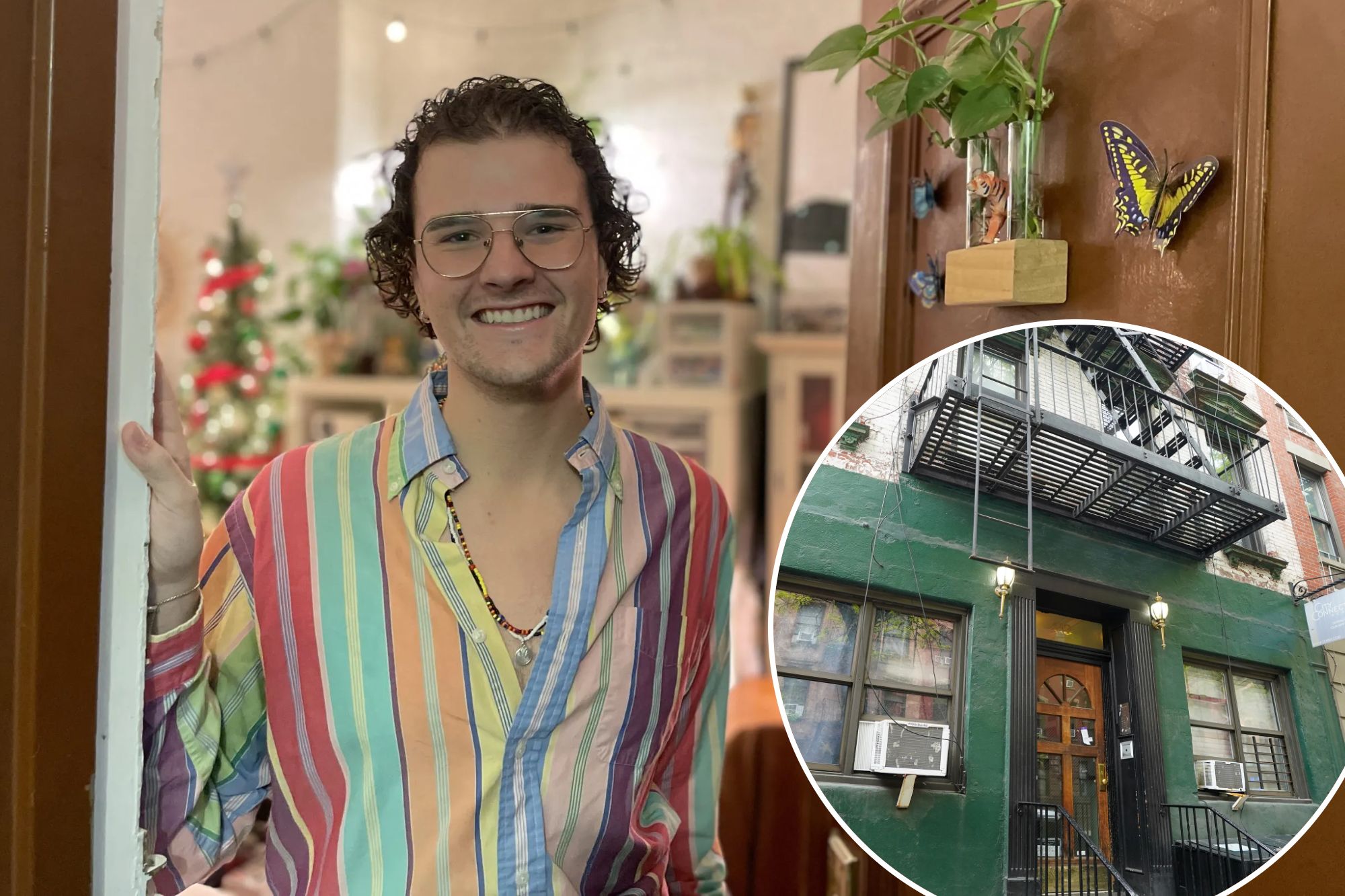
Just because it’s a shared amenity doesn’t mean a resident can share it with the outside world.
Bryson Kernan Clark, a Fordham University grad, is being sued by his Hell’s Kitchen landlord for taking his community-building initiative a step too far. For years, Clark has allegedly used his building’s shared outdoor space, an al-fresco hangout that he doesn’t own, as a gathering place for pumpkin painting, plant exchanges, dinner parties and even a kids’ summer camp — all attended by area locals who don’t reside in the 13-unit building itself.
Clark moved into unit 1D at 419 W. 56th St., a home that opens to a communal residents’ rear yard, in 2021 and sought to create “Home in Hell’s Kitchen.” Its sliding-scale membership charged visitors $25 to $50 monthly for access to, as Clark described on his website, events “designed to bring people together and foster a sense of community” and to “transform a space.”
But it wasn’t his space to transform. Clark did all of it, the landlord alleges, “without … prior knowledge or consent” — and without any legal right to do so, since his lease covers only Apartment 1D, and explicitly excludes the outdoor area.
Tockwotten Associates, Inc., the corporate owner of the property, filed suit in Manhattan Supreme Court on April 28 seeking a preliminary injunction, enforcement of Clark’s lease and no less than $25,000 in damages, The Post has learned. Tockwotten did not respond to The Post’s request for comment.
The defendants are Clark and his father, Bradley L. Clark of Fort Worth, Texas, who co-signed as guarantor when Bryson first signed his lease for $2,000 a month. Clark, too, did not respond to a message seeking comment.
The verified complaint describes a pattern of escalating disruption stretching back to 2024. Clark allegedly hosted gatherings “on a near-daily basis from the afternoon through the late night and early morning hours,” with guests playing “excessively loud music” and engaging in “conversations at unreasonably high volume.”
On Oct. 12, 2024 at 12:15 a.m., a neighbor submitted a 311 noise complaint — categorized as “Banging/Pounding” — for the building’s address, according to the documents. Police responded but found no ongoing violation by the time they arrived.
A neighbor’s forwarding email to the building and management, however, tells a different story, the records also show.
“Please find attached an after hours 311 noise complaint for apartment 1D… And to all my neighbors in this building, I am sure you have experienced the beautiful inconsiderate neighbor below, so please: This is the time to speak up.”
On May 23, 2025, another resident wrote directly to landlord Anthony Kissling.
“For the last few hours apt 1D is running some kind of camp for kids as they are using microphones all singing n just being kids. But I believe Bryson Clark is running a business and this really unfair that as a tenant I can’t even open my back windows,” the resident said in an email.
That July, guests appeared in the backyard past 11:30 p.m. while Clark allegedly wasn’t even home.
A neighbor and the building superintendent emailed management: “11:30 pm last night suddenly 3 people, who do not live in the apt were partying in the backyard … after 11pm n they decide to sit outside slamming the damn door with lights on as if they own the place,” as seen in the court documents.
The landlord’s attorneys, Sperber Kahan Law Group — who also didn’t respond to a message seeking comment — confirmed the usefulness of that email in a one-word reply to building management: “yes.”
By April 5, 2026, the situation had allegedly spread beyond the building’s own backyard. Clark had encroached into an adjacent neighbor’s outdoor area as well, leaving excessive trash throughout shared spaces after hosting roughly 20 guests, the suit adds.
In the court documents, the landlord leans heavily on the lease itself, signed by Clark and renewed as recently as Oct. 31, 2024 at $2,400 per month. Paragraph 29 of the lease, the complaint notes, required Clark to refrain from interfering with other tenants’ comfort, safety, or rights — and spelled out that “interference” includes “annoying sounds, smells and lights.”
The backyard, the landlord also argues, is a common area Clark had no right to occupy or furnish. When building staff told him to stop, he allegedly refused. When the landlord sent formal notices and warnings, he allegedly ignored them. The complaint concludes that “any further attempts to put Defendant Bryson Clark on notice is futile.”
None of this is secret. Clark publicized his venture extensively, maintaining a website at HomeInHellsKitchen.com, running Instagram and Facebook pages, and speaking to local outlet W42ST.nyc in a November 2024 profile headlined “Neighbors Find Connection and Fun at ‘Home in Hell’s Kitchen’ Meet-Ups.”
In that article, Clark described hosting dozens of events “mainly held in Bryson’s plant-filled apartment and backyard.”
He spoke warmly about wanting to create a neighborhood third place — somewhere between home and a bar — and noted that he hoped to eventually open a permanent brick-and-mortar hangout.
“I imagine it to be kind of like a showroom with furniture, art and plants that will fund free community events,” he told the publication.
His website offered two membership tiers: a $25-per-month “Community Member” plan with access to three events per month and early RSVP privileges, and a $50-per-month “Community Champion” tier with unlimited event access and merchandise discounts. The landlord alleges Clark was financially benefiting from events hosted in a space he never paid to use.
Tockwotten is seeking an injunction barring Clark and anyone acting with him from entering the building’s backyard — or the neighboring tenant’s backyard — during the litigation, as well as an order compelling removal of all personal belongings Clark installed there, including a tent, a table and chairs. The suit also demands Clark be forced to comply with his lease terms and seeks attorneys’ fees of at least $25,000.
Multiple neighbors have allegedly already given notice of intent to vacate over the disruptions.
The landlord’s memorandum of law warns that with summer near, it makes the situation more urgent.
“With warmer weather approaching, there is an imminent risk that Defendant Bryson Clark will resume this conduct, including the playing of excessively loud music, late-night disturbances and the use of intrusive lighting.”
The filing further argues that the harm is “not merely economic; it strikes at Plaintiff’s fundamental right to control and maintain its property and ensure a safe, livable environment for its tenants.”