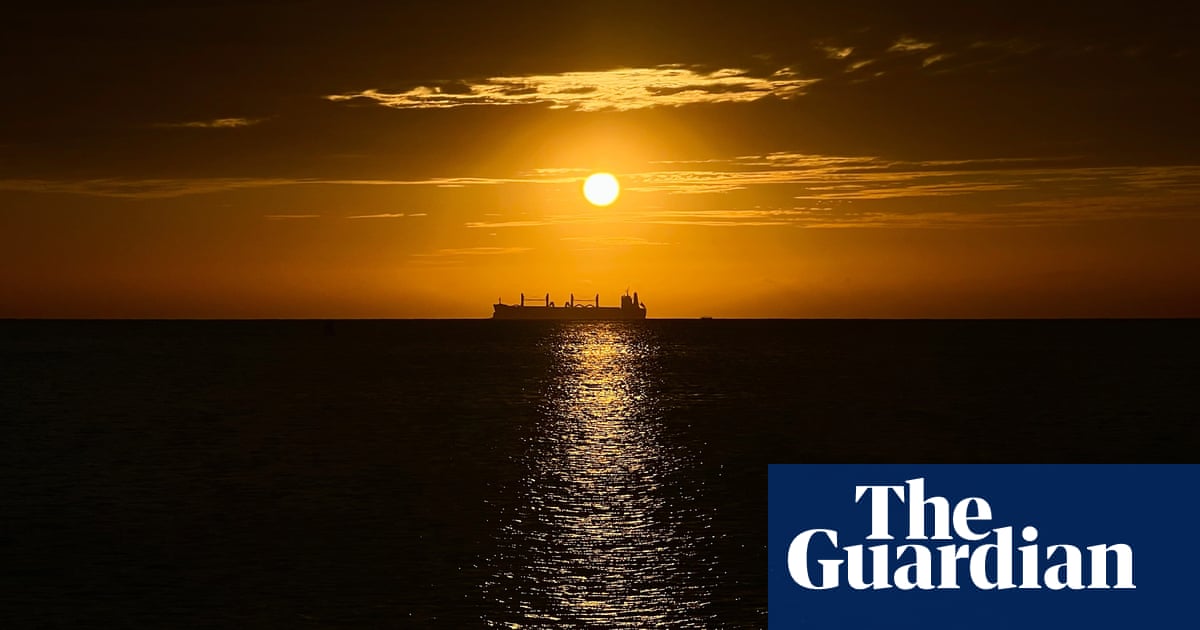
An oil tanker in the Caribbean Sea at sunset on Tuesday during the Santa Marta climate talks in Colombia this week. Photograph: Iván Valencia/APView image in fullscreenAn oil tanker in the Caribbean Sea at sunset on Tuesday during the Santa Marta climate talks in Colombia this week. Photograph: Iván Valencia/APCould key climate talks mark ground zero in global push to ditch fossil fuels?Colombia hosted nearly 60 countries at pivotal time on world stage for fight to transition to a clean energy future
Looking out to sea from the grey sandy beaches of Santa Marta, on Colombia’s Caribbean coast, it is never hard to spot evidence of the country’s thriving fossil fuel export trade. Oil tankers ride at anchor on the horizon, and sometimes, locals say, lumps of coal wash up on the shore, blown off the collier ships that carry cargos from the nearby mines.
It was here, on Wednesday evening, that the Colombian government took a bold step to shift its economy – and that of the rest of the world – away from dependence on coal, gas and oil and into a new era of clean energy. With the first ever conference on “transitioning away from fossil fuels”, the host joined nearly 60 countries determined to loosen of the grip of petrostates on the world’s future.
View image in fullscreenColombia’s Irene Vélez Torres, left, greets the Dutch minister of climate and green growth, Stientje van Veldhoven. Photograph: Raúl Arboleda/AFP/Getty Images“This is the beginning of a new global climate democracy,” Irene Vélez Torres, Colombia’s environment minister and chair of the talks, said in closing remarks that celebrated a “new method” of bringing together high-ambition governments, parliamentarians and civil society groups to accelerate the decarbonisation of their economies.
At this moment in history, the conference may also mark a new global divide between “electro-democracies” and petro-dictatorships.
The initiative has come at a pivotal moment in the climate fight. Oil and gas prices have soared since the US-Israel attacks on Iran, the second such crisis within five years, after the price rises that followed Russia’s invasion of Ukraine. Households across the world are spiralling into debt, farmers cannot afford fertiliser and governments are remembering that a dependency on volatile fossil fuels is holding them hostage to geopolitical forces they cannot control.
The global economy faces a triple whammy: rising energy costs; rising food costs that follow; and the spectre of rampant inflation that will raise interest rates and add to the cost of servicing debt. Both rich and poor nations are feeling the impact, but the poor with their higher levels of debt and lower reserves are suffering more.
View image in fullscreenFatih Birol: ‘This is bigger than all the biggest crises combined, and therefore huge.’ Photograph: Ludovic Marin/AFP/Getty ImagesRepeated oil shocks blighted the 1970s, and the current crisis is not only greater than those but more impactful than all previous crises combined, according to Fatih Birol, the world’s leading energy economist and chief of the International Energy Agency, the gold standard in energy research. “This is bigger than all the biggest crises combined, and therefore huge,” he said in an exclusive Guardian interview. “I still cannot understand that the world was so blind-sided, that the global economy can be held hostage to a 50km strait.”
What is different today from previous oil shocks is the ready availability of a viable alternative: cheap, reliable and plentiful renewable energy from the wind and sun, with modern battery technology to smooth over any intermittency; while electric vehicles and heat pumps can shunt transport and heating off fossil fuels and on to far more efficient electricity.
For those reasons, Birol predicted the current shock would mark a permanent change for the global energy industry, leading consumer countries to lose trust in fossil fuels. “Their perception of risk and reliability will change,” he said. “Governments will review their energy strategies. There will be a significant boost to renewables and nuclear power and a further shift towards a more electrified future. And this will cut into the main markets for oil.”
These changes would be lasting, he added. “The vase is broken, the damage is done – it will be very difficult to put the pieces back together. This will have permanent consequences for the global energy market for years to come.”
It is an irony not lost on Simon Stiell, the UN’s climate chief, that it is the oil industry’s dominance of global economies that has finally woken governments to the dangers. “The fossil fuel cost crisis now has its foot on the throat of the global economy,” he said. “Those who have fought to keep the world hooked on fossil fuels are inadvertently supercharging the global renewables boom.”
View image in fullscreenPhilip Nugent, director general for EU, international and marine affairs; Colombia's environmental minister, Irene Vélez Torres; Stientje van Veldhoven, minister of climate policy and green growth of the Netherlands, and Maina Talia, minister of home affairs, climate change and environment of Tuvalu, talk onstage at the end of the conference in Santa Marta, Colombia. Photograph: Iván Valencia/APRenewables overtook coal in global electricity generation last year for the first time, according to the thinktank Ember, generating 33.8% of power compared to coal’s 33%. Interest from consumers in solar panels and batteries, from Pakistan to the UK, has leapt further since the Iran war.
“The economic logic of renewables [is] impossible to ignore,” said Stiell. Military advisers have weighed in too, pointing out that renewables offer a better route than fossil fuels to national security. Stiell noted: “Governments are pushing renewables plans into overdrive: to restore national security, economic stability, competitiveness, policy autonomy and basic sovereignty.”
But no one should write off the petrostates just yet. The world’s biggest gas producer, the United States is increasingly flexing its military muscle to assert the Trump administration’s goal of “energy dominance”. Russia, the second biggest gas supplier, is waging war against its democratic neighbour Ukraine. Fossil fuel interests are pouring huge sums into the political campaigns of far right candidates in the Americas and Europe.
The Santa Marta vision of a “new global climate democracy” sets people power against this. Polls constantly show an overwhelming majority of people in the world want their governments to take stronger action against the climate crisis, but at many international meetings their voices are drowned out by corporate lobbyists or shut down by petrostate vetoes.
View image in fullscreenA delegate at the conference in Santa Marta that was for many a shining example of science-led decision-making. Photograph: Iván Valencia/APAt Santa Marta, by contrast, science led the way on the opening day, followed by a “people’s summit” and gatherings of parliamentarians. All of these groups sent representatives to the high-level sessions in the final two days, where there were no vetoes, no fractious negotiations over minutae, only intensive and constructive dialogue on how to move forward. Many participants called the gathering historic but few were under any illusions that it was anything more than a strong start.
Claudio Angelo, of the Observatorio do Clima, a thinktank in Brazil, said: “I don’t think the Santa Marta process represents any immediate threat to the fossil fuel industry. This is more about countries organising to draw up a plan. Even within the ‘doers’, the fossil industry landscape is diverse: national oil companies in Latin America, private oil majors in Europe and parts of Africa. These folks will fight for lenient transition calendars until they’re either outcompeted by Chinese electricity or forced by governments to diversify.”
Though shifting to renewables will work out cheaper for all countries in the long-term, there is an upfront cost to the switch. Fossil fuel producer nations will also need finance to invest in new industries to replace lost oil, gas and coal export revenue.
The Santa Marta conference was not intended for new finance pledges – rich countries offered a settlement of $300bn a year by 2035 at the Cop29 conference in 2029, and that will not be improved on now the US has withdrawn its dollars.
View image in fullscreenA debate at the conference. Photograph: Raúl Arboleda/AFP/Getty ImagesBut there could be other routes to finding cash. Diverting some of the $1.5 trillion currently spent each year on subsidising fossil fuels around the world would help, and raising money from the companies that have profited from the climate crisis, through windfall taxes and other mechanisms, is always an option. David Hillman, director of the Make Polluters Pay coalition, said: “Fossil fuel giants are figuratively making a killing from this war. Their excessive unearned profits need to fund the transition to renewables to hasten the end of our fossil fuel dependence.”
Almost all of the 59 nations participating at Santa Marta are democracies, which is both a strength and a vulnerability. Colombia will hold a presidential election at the end of May, in which the ruling party’s candidate, Iván Cepeda, faces a fierce challenge from the far-right populist Abelardo de la Espriella, who wants to increase fracking and oil production. If the latter wins, the global energy transition movement would lose one of its most important nations.
View image in fullscreenJoseph Sikulu, an activist from Tuvalu, talks during the conference. Photograph: Iván Valencia/APColombia is not the only country facing difficulties. The Netherlands, co-host of Santa Marta, announced new drilling in the North Sea just before the conference. The UK is mulling new North Sea fields too, and other countries present, from Brazil to Tanzania, also have fossil fuel expansion plans. Those decisions will have to be reversed for this to become the hoped-for “conference of doers”.
Before the next conference, to take place early next year on the Pacific island of Tuvalu, which is co-hosting with Ireland, countries are supposed to start the process of drawing up national roadmaps to the phaseout of fossil fuels. The organisers want these plans to feed into the broader UN climate negotiating process and to spur others to join the transition movement.
View image in fullscreenMary Robinson on the sidelines of the Santa Marta conference: ‘We need three transitions: out of fossil fuels, into renewable energy for all, and into a world that cares for nature. All must be grounded in justice.’ Photograph: Raúl Arboleda/AFP/Getty ImagesRoadmaps offer a way for countries to attract investors, and also provide guidance for their industries to help ensure the transition to a low-carbon world is fair to workers and the most vulnerable people. Mary Robinson, former president of Ireland, said: “We need three transitions: out of fossil fuels, into renewable energy for all, and into a world that cares for nature. All must be grounded in justice.”
Santa Marta, a historically coal-fuelled town at the heart of a coal- and oil-fuelled country, may eventually be regarded as ground zero for the demise of fossil fuels. Fernanda Carvalho, head of policy for climate and energy at WWF International, said: “It is here that the seeds of a new, implementation-focused initiative have been planted.
“In times of an exhaustion of multilateral processes and a gap in delivering the system change we need, what is emerging offers a different approach. This could be a real bottom-up process that centres the voices of communities most affected by fossil fuel extraction and consumption.”
But despite the “contagious” hope felt by many involved in the Santa Marta talks, there remains a long road ahead.