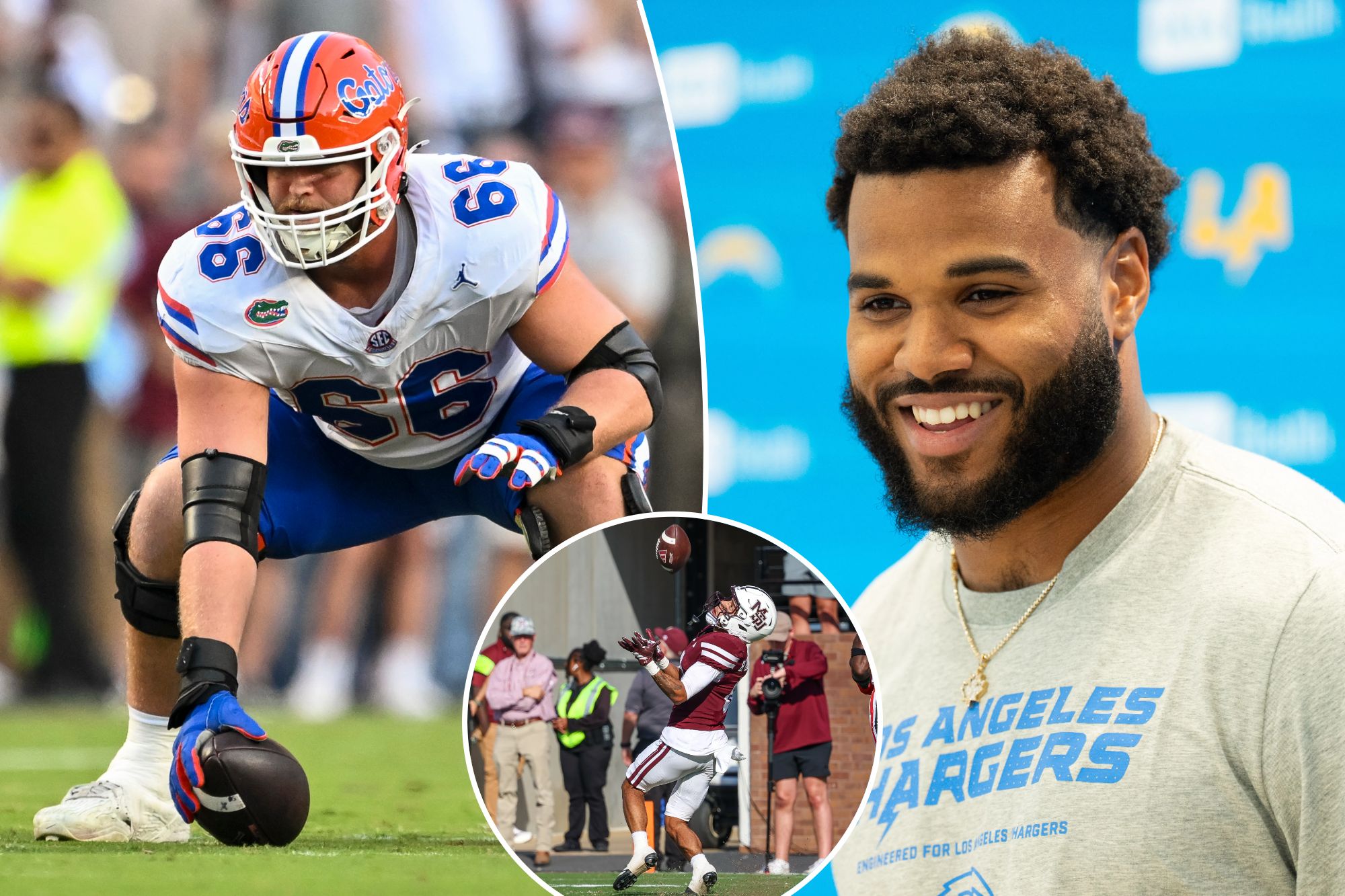
Here’s a look at the Chargers’ 2026 draft class:
Slaughter faces a learning curve as he moves from center, the position he played exclusively in college, to guard. But the door is wide open for him to claim a starting job, simply because the Chargers have a glaring need at that position after moving on from both of last year’s starters.
If he’s up to the challenge of the transition, it’s hard to imagine him not in the starting lineup for the season opener.
The Chargers needed to add high-end speed to their wide receiver room, and Thompson certainly brings that. The 4.26-second 40 he ran was the fastest at this year’s combine.
He isn’t the biggest wide receiver, standing just a shade over 5-foot-9, but he has the necessary speed, as he showed last year with 57 catches for an SEC-best 1,054 yards. And in Mike McDaniel’s offense, he’ll have a chance to flourish.
Mesidor walks into a great situation, being able to learn and develop behind Tuli Tuipulotu and Khalil Mack. He’ll get on the field as a rotational rusher as a rookie, but it’s really about the future for the former Hurricanes star.
In time, he has a chance to be a three-down edge player.
The Chargers traded up for the massive, 6-8 Burke, so obviously they had their eye on him and a plan in place for his development. It’s a fact that there just aren’t many human beings walking the planet that have the size and ability to play tackle in the NFL, so it makes sense to keep adding to that position.
But with Joe Alt and Rashawn Slater in place as the starters and Trey Pipkins projected to be the swing tackle, you wonder if the investment matched the need.