Statistically, the Dodgers have one of the best offenses in baseball, if not the best offense in baseball.
They rank in the top two in the other major offensive categories: runs scored, batting average, on-base percentage, slugging percentage.
So why does it feel as if their lineup isn’t doing what the sport’s most expensive lineup should be doing? Why does it feel as if a disproportionate number of their at-bats are uncompetitive? Why does it feel as if they have played too many games that looked like the last two of their recently-completed series against the Miami Marlins?
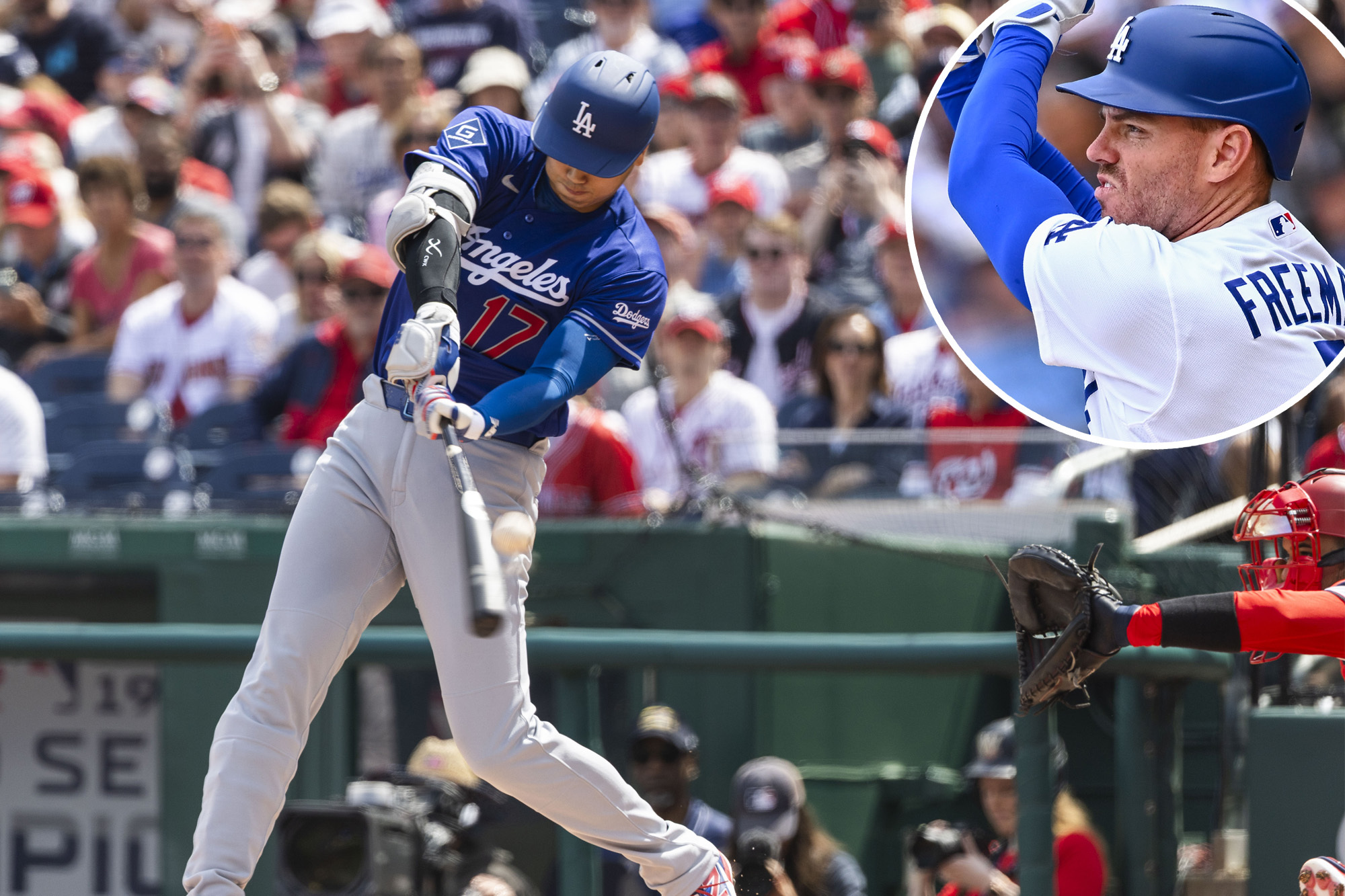
“We’ve kind of been going through it, I would say, as a group,” first baseman Freddie Freeman said.
The Dodgers lost their three-game series against the Marlins, but they are still 20-11. As inconsistent as they are, even after a 3-2 loss in the series finale on Wednesday, they remained in first place in the National League West, still a half-game ahead of the San Diego Padres.
“Luckily,” Freeman said, “we have really, really good pitching. That’s why we’re kind of where we’re at right now.”
To be clear, the feast-or-famine offense won’t cost the Dodgers the division or a place in the postseason.
Over the five months remaining in the regular season, however, their lineup will have to evolve into one that can win games in October.
They made such a transformation last year, and by the time the playoffs came around, their offense was relentless.
That quality was a major reason why they won their second consecutive World Series, and that quality is what’s missing right now. What’s been particularly striking about the last couple of weeks are the number of easy innings opposing pitchers have enjoyed against them.
“We’re just not getting a whole lot of opportunities,” Roberts said.
Asked if the Dodgers were overly dependent on homers, Roberts said he didn’t think so, pointing to how their .273 average is second-best in the majors.
The Dodgers racked up 42 homers in their first 22 games, and they averaged 6.0 runs per game in that period.
In the nine games since, the Dodgers homered just three times. Their runs-per-game average in that stretch was 3.8, and they lost more than they won.
Coincidentally or not, that nine-game run followed a visit to a high-altitude Coors Field in Colorado, which has a reputation as a hitter’s paradise but also the kind of place that can disrupt a hitter’s swing.
The star-studded top of the lineup still looks to be in hibernation mode.
Leadoff batter Shohei Ohtani, who hit a career-high 55 homers last season, has only one long ball in his last 15 games.
Two years ago, in his first season with the Dodgers, Ohtani was limited to just hitting because he was still recovering from an offseason elbow operation. Last year, he didn’t start pitching until the middle of the season.
Ohtani has returned to being a two-way player on a full-time basis, and the organization is carefully monitoring his workload to ensure he won’t be worn down entering the playoffs.
Of the effects his pitching had on his swing, Ohtani said in Japanese, “I don’t think it’s very hard to maintain it when I’m doing well. But to take it from bad to good requires you to do certain things. When you include pitching and you think of the total workload, it’s not as if you can work that long each and every day. I think what’s hardest is to make adjustments within that limited amount of work that you can do.”
The spot behind Ohtani is even more problematic. Kyle Tucker’s struggle in the two-hole prompted Roberts to drop him to cleanup when the Dodgers opened a three-game series in San Francisco on April 21. The responsibility of protecting Ohtani became that of Freeman, who is 4 for 29 since the switch.
“Right now, Freddie’s not feeling good,” Roberts said.
“I would have fixed it by now if I knew,” he said. “Maybe the day off will fix it.”
The team’s day off on Thursday will be the first in two weeks. The Dodgers will resume play on Friday in St. Louis.
Freeman was 0 for 5 on Wednesday. In his final at-bat, he hit a weak grounder to second base that resulted in a game-ending double play.
“I had pitches to hit,” Freeman said. “I just didn’t hit ‘em. I had strikes, I swung at the strikes, I didn’t the strikes, so …”
Freeman pointed to two balls that he hit hard – a lineout to center field in the fifth inning and a double-play ball to short in the seventh.
Early in the season, it was Andy Pages who was carrying the Dodgers. They have since received unexpected contributions from Dalton Rushing and Hyeseong Kim.
The optimistic view is that players such as Ohtani, Tucker and Freeman will eventually start hitting, and that if they can still get production from the likes of Pages, Rushing and Kim, their offense will have a chance of being special.
But they’re not close to that. Right now, their offense doesn’t look like it’s worth the $1-billion-plus they have invested in it, regardless of what the statistics say.