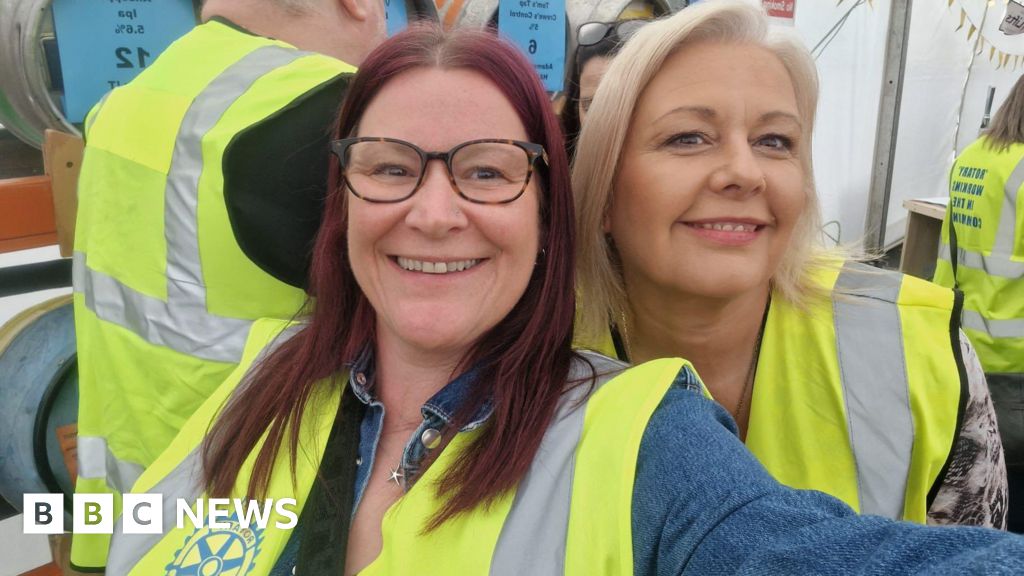
ShareSaveAdd as preferred on GoogleEleanor LawrieSocial Affairs ReporterDebbie TaylorDebbie's organisation takes part in lots of events within the local community"It's been a rollercoaster," says Debbie Taylor.
Her domestic abuse service has been trying in vain to buy the derelict Ram's Head pub in Newton-le-Willows, Merseyside for nearly three years.
But under landmark new "community right to buy" powers in England that came in to law this week, the organisation may finally get to transform it into a hub providing local services.
"It's more than a building. It's what it can represent in the future for us and for the families that we're supporting," Taylor explains. "It's safety, stability, a future for people in our communities left with no options when they're in crisis."
Sweeping changes in England have put power into the hands of thousands of community groups like Debbie's.
The new law is part of the English Devolution and Community Empowerment Act, which was described by ministers as "the biggest transfer of power to our communities in a generation".
It means grassroots organisations will now have a right to buy community assets unchallenged, if they can fund the necessary funds within 12 months.
There is already a "right to bid" for assets of community value such as pubs and libraries, with a six-month window to raise funds. But one study suggested about 2% transfer into community ownership, mainly because groups struggle to raise the money in time.
When the Ram's Head came up for auction, Taylor's organisation, Domestic Abuse WA12, had not got enough money together in time, and the pub did not meet its reserve price to sell.
With a combination of a public fundraiser, borrowing and charitable grants, she hopes to both expand the organisation's services and stop the disused pub being a target for antisocial behaviour.
"Securing the property would allow us to bring all our levels of support together under one roof to create an accessible community where people can feel safe but also rebuild their lives.
"It could have such value in our community for so many people, and be saved as a beautiful building as well."
"This is a real watershed moment, we are thrilled," says Tony Armstrong, chief executive of Locality, the national network for community-led organisations.
"We know there is a real need for dedicated funding and support around community ownership. It's a fantastic new right, but it needs to be backed up by clear support and access to resources."
The new rights are slightly bittersweet, he says, after the current government did not renew the £150m Community Ownership Fund, which helped community groups take control of local assets at risk of closing.
Without a designated pot of money, Armstrong fears that even with a 12-month window, only the wealthiest communities will be able to raise the money required.
"The key risk for this is that it remains an achievement on paper, rather than being something which can be taken up, up and down the country. I think that's our real concern," he says.
The new law also widens the definition of what makes something an "asset of community value".
Previously, a building had to have been used for community benefit within the past five years, but that cap will be lifted.
The definition will also be expanded to include assets that bring economic as well as social wellbeing to the area, as well as a new sporting category.
That's a change that could help Deana Bamford, whose co-operative Coalville CAN wants to turn the Leicestershire town's shuttered market hall into a community hub for clubs and social enterprises, along with a café and rotating events programme.
The local authority, which owns the building, turned down the co-op's application to turn the former market hall into an asset of community value. But the new laws give groups the right to appeal this decision.
"Hopefully that will give us more traction to be able to push them to say 'we're going for it again,'" she says.
"There's still a lot of industry around the edge of the town, and there's still loads of people who could come into the town centre, if we could start getting hold of the buildings that aren't being used and make them available for people to do the things they're passionate about," she says.
The co-operative used community share offers to help open their present building, CAN HQ, which showcases the work of over 100 local creatives and artists, alongside an advice drop-in, repair workshop and kids clubs.
They have also benefitted from funding from musician Brian Eno's Coral Foundation.
"Coalville is a town typical of many others… it's got areas of deprivation – you might call them that – but we call it full of local people with loads of skills and talents that haven't been given the chance." Bamford says.
She hopes the new law will mean places like the market hall permanently stay in community hands.
"It's for forever. Once the asset's been secured and upgraded, it can change its purpose, but it can't change its ownership."