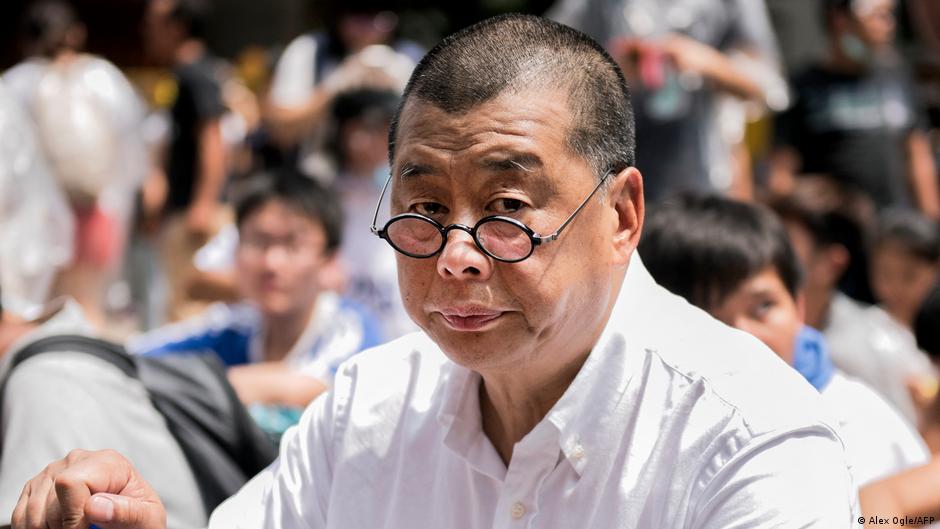
Before being imprisoned for 20 years, Jimmy Lai founded Hong Kong's largest pro-democracy newspaper. His son said the award shows that those who fight for the freedom of others "are never alone."
https://p.dw.com/p/5D324Lai used his Apple Daily publication as a platform for free speech in Hong KongImage: Alex Ogle/AFPAdvertisementArriving in Hong Kong as a penniless 12-year-old stowaway from southern China, Jimmy Lai sought only freedom and a future. At the time, Lai could never have imagined how his life would become forever intertwined with this former British colony.
"I'll sink with the ship, because this place gives me everything," said Lai in an interview about Hong Kong with DW a few months before he was taken into custody in December 2020. He was one of the first high-profile figures to be targeted under a "national security law" imposed on Hong Kong by Beijing following a crackdown on pro-democracy protests.
Beijing had said the law would restore Hong Kong "from chaos to order" after demonstrations in 2019 opposing an extradition bill morphed into massive protests against Beijing encroaching on Hong Kong's civil liberties.
Since then, the pro-democracy media mogul has spent nearly 2,000 days in solitary confinement in Hong Kong's maximum-security Stanley Prison.
Lai's years-long trial ended this February, when the 78-year-old was sentenced to 20 years in prison for "colluding with foreign forces." While he had pleaded not guilty to all charges, his legal team said he will not appeal.
The sentence is the heaviest punishment handed down so far under the national security law, and Lai's trial has symbolized for many people the severe erosion of press freedom in Hong Kong as part of Beijing's broader strategy to silence critical voices.
In recognition of his defense of press freedom and freedom of speech, DW has awarded Jimmy Lai with this year's Freedom of Speech Award.
Since 2015, the DW Freedom of Speech Award has honored journalists and human rights defenders as a way to call attention to restrictions on press freedom and concerning human rights situations around the world.
Sebastien Lai, Jimmy Lai's son and a longtime advocate for his release, told DW that "people who fight for freedom, people who fight for the freedom of others are never alone." And it's meaningful at a time when "a lot of media in Hong Kong now are self-censoring."
"I think if he knew about it [the award], he'd be very happy," Sebastien Lai said.
DW Director General Barbara Massing said that with the award, DW is honoring Jimmy Lai's "indispensable dedication to democratic values."
"Jimmy Lai has stood unwaveringly for press freedom in Hong Kong at great personal risk, even as space for independent journalism became increasingly limited. With Apple Daily, he gave journalists a platform for free reporting and a voice to the democracy movement in Hong Kong. His commitment reminds us that press freedom is never a given – it must be constantly defended."
Jimmy Lai was born to a wealthy family in Guangzhou, a city in southern China. His life was shattered by the Chinese civil war. His father fled, his mother was sent to a labor camp, and his family lost everything.
At the age of 12 after tasting a piece of chocolate from Hong Kong—a rare flavor he believed was from a better world—Lai decided to stow away on a fishing boat heading for the British colony, which was handed back to China in 1997.
Jimmy Lai: A life that rose and fell with Hong KongTo view this video please enable JavaScript, and consider upgrading to a web browser that supports HTML5 video
In 1960s Hong Kong, starting with nothing, Lai went on to become a textile tycoon through the success of his clothing brand, Giordano, founded in 1981. For Lai, freedom at first meant a full belly, but once he had achieved financial security, he came to realize that freedom meant something more. The 1989 Tiananmen Square massacre of pro-democracy protesters in Beijing became his turning point.
"When the Hong Kong handover was going to happen in 1997, he knew that if China was willing to do the Tiananmen Square massacre, then someone in Hong Kong needed to campaign for democracy and defend this freedom; someone who had the means and the ability," said Sebastien Lai.
When China sent its tanks to crack down on the protests at Tiananmen Square, Jimmy Lai publicly supported the pro-democracy students and even wrote an open letter criticizing the Chinese premier. His business in mainland China was blacklisted as a result. Following this, he pivoted to the media industry, founding Next Magazine, and later, Apple Daily.
His media outlets became known for their sharp, tabloid-style journalism, and later for independent reporting that exposed scandals and criticized government policies. Though sometimes criticized for sensationalism and excessive entertainment, they remained hugely popular with the public.
Mark Clifford, the president of the Committee for Freedom in Hong Kong, and a former Apple Daily board member, described the newspaper to DW as being a "crazy mixture of investigative reporting, stock market tips, paparazzi scandal, and an unremitting focus on freedom, free markets and democracy."
With his publications, Lai also became one of Beijing's most outspoken critics. He even joined street protests himself during both the 2014 Umbrella Movement and the 2019 anti-extradition bill protests.
After the national security law took effect in 2020, Lai was arrested and his Apple Daily ceased operations in 2021. Following this, several independent media outlets in Hong Kong have also shut down due to the shrinking space for press freedom.
Last December, the media tycoon, who is a British citizen, was found guilty under the national security law. The court's judgment described Lai as harboring a "rabid hatred" for the Chinese Communist Party (CCP). It accused Lai of consciously leveraging Apple Daily and his personal influence to orchestrate various campaigns aimed at undermining the legitimacy and authority of both the CCP and the Hong Kong government.
Who is Hong Kong publisher Jimmy Lai?To view this video please enable JavaScript, and consider upgrading to a web browser that supports HTML5 video
"A 20-year sentence is a death sentence," said Sebastien Lai. His family is deeply concerned about the 78-year-old's health behind bars, saying that Lai is a diabetic, and has lost 10 kilograms over the past year, while suffering from shedding nails and decaying teeth.
Sebastien hasn't seen his father for 5 years and can only stay in touch by mail. He cannot go back to Hong Kong for safety reasons. He said it's "painful" to know that "there's a very good chance that he [Jimmy Lai] will die in prison."
Clifford, who has known Jimmy Lai for more than 30 years, warned that letting Lai die in prison would be a "disaster" for the CCP and would make him the second high-profile political prisoner to die in Chinese custody, after Nobel Peace Prize laureate Liu Xiaobo, who died of cancer in 2017.
The prosecution, however, has cited medical reports that claim Lai is in "stable" condition. They rejected allegations of Lai's deteriorating health, arguing that he has been held in solitary confinement at his own request for security reasons.
US President Donald Trump, who in 2025 said he asked Chinese leader Xi Jinping to "consider" releasing Lai, is again expected to meet Xi in Beijing next month.
Sebastien Lai said that he's hopeful that Trump could intervene to secure his father's release, considering his "incredible track record of getting people out of prison."
However, he added that it is hard to imagine at this moment what it would be like if his father were released.
"Even just sitting at our dining table and cooking something and all of the family eating together. I think that's what I look forward to the most."
Hong Kong's Jimmy Lai sentenced to 20 years To view this video please enable JavaScript, and consider upgrading to a web browser that supports HTML5 video
DW's East Asia correspondent Rik Glauert also contributed to this report.