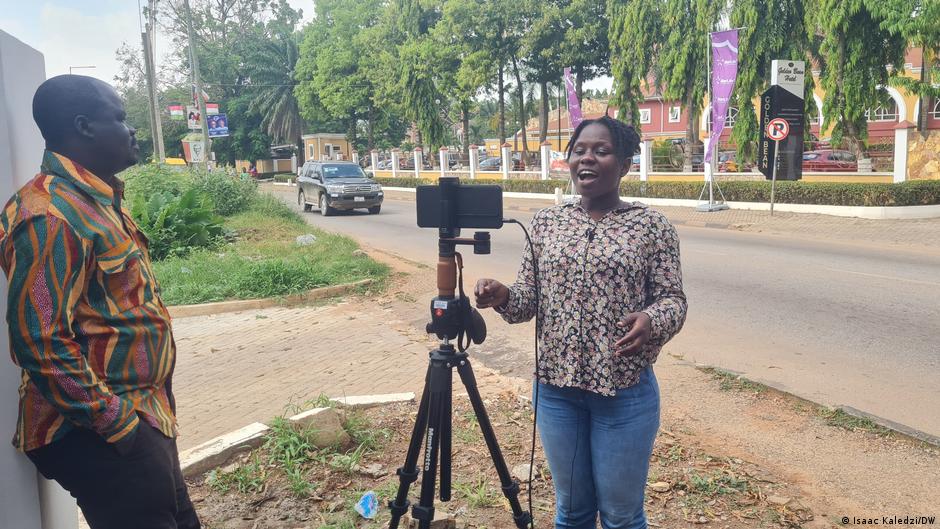
In Ghana, DW Akademie works with women journalists as they try to advance in their careers despite gender barriers.
Image: Isaac Kaledzi/DWAfter more than a decade working across the media spectrum in Ghana, Ewurama Attoh can be proud of a career that runs the gamut, from reporting for television to crafting promotional campaigns to co-hosting a morning talk show.
"I have a real passion for communication," she said. "I've seen how that passion can help shape public discourse and help bring forward voices that are often underrepresented."
It's this drive, dedication and passion, however, that can also hold back Ghanaian women journalists like Ewurama in their professions and thereby in their ability to participate wholly in public life. Because the higher they soar in their jobs, the more responsibilities they take on, the more they pursue substantive stories, the more challenges and resistance they encounter, says Ama Kodjo, DW Akademie’s program director for Ghana.
With this understanding, DW Akademie initiated a workshop project titled "Safety for Female Journalists" earlier this year. Gathering with 12 women journalists in northern Ghana, which is generally less developed and more patriarchal than the country's south, the idea was to reflect on experiences both in and out of the newsroom.
Harassment and discrimination have burdened many women like Attoh, but the meeting was more focused on solutions: practicing intervention in difficult scenarios, risk assessment and staying safe, including how to protect yourself while covering violence. One discussion was particularly instructive, and telling: photographing insect bites for diagnosis, allergy disclosures to colleagues, always carrying an insurance card, choosing lower floors with two exits and changing hotels if the reputation is risky.
As a bureau chief, Shawana Yussif is tasked with finding ways to cover hard-to-access stories, and has herself been in tricky reporting situations. Image: Knii Fiofio"There was a lot of interest in this," Kodjo noted, "because these kinds of workshops are not typically offered by their media employers."
For Shawana Yussif, the northern bureau chief in Tamale for Ghana's Channel One TV and Citi FM, it was the workshop's material on getting the stories while staying safe and calm that hit home.
"I face limited resources for field reporting, poor road networks when covering remote areas, pressure to meet tight deadlines and sometimes difficulty accessing timely information from institutions," she said. "And this relates to misinformation, security risks during sensitive assignments, and balancing speed with accuracy."
Ghana ranks 52nd out of 180 countries surveyed in 2025 by Reporters Without Borders in its annual World Press Freedom Index. Like journalists in other parts of the Global South, Ghanaian media workers can endure threats and attacks, and media companies face financial constraints. In this environment, DW Akademie’s projects in Ghana focus on expanding media skills, as well as resilience and reporting across conflict and trauma. Workshops also offer training in critical approaches to AI-generated content, fact-checking, cyberbullying and hate speech.
Attoh attended the training earlier this year although she said her challenges have been perhaps less threatening and more unnerving.
Ewurama Attoh's media career has been wide-ranging and given her broad professional experience, but she still comes up against gender discrimination and hesitancy when it comes to interviewing men. Image: DW Akademie Ghana/DW"I often have to work twice as hard to be heard and taken seriously, especially when it comes to decision-making in the workplace," she said. "There have been instances on panels where male guests on our morning show cancel at the last minute when they learn I'll be the host. They say they're just not comfortable with me asking them questions."
Hamdia Abdul Hameed, who is a news anchor and reporter with the multimedia organization Zaa, says this feels all too familiar at her job, too.
"In such situations, some people may turn defensive or unwilling to share information," she said. "I just try to remain calm and professional and avoid confrontation."
Hamdia Abdul Hameed, like many reporters, has encountered unwilling sources, but she's found that remaining calm and avoiding confrontation often helps her get the information she needs. Image: DW Akademie Ghana/DWThe skills to do the jobDuring the training, Yussif recalled being in a tricky, potentially dangerous situation while on a recent assignment — and in doing so, realized that erring on the side of safety had helped her confidently do her job.
She described being on the road to a remote area to write about drought. Some farmers offered to drive her to their crops to see the impact. En route, she saw that several of the farmers were carrying cutlasses, perhaps understandably, considering their work. But still, Yussif felt uneasy.
"I remained calm and discreetly recorded a short video of the group," she said. "I then shared it with a trusted family member and a close friend. I also sent them my live location.
"I took these precautions," she continued, "to ensure that others were aware of where I was and who I was with. Fortunately, nothing harmful happened, and I was able to complete the assignment safely."
The 'Safety for Female Journalists' workshop is an activity within the Media Safety project at the DW Akademie Ghana office, supported by Germany's Federal Ministry for Economic Cooperation and Development (BMZ).