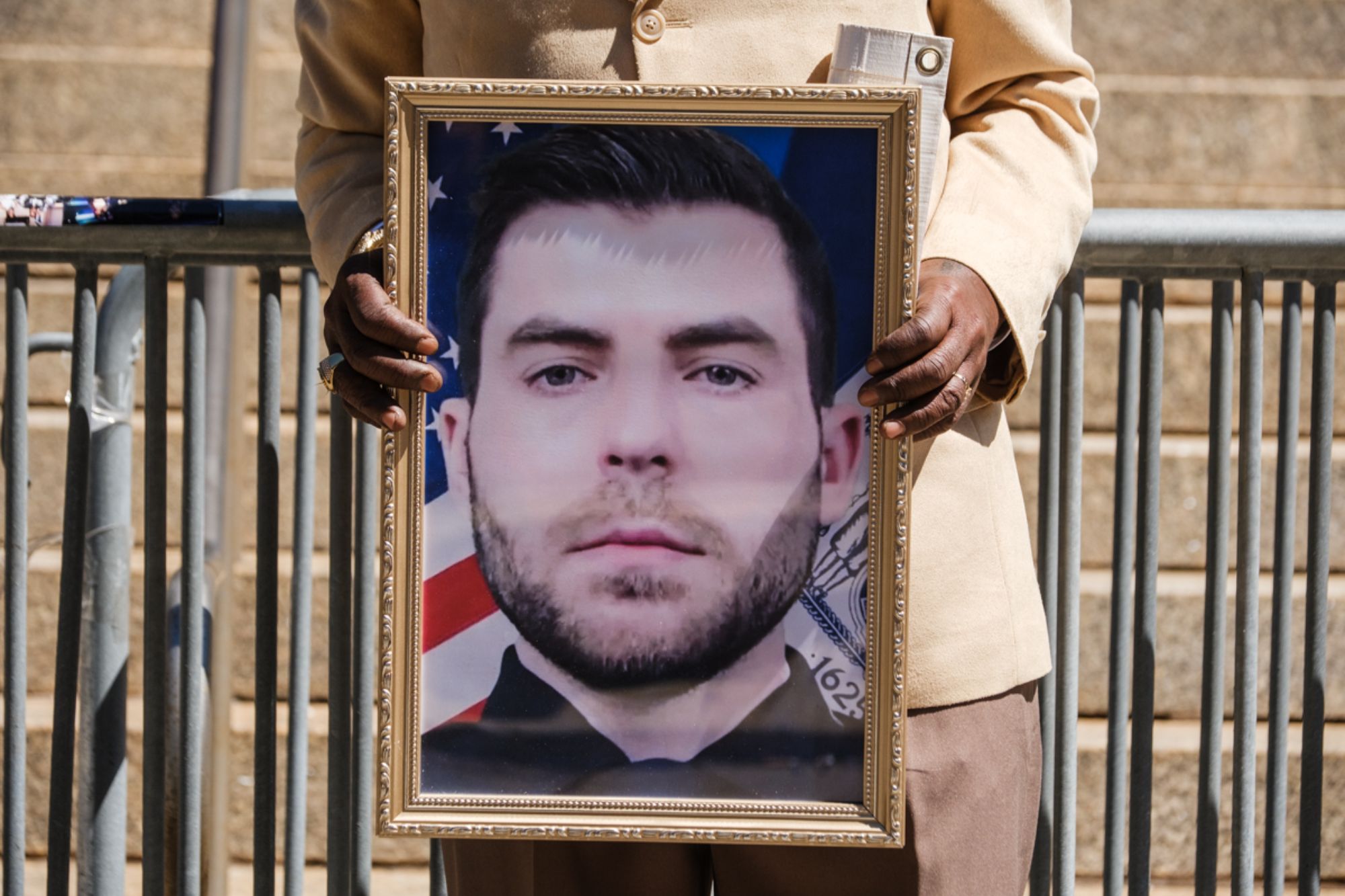
A man holds a photo of Jonathan Diller outside the Queens Courthouse. Stephen Yang for NY Post On Monday, when Queens County Supreme Court Justice Michael Aloise sentenced the killer of NYPD Det. Jonathan Diller to 115 years to life in state prison, he made Diller’s wife Stephanie and son Ryan a solemn vow.
Killer Guy Rivera, he said, “will die in a prison cell, which I promise you he will.”
Queens DA Melinda Katz agreed, saying the decision by the soon-to-retire Aloise — one of the county’s best and most respected jurists — “ensures that this defendant will never be free again to terrorize the streets of New York City.”
Rivera is the kind of defendant for whom prisons are made: a three-time convicted persistent felony offender, a career criminal who murdered one police officer and tried to kill another while possessing two loaded firearms.
Aloise structured his sentence to ensure that Rivera will die in prison under current law, as he should.
But in New York, life doesn’t mean life — and if our legislators have their way, 115 years won’t mean 115 years.
The state Legislature is dangerously close to approving the Elder Parole Bill, which would require the state Parole Board to grant a parole interview to any defendant who turns 55 and has served at least 15 years of his sentence.
If parole is denied, they’ll get another hearing every two years.
Rivera, now 36, will get a parole hearing in just 19 years if this bill passes.
There are no restrictions on which defendants get the hearing.
The brutality of the crime, prior criminal record, lack of remorse or record in prison are not disqualifiers.
A sentence of life without parole or 115 years behind bars would make no difference.
John Taylor, convicted of executing five people in the Queens Wendy’s massacre in 2000, was sentenced to five consecutive prison terms of life without parole after his death-penalty sentence was reversed.
Now 62, he’d get a mandatory parole hearing every two years if this bill becomes law.
James Allen Gordon was sentenced to three consecutive life-without-parole sentences for the rape, sodomy, torture and murder of three women in Queens in 1996.
When he turns 55 next year, he’d get a hearing within 60 days of his birthday.
Ridiculous, you may say — the state Parole Board wouldn’t even contemplate releasing people like that.
Consider Scott Cobb, convicted of murdering uniformed NYPD Officer Edward Byrne on a Queens street in 1988 while he guarded a witness, in a brazen crime that terrorized the city: Cobb was paroled in 2023.
Or look at Tracey Middleton, who murdered 61-year-old grandmother Mildred Greene in 1987, shooting her in the head as she worked her night job at a Queens cab stand.
She was killed because she was scheduled to testify to the grand jury against the very drug dealers who murdered her — and her brutal slaying sent shock waves through the criminal-justice system, as DAs scrambled to assure witnesses they would be safe.
Middleton was paroled in 2022, after serving the minimum sentence.
I watched each one of these four cases when the defendants were sentenced; I was the prosecutor on two of them.
I heard the judge in each case pronounce that the defendants would spend the rest of their lives in prison.
I watched family members and police officers walk out of those courtrooms with some measure of comfort, believing the killer of their loved ones and colleagues would never be released.
Parole Board members, appointed by the governor, must be confirmed by the leftist Democratic state Senate.
Of the 16 current members — half appointed by Gov. Andrew Cuomo, half by Gov. Kathy Hochul; all since 2017 — only one has any police experience, and just three are former ADAs.
And the results show it: New York’s Parole Board has paroled at least 43 cop killers since 2017.
In 2011, only 12% of inmates charged with murder or with attempted murder in the first degree were released to parole after their first interview.
For violent felony offenders, the number tripled from 7% in 2011 to 22% in 2024.
For all eligible inmates, release rates more than doubled from 18% in 2011 to 41% in 2024.
In their ideological zeal to empty New York’s jails and prisons, our legislators have abandoned crime victims, their families and any concept of deterrence.
If they vote to loosen the rules still further with Elder Parole, they’ll have to explain that choice to Stephanie Diller — and tell her why her husband’s killer should be eligible for parole in just 19 years.
Jim Quinn is a retired career prosecutor in the Queens District Attorney’s Office, where he served for 42 years.