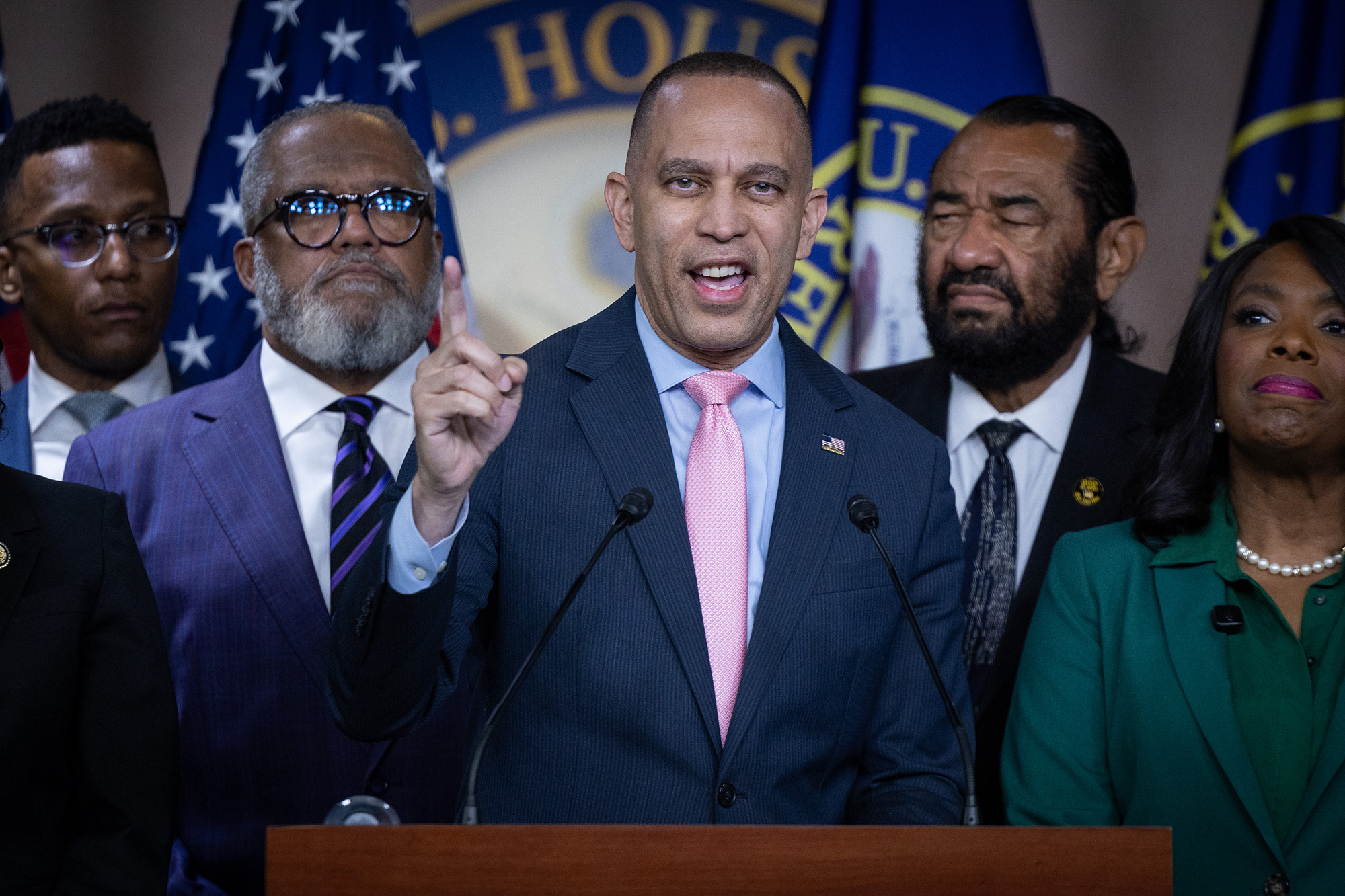
House Minority Leader Hakeem Jeffries (D-NY) speaks at a press conference with other members of the Congressional Black Caucus on the Supreme Court decision in Louisiana v. Callais, at the U.S. Capitol in Washington, DC on April 29, 2026. Anadolu via Getty Images Hail to the Supreme Court for slapping down the obsessive use of race in drawing electoral lines — recognizing that it has nothing to do with boosting equality, but rather offends the Constitution’s guarantee of equal protection under the law.
Wednesday’s common-sense 6-3 ruling struck down a Louisiana districting scheme that added a second majority-black House district in the name of complying with the 1965 Voting Rights Act.
That act, Justice Samuel Alito’s majority opinion explained, “did not require Louisiana to create an additional majority-minority district” since there was “no compelling interest” to justify such “use of race.”
Indeed, “that map is an unconstitutional gerrymander, and its use would violate the plaintiffs’ constitutional rights.”
Sixty years ago, Congress imposed intrusive racial concerns in districting as a remedy to once-pervasive and systemic “state-sponsored” discrimination that long thwarted meaningful political participation by black citizens in violation of the 14th Amendment’s equal-protection guarantees.
But the civil-rights laws, and America’s social progress, have produced a very different country today, even in the deepest South.
All the way back in 2003, in a ruling allowing some continued affirmative action, Justice Sandra Day O’Connor warned that “25 years from now, the use of racial preferences will no longer be necessary” to achieve justice.
And any other use of race is repugnant to the very protections the ’65 law aimed to guarantee.
Note that the high court didn’t completely strike down the Voting Rights Act; it only limited obsessive government use of race when no one can point to any actual wrong to be righted: Some statistical incongruity isn’t evidence of discrimination, period.
No one is pretending that racism no longer exists, nor that some official recognition of race can still be appropriate: Louisiana still can’t adopt a map that draws bizarre shapes to avoid any natural majority-minority district, for example.
Wednesday’s decision moves the country forward, closer to the day when politics is driven by the content of candidates’ programs, and not by the color of anyone’s skin.