Seventeen current and former legislators are demanding that Gov. Kathy Hochul’s administration enforce the state’s controversial green energy law — even while admitting they knew the mandates could trigger a spike in energy costs when approving them.
The extraordinary admission came in an April 17 court brief supporting a lawsuit filed by climate change activists.
The environmental groups sued to try to force Hochul’s administration to comply with the green mandates of the Climate Leadership and Community Protection Act of 2019 over concerns that the deadlines are unrealistic and the requirements are inflating utility bills and walloping ratepayers.
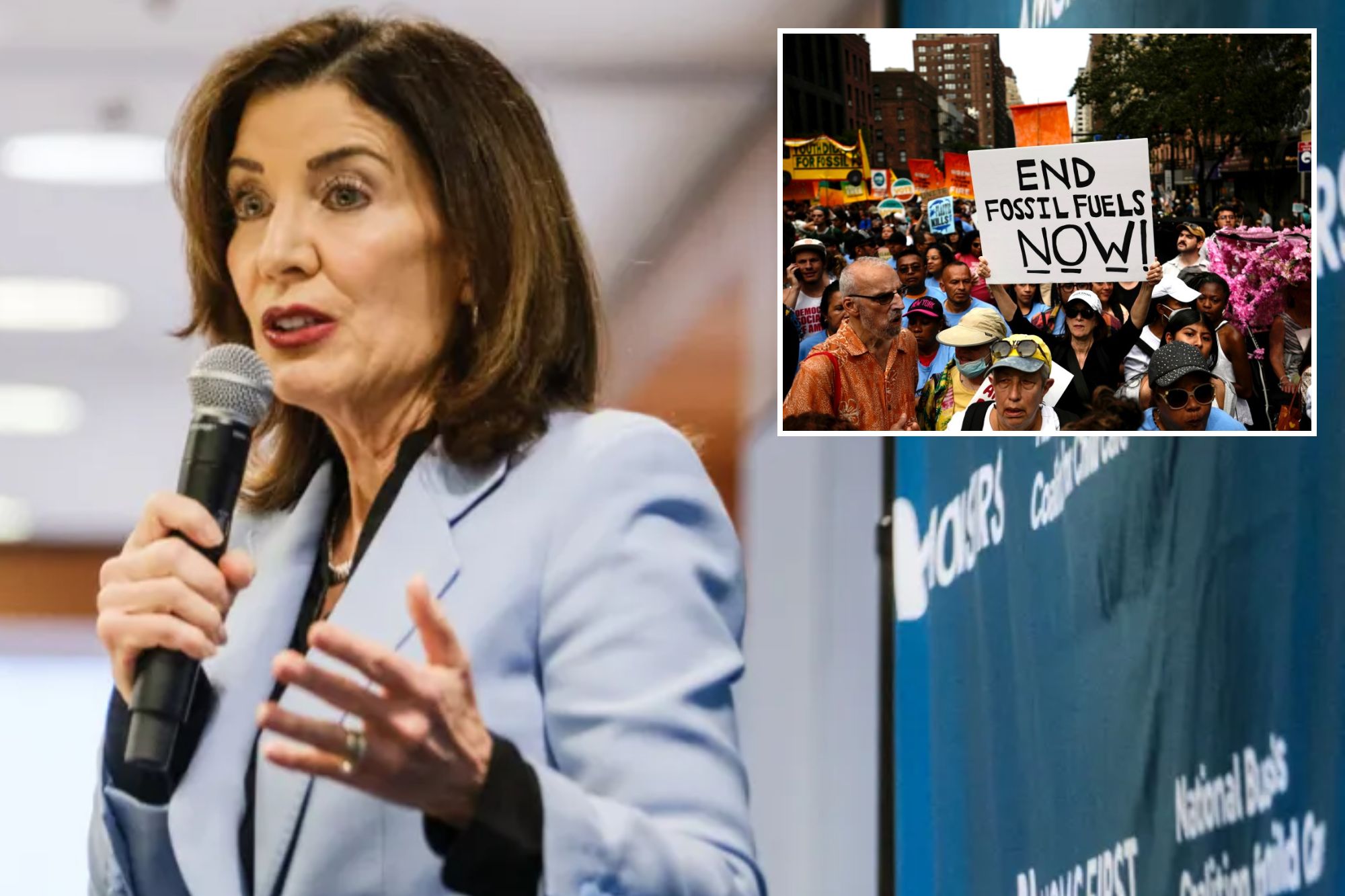
17 former and current lawmakers want Gov. Hochul and her administration to enforce the controversial green energy law despite knowing it could lead to a rise in energy costs. Stephen Yang for NY Post The filing claims the architects of the law knew all along the mandates would be pricey.
“The Act’s language confirms that economic considerations were incorporated into its framework,” the law states. “The [law] also directly acknowledges that the transition to a clean energy economy may impose costs and affect certain sectors more than others.
The law acknowledged “the risk of job displacement” and “adverse effects on small businesses” but said the state Department of Environmental Conservation should work to try to minimize cost to everyday New Yorkers, the eco activist politicians said in the filing.
“This general mandate does not, however, as DEC suggests, instruct the agency to avoid the costs of climate action altogether by refusing to comply with the mandate to issue regulations,” they stated. “Rather, the Act directs DEC to manage and mitigate those costs while carrying out the statute’s emissions reduction goals.”
The brief was signed by lawmakers including Senate Health Committee Chairman Gustavo Rivera, Assembly Housing Committee Chair Linda Rosenthal, and Democratic Socialists of America Assembly members Emily Gallagher, Diana Moreno and Phara Souffrant Forrest.
Legislators made this admission in an April 17 court brief that supported a lawsuit filed by climate change activists. AP The amicus curiae brief was filed in a lawsuit filed by climate change activists to force the Hochul administration to implement the law, instead of fighting to delay compliance.
A state Supreme Court judge ordered Hochul to enforce the law, but the administration filed an appeal while the governor negotiates to amend the edict, which would make the court case moot.
Business and consumer advocates blasted the “out of touch” filing by lawmakers in support of raising energy prices.
“This amicus brief is completely out of touch—and frankly, unconscionable,” said Justin Wilcox, executive director of Upstate United.
“At a time when New Yorkers are already struggling with rising costs, these lawmakers are going out of their way to advocate in court for a position that would effectively force many struggling families to shoulder steep new energy and transportation expenses just to heat their homes and commute to work.”
Ken Lovett, the governor’s senior communications advisor on energy and environment, said “struggling New Yorkers cannot be expected to shoulder higher costs” as he blamed the federal government for increasing costs across the board.
Start your day with all you need to know Morning Report delivers the latest news, videos, photos and more.
“While we don’t comment on pending litigation, Governor Hochul has made clear the need to make common-sense changes to the law to keep the lights on and costs down for all New Yorkers,” Lovett said. “While some would have us bury our heads in the sand by ignoring the economic and political challenges we face, Governor Hochul is focused on delivering for New Yorkers.”
A report by the New York State Energy Research and Development Authority claims that without changes, the impact of the climate change act by 2031 could boost gas at the pump by $2.23 a gallon, increase natural gas costs to $2,300 a year in New York City households and more than $4,000 a year for upstate households The state would only be able to offset some of those costs, the analysis said.