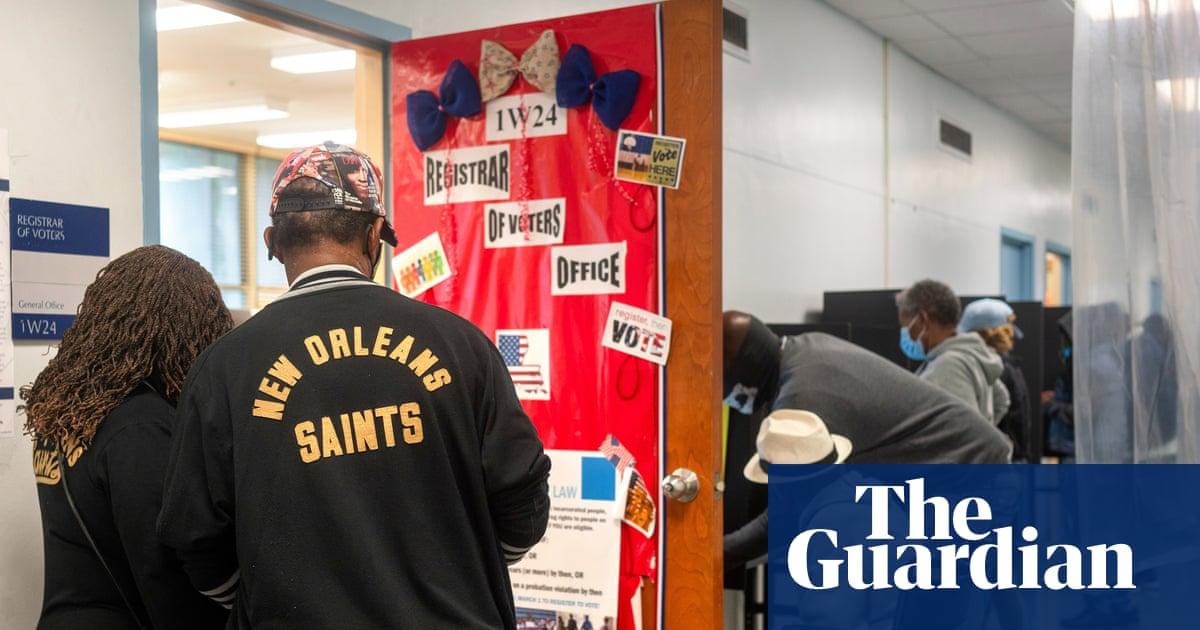
People wait to cast their ballot for the upcoming presidential election as early voting begins in New Orleans, Louisiana, on 16 October 2020. Photograph: Kathleen Flynn/ReutersView image in fullscreenPeople wait to cast their ballot for the upcoming presidential election as early voting begins in New Orleans, Louisiana, on 16 October 2020. Photograph: Kathleen Flynn/ReutersUS supreme court rules Louisiana must redraw its congressional map in landmark caseAt the heart of the case was the question of how much lawmakers are allowed to consider race when they redraw districts
The US supreme court has ruled that Louisiana will have to redraw its congressional map, in a landmark voting rights case.
At the heart of the case, Louisiana v Callais, was a thorny question of how much lawmakers are allowed to consider race when they redraw districts to ensure that Black voters are adequately represented. The supreme court initially heard oral arguments in the case last March, but took the unusual step of asking lawyers to re-argue the case last fall. In setting the case for a re-argument, the justices raised the stakes of the case, asking lawyers to focus on whether section 2 of the Voting Rights Act was constitutional.
The decision comes after years of legal wrangling over the boundaries of the map.
After the 2020 census, the Republican-controlled state legislature drew a new congressional map in which Black voters comprised a majority in just one district despite being about a third of the state’s population. A group of Black voters sued the state in 2022 under the Voting Rights Act, arguing that the map diluted the influence of Black voters in the state by packing them into one district and spreading them out over the remaining ones.
The Black voters won the case and a federal judge blocked Louisiana from using the map and instructed the state to draw a new one with a second majority-Black district. The state complied, drawing a new map with a second-majority Black congressional district that stretches diagonally across the state from Shreveport to Baton Rouge.
But a group of non-Black voters challenged that new map, claiming that voters had unlawfully been sorted by their race in violation of the 14th amendment’s guarantee of equal protection. A three-judge panel agreed with those plaintiffs and blocked the new map from going into effect last year. That decision was paused by the supreme court and the remedial map was used in the 2024 election last fall’s election. Cleo Fields, a Black Democrat, won the seat.
During oral arguments in March, Edward Greim, a lawyer for the plaintiffs, said it was obvious that race had predominated in drawing the district because it was so irregularly shaped.
But lawyers representing Louisiana as well as the Black voters who brought the original claim said that there was a clear explanation for the strange shape. When they were drawing the map, Louisiana Republicans had wanted to preserve the safe seats of the House speaker, Mike Johnson; the House majority leader, Steve Scalise; and Julia Letlow, a member of the House appropriations committee. They had rejected the possibility of drawing a more compact district in order to preserve those seats.