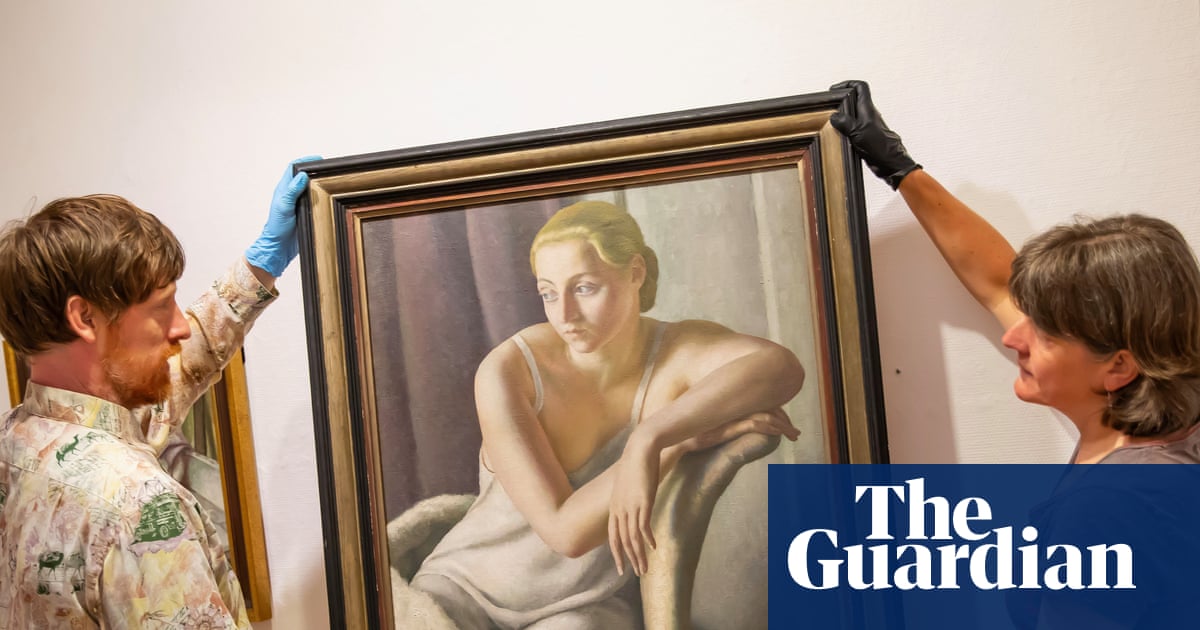
The technician James Sayer and curator Katie Herbert hang Portrait of Eileen Mayo by Dod Procter at Penlee House in Penzance. Photograph: Jonny Weeks/The GuardianView image in fullscreenThe technician James Sayer and curator Katie Herbert hang Portrait of Eileen Mayo by Dod Procter at Penlee House in Penzance. Photograph: Jonny Weeks/The Guardian‘Still lots to talk about’: UK galleries team up to shine light on female artistsTracey Emin among creators on display at Making Her Mark, a project by Penzance, Worcester and Kirkcaldy galleries
Like many regional galleries, the collection at Penlee House in Cornwall tends to be dominated by male artists, a legacy of the inequality faced by female creators over centuries.
But from Thursday, thanks to a collaboration between galleries, visitors to the site in Penzance will be able to view work by some of the Britain’s great female artists.
In prime position above a marble fireplace there is a challenging Tracey Emin. In a room across the hallway, a vibrant Barbara Hepworth is hanging. The exhibition also includes work by the likes of Laura Knight, Elizabeth Forbes and Gillian Ayres.
View image in fullscreenI Loved My Innocence by Tracey Emin and (right) a tapestry by the textile artist Imogen Bright Moon. Photograph: Jonny Weeks/The GuardianView image in fullscreenIt is the first exhibition to open as part of Art Fund’s £5m Going Places programme. Photograph: Jonny Weeks/The Guardian“It’s a wonderful opportunity for visitors to come and see amazing work by some of our best women artists,” said Katie Herbert, the curator at Penlee House. “We may never see a Tracey Emin here again.”
The show, called Making Her Mark, is a collaboration between Penlee, Worcester City Art Gallery and Museum and Kirkcaldy Galleries in Fife, Scotland, with each providing more than 20 works.
Making Her Mark will remain in Penzance until autumn and move on to Worcestershire and Fife next year.
It is the first exhibition to open as part of Art Fund’s £5m Going Places programme, which brings together 20 museums across the UK’s four nations to share and celebrate their collections over the next five years.
Herbert described how the galleries taking part in the project had got together to try to find common ground and aims. “It was a bit like speed dating,” she said.
View image in fullscreenThe installation taking shape at Penlee House. Photograph: Jonny Weeks/The GuardianView image in fullscreenFeatures, Fingers, Foot by Lys Hansen. Photograph: Jonny Weeks/The GuardianThe Penzance, Worcester and Kirkcaldy galleries clicked, and fastened on the idea of the exclusion women faced in the art world. Herbert said: “We do have some women artists in our collections but not as many as maybe we should.”
Herbert admitted she had been a little worried about displaying the Emin (which comes from the Worcester collection) so prominently, in case regular gallery visitors were a little shocked. “But I was persuaded to give it a good spot.”
View image in fullscreenI Loved My Innocence by Tracey Emin. Photograph: Jonny Weeks/The GuardianA key thread is the lack of access women have traditionally had to art schools, and the barriers they have faced.
One of the paintings on show reflecting this is Dod Procter’s Portrait of Eileen Mayo. Procter and Mayo studied art, but women were restricted from access to life classes and ended up painting each other in private. “They used each other as models,” said Herbert.
Though Barbara Hepworth had a studio in Cornwall, Penlee House has nothing by her, and Herbert said they were thrilled at being able to show one of her pieces held in Worcester’s collection.
View image in fullscreenHerbert (centre) with Zoe Burkett, education officer (left) and the artist Kate Turner at Penlee House. Photograph: Jonny Weeks/The GuardianAnother key work is the Scottish artist Lys Hansen’s Features, Fingers, Foot, which comes from Kirkcaldy. It depicts the artist’s son clinging and smothering her, a representation at the rage she felt at being steered towards domesticity.
Herbert said there were some challenges in putting together a show needing so much collaboration. For instance, a tapestry by the British Romani textile artist Imogen Bright Moon, provided by Worcester, turned out to be much bigger than anticipated. Happily, room was found for it next to the Emin.
Gracie Divall, the programme lead for Going Places, said this first collaboration had prompted the three organisations to think about their collecting policies. “It’s exciting that new relationships are being forged across the country,” she said.
View image in fullscreenGracie Divall. Photograph: Jonny Weeks/The GuardianFuture themes to be explored in other exhibitions include heritage crafts that are at risk and the experience of refugees.
Another strand of the project is to encourage people to create their own art. In Penzance, the artist Kate Turner worked with care-experienced young people as part of the Making Her Mark project.
They travelled to Worcester and to Scotland – more than 12 hours on the train – and produced a protest banner in response to some of the themes the exhibition explores that also hangs in the gallery.
Turner said female artists continued to face challenges, making the themes in the exhibition as relevant as ever. “There’s still a gender pay gap for women in the arts. Misogyny can still be very present in wider society. Representation of women artists has definitely improved, but I think there’s still lots to talk about.”