Buffer zones occupy a grey area in international humanitarian law, as rules around them in contemporary warfare are not particularly clear.
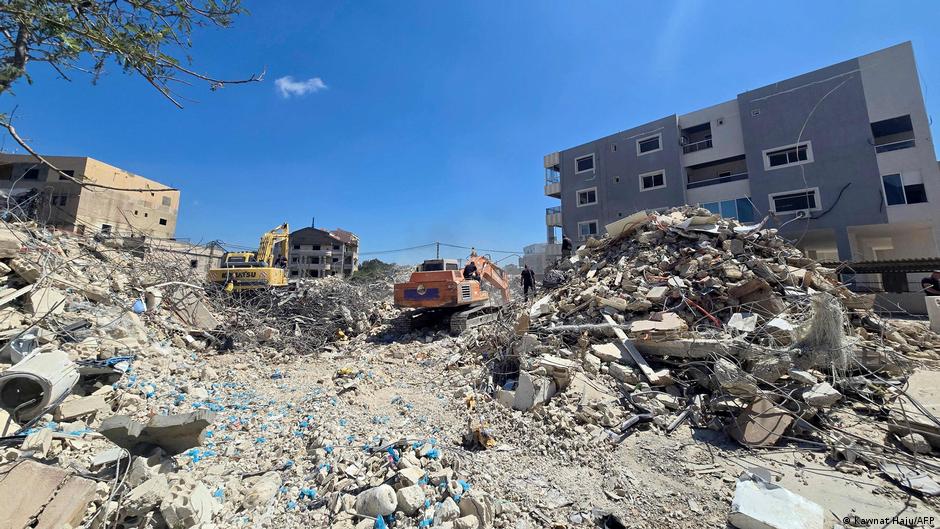
https://p.dw.com/p/5CxihIsrael says it wants a buffer zone in southern Lebanon to prevent attacks from Hezbollah but critics say it's a form of occupation and that Israel may be committing war crimes there Image: Kawnat Haju/AFPAdvertisementIs a buffer zone — such as the one that Israel is establishing in Lebanon — legal under international law?
But the long answer is more complicated and, experts say, leads to the conclusion that what Israel is establishing in southern Lebanon may not actually be a "security buffer zone" at all, at least not under international law.
Since early March, Israeli troops have taken over an area of Lebanon between 5 and 10 kilometers (3 and 6 miles) away from the border. Israel has argued it is acting in self-defense. Prime Minister Benjamin Netanyahu says the buffer zone in southern Lebanon is to "thwart the threat of invasion" from the Lebanese militant group Hezbollah.
The reason an answer to the original question is so complex is that buffer zones, as they are often used in warfare and politics this century, are not very well defined under international humanitarian law. Much of this law was developed following the world wars of the last century.
"Buffer zones are not really explicitly covered anywhere in international law," confirms Gustav Meibauer, an assistant professor in international relations at Radboud University in the Netherlands, who has studied phenomena such as buffer and no-fly zones. "The standard sources — like the UN Charter, the Geneva or Hague Conventions — don't have a lot to say on buffer zones, at least not explicitly."
Buffer zones can have positive aspects, legal researcher Eian Katz argued in a commentary for the University of Chicago Law Review; his 2017 article is still considered one of the best texts on buffer zone law, experts say.
"They enhance border integrity by better enabling states to guard against emerging security threats from nonstate actors, especially terrorism and illegal immigration. They may also be used to contain war zones," Katz, who now works as an attorney for the US State Department, continued. A buffer zone can also have a humanitarian function, where it helps shelter the displaced, or aid can be distributed.
"But buffer zones are not always inspired by such noble aims," Katz added, "and they have been alternatively deployed as a pretext to broaden a sphere of influence or pursue discrete foreign policy objectives."
In fact, Meibauer says the blurry legal situation around buffer zones can actually make them more appealing. "Politically speaking, that legal gray zone they're in might actually make them attractive to decision makers who don't necessarily want what they are doing to be covered quite so explicitly by international law," he explains.
They may also prefer to use the term buffer zone simply because it sounds better, he adds. "Occupying and annexing is what evil people do," he says, "whereas a buffer zone sounds more like a softer, restrained, limited type of tool, one that's more acceptable to both domestic and international audiences."
There are several factors the law would consider when deciding whether a buffer zone is legal.
One of the most important is whether the buffer zone was created via mutual agreement or was self-imposed. For example, two countries decide it's a good idea to have space between them so that their soldiers won't accidentally shoot at one another. Then, from the perspective of international law, that's usually not a problem.
But if a buffer zone is unilaterally imposed on one country by another, that's different and can be seen as a threat to sovereignty.
In that case, there are three, often overlapping arguments used when a buffer zone is imposed, Katz says in his legal commentary.
These are: The buffer zone was permitted by the United Nations Security Council, the country that imposed the buffer zone is doing so for humanitarian reasons, or the country that imposed the buffer zone is acting in self-defense.
After a buffer zone has been established, whether or not it's legally justified, "international law still governs its operation," Katz continues. "The Geneva Conventions and their additional protocol, which set the ground rules for armed conflict, would form the basis of that law."
These rules stress the principles of proportionality and military necessity — that is, what your army is doing may be justified by your reasons, but your soldiers are not going any further than they absolutely need to. Both proportionality and necessity also apply to buffer zones and the law has a high bar for those. For example, the conventions say civilian objects, private property and infrastructure shouldn't be targeted or destroyed except under certain, strictly defined circumstances, where they might contribute to a military objective.
Israel often claims Hezbollah is using buildings in the buffer zone and on March 22, Israeli Defense Minister Israel Katz ordered the military to "accelerate the destruction of Lebanese homes" near the Israeli border based on the "model in Gaza."
"There needs to be a legitimate military objective and operational objective — and the only way to achieve it would be to destroy the civilian property," Janina Dill, co-director at Oxford University's Institute for Ethics, Law and Armed Conflict, told CNN in April 2025, speaking about Israeli army conduct in Gaza.
However, the deliberate, widespread destruction of civilian property without a clear military necessity is a war crime, Dill told the US broadcaster.
The same principles of proportionality and necessity also apply to human beings in the buffer zone. If it is feasible, there should be attempts at contact, identification and diversion before you shoot at a civilian, Katz says. However, he adds, "illegal uses of force have become common occurrences in many buffer zones."
Another factor that international law considers when it comes to buffer zones is how permanent they are. Early international law tended to see buffer zones as temporary things — when war was over, there'd be no further need for them.
In fact, if buffer zones do become permanent, they might not actually be buffer zones at all, Meibauer points out.
"Politically, a buffer zone or security zone is often largely performative," he says. "What matters is not what something is called, but what is being done."
Under international law, an area is considered occupied when there is a foreign military in place, without permission from the country being occupied, and the foreign military has established control over that area.
On Tuesday, US Secretary of State Marco Rubio said that Israel doesn't want to hold territory in Lebanon permanently. However, senior Israeli politicians, including the defense minister, have said the opposite and also told Lebanese civilians — around 1 million have been displaced so far — they won't be able to return to their homes.
"To the extent that this invasion [of Lebanon] becomes a de facto permanent arrangement where, one, territory is rendered uninhabitable, and two, under the effective control of Israel, then what we are looking at is an occupation," Meibauer concludes.
"And that matters because there are all sorts of legal consequences that emanate from that. Occupation is governed at length by the Geneva Conventions and the Hague Conventions."
Israel‑Hezbollah ceasefire holds despite sporadic clashesTo view this video please enable JavaScript, and consider upgrading to a web browser that supports HTML5 video