Europe's climate extremes have hit new highs — but renewables are now supplying nearly half of the continent's electricity.
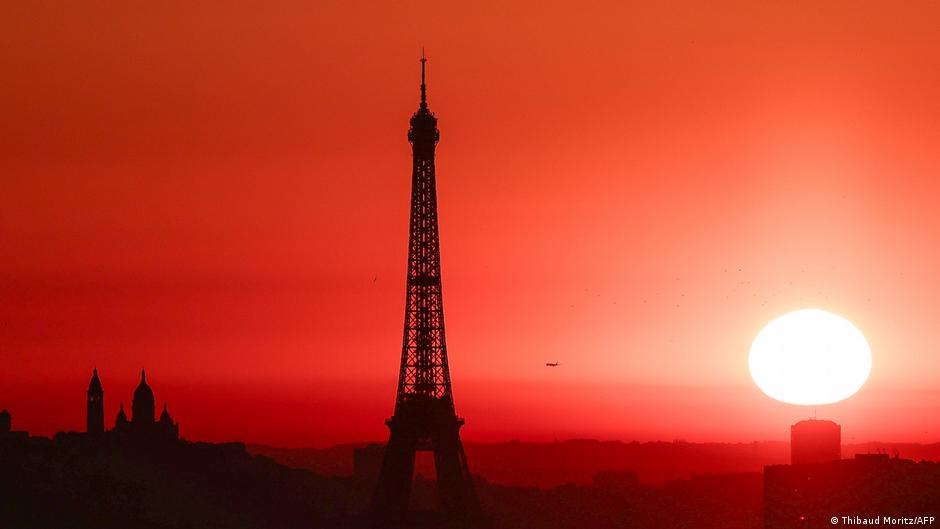
https://p.dw.com/p/5CvYcThe sun rises over the Eiffel Tower and Sacré-Cœur in Paris on July 1, 2025, as the city went on red alert during a searing heatwave that gripped much of Europe.Image: Thibaud Moritz/AFPAdvertisementVirtually no part of Europe was left untouched by extreme weather and hotter temperatures in 2025. The continent endured unprecedented heatwaves, experienced its largest wildfire and recorded its hottest-ever sea surface temperatures.
Those are the key findings of the European State of the Climate 2025 report, published annually by the EU's Copernicus Climate Change Service and the World Meteorological Organization.
"The pace of climate change demands more urgent action," said Samantha Burgess, Strategic Lead for Climate at the European Center for Medium-Range Weather Forecasts. "With rising temperatures, and widespread wildfires and drought, the evidence is unequivocal; climate change is not a future threat, it is our present reality."
At least 95% of Europe saw above-average annual temperatures, with the United Kingdom, Norway and Iceland each measuring their warmest year ever. The continent was hit by several heatwaves, one of which lasted for 25 days and affected multiple countries.
Northern Europe was also impacted, with the sub-Arctic region across Norway, Sweden and Finland sweltering during 21 days of extreme temperatures. Ordinarily, the region would expect no more than two days of heat stress. Spain, meanwhile, endured its most intense heatwave since at least 1975. As the emissions from burning coal, gas and oil drive changes in Earth's climate, the report found that five of the continent's 10 warmest years have occurred since 2019.
And the trend is not restricted to land. Sea surface temperatures across the European region reached their highest annual average on record for the fourth year in a row. This wreaks havoc on marine biodiversity, causing mass mortality events and throwing food webs out of balance.
Very hot conditions also come with a real human cost. Heat-related deaths in Europe reached nearly 63,000 in 2024 according to estimates from the Lancet Countdown, a separate annual report that tracks the health impacts of climate change. Researchers also found that mortality connected to high temperatures has increased in almost 100% of regions monitored since 2014.
"Europe is warming twice as fast as the global average, with far-reaching repercussions on socioeconomic wellbeing and on ecosystems and biodiversity," said Celeste Saulo, secretary-general of the World Meteorological Organization.
In May, more than half of the continent experienced varying degrees of drought. The year also saw the driest soil moisture conditions on record, creating conditions that can lead to lower crop yields and increase wildfire risk.
Overall, 2025 was catastrophic year for wildfires in Europe, with more than 1 million hectares of land burned. Greece witnessed one of its most severe wildfire outbreaks in recent years when 50 fires began in 24 hours.
More than two-thirds of European rivers ran below their average annual flows, driven by drought.
At the same time, the sunny conditions were also a boon to solar energy, which is essential to transitioning away from planet-heating fossil fuels. Every single EU country experienced growth in its solar grid in 2025.
Rising temperatures trigger a series of cascading effects, including melting once frozen areas. In March, Europe lost snow cover roughly equivalent to the combined size of France, Italy, Germany, Austria and Switzerland. The largest losses were in Eastern Europe.
Glaciers receded in almost every European region, particularly in Iceland, which recorded its second greatest annual loss since 1976.
The Greenland Ice Sheet shed around 139 gigatons of ice. Over the past 50 years, ice loss in Greenland and Antarctica has led to three centimeters of sea level rise. Each additional centimeter exposes about 6 million people to coastal flooding.
Fossil fuels haven't just driven these extreme weather events; they have also proven to be a deeply volatile commodity in a time of geopolitical conflict. Europe has responded by investing in its own homegrown energy sources, with renewables now supplying nearly half of the continent's electricity.
Wind and solar edged out fossil fuels in the EU for the first time in 2025, according to Ember, a global energy think tank.
Solar power set a new record, contributing about 13% of the continent's electricity. This is the fourth year running that solar has grown by more than 20%.
In Hungary, Cyprus, Greece, Spain and the Netherlands, solar represented a fifth of each country's electricity.
"This milestone moment shows just how rapidly the EU is moving towards a power system backed by wind and solar," said Beatrice Petrovich, senior energy analyst at Ember. "As fossil fuel dependencies feed instability on the global stage, the stakes of transitioning to clean energy are clearer than ever." Edited by: Tamsin Walker
No security without energy security: EU Energy CommissionerTo view this video please enable JavaScript, and consider upgrading to a web browser that supports HTML5 video