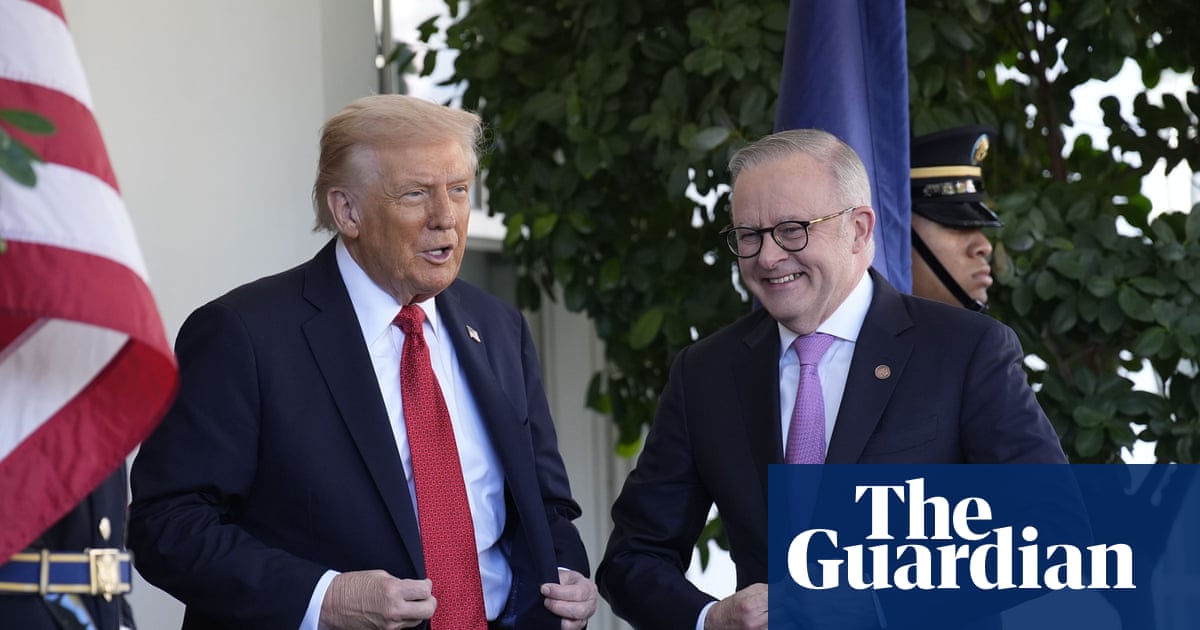
Donald Trump and Anthony Albanese. The Trump administration has labelled Australia’s news bargaining incentive plan ‘foreign extortion’. Photograph: Yuri Gripas/CNP/ShutterstockView image in fullscreenDonald Trump and Anthony Albanese. The Trump administration has labelled Australia’s news bargaining incentive plan ‘foreign extortion’. Photograph: Yuri Gripas/CNP/ShutterstockTrump administration labels Australia’s media bargaining laws ‘foreign extortion’Albanese defends plan forcing Meta, Google and TikTok to make deals with Australian news publishers through a levy
The Trump administration has described Australia’s moves to make big tech companies pay for news online as “extortion” but Anthony Albanese defended the plan by saying it was about protecting and rewarding media outlets for the work they produce.
Labor’s plan to encourage Meta, Google and TikTok to make deals with Australian news publishers, or face a 2.25% levy, is likely to be supported by the Coalition and Greens in parliament. But a bigger problem may be the ire of Donald Trump, who has strongly opposed extra regulation being imposed on US-based tech companies. A major tech industry lobby group on Wednesday urged the White House to consider retaliatory trade measures.
The Australian Financial Review quoted a Trump administration spokesperson, Kush Desai, as saying the US government would examine the details.
“President Trump is committed to defending America’s leading technology sector from digital services taxes and other forms of foreign extortion,” he said. “The Trump administration will continue to address these issues with our trading partners.”
Guardian Australia has contacted the White House for comment.
The US-based Computer & Communications Industry Association – a trade group for the tech industry which represents Meta and Google as well as other major big firms including Apple, Amazon, Google, Uber and Pinterest – also criticised the Australian proposal, calling it “discriminatory”.
In a strong statement, the CCIA attacked what it called “arbitrary service definitions”.
“This would effectively function as a coercive levy tied to linking and displaying local news content – what is, in trade parlance, an illegal performance requirement,” it said.
“The Computer & Communications Industry Association strongly opposes this proposal and urges the U.S. government to publicly and forcefully challenge the draft measure, including through targeted trade remedies, if legislation passes. The Incentive is discriminatory in both design and effect, singling out predominantly U.S. firms while distorting digital markets and undermining open internet principles.”
Google and Meta also strongly criticised the government’s change. Google rejected the need for the reform and was scathing Labor didn’t include AI platforms, while Meta – which manages Facebook and Instagram – said the government’s position was “simply wrong”.
Asked about the comments from the White House on Wednesday, Albanese said the plan was necessary.
“I think that whether you’re from Bloomberg or from the Fin or the West or Seven, your intellectual property, your work should be valued and someone shouldn’t be able to take your work and make a profit from it without payment,” he said. “That’s intellectual property, that’s creativity, that’s hard work.
“This is property that you are producing. I value your work. I respect the work that journalists do.”
Albanese stressed that there would be “no revenue gain” for the Australian government, noting that the government wanted companies to make deals and not have to pay the levy at all.
Read moreWhile the Coalition’s shadow communications spokesperson, Sarah Henderson, stopped short of backing the changes on Tuesday, the Nationals leader, Matt Canavan, on Wednesday voiced support for making big tech pay for news, raising prospects of the scheme passing through parliament with Coalition support.
“I’d like to see the government just bring it to fruition because I absolutely do think that these large overseas big tech companies should be contributing to the news services of all Australians,” he told Channel Nine.
“Given those companies are using a lot of those news, monetising those news, they should be making a contribution back to those news services.”
The Greens’ communications spokesperson, Sarah Hanson-Young, said she wanted to see more details, including how deals would be done and how the funding would be distributed, raising concern that smaller or regional publishers would be left behind. But it’s expected the Greens will back more support for news outlets.
“Who is going to make sure it goes to good quality, public interest journalism?” Hanson-Young asked. “It shouldn’t just be going to shareholders, big media companies and their shareholders, it needs to go to the creation of journalism.”