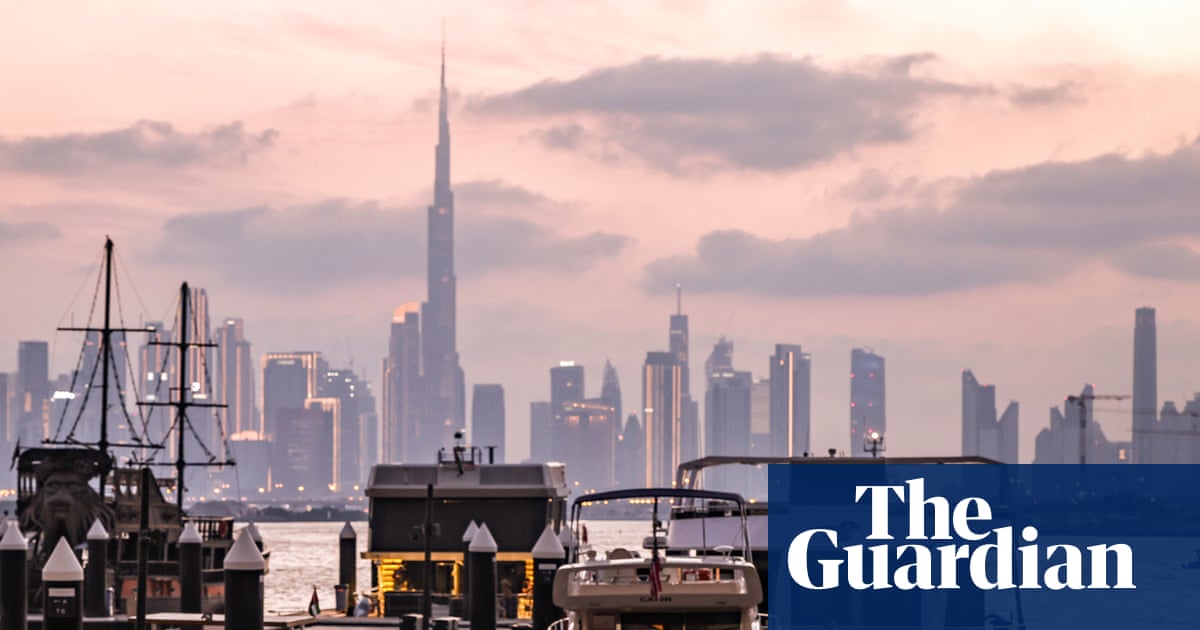
A moment of quiet at Dubai’s Creek Harbour earlier this month. The UAE has been hard hit by Iran and has privately pushed Gulf states for couterattacks. Photograph: Fadel Senna/AFP/Getty ImagesView image in fullscreenA moment of quiet at Dubai’s Creek Harbour earlier this month. The UAE has been hard hit by Iran and has privately pushed Gulf states for couterattacks. Photograph: Fadel Senna/AFP/Getty ImagesAnalysisHow the UAE’s decision to leave Opec could recast the Middle EastPatrick WintourDiplomatic editorDefection is damaging to Saudi Arabia’s prestige – and could strengthen the US hand in the region
The United Arab Emirates’ decision to walk out of Opec is a political as much as business decision, and will reignite the simmering rows between the UAE and Saudi Arabia – which had been covered up by their shared anger with Iran over its attacks on the Gulf states since the start of the US-Israel war on Tehran.
In the short term, leaving the oil producing cartel it joined in 1967 gives the UAE the freedom to respond quickly to a long-term prospect of constrained supplies, and to maximise profit. But it is a decision the UAE has considered before, as UAE and Saudi tensions over production quotas have been longstanding.
But the timing and unilateral nature of the UAE decision shows how other intra-Gulf disputes over how to respond to the Iran war could recast the Middle East.
The defection is, of course, a blow to Saudi Arabia’s prestige, since it positions the UAE as the Gulf state closest to Donald Trump, a long-term critic of Opec, and weakens the Saudis’ ability to manage the price of oil.
The announcement, without any prior consultation, came as the six-member Gulf Cooperation Council (GCC), which includes Saudi and the UAE, was meeting in emergency session in Jeddah, the first time it had done so since the Iran attacks.
Ever since the conflict with Iran started, the UAE, the Gulf state politically closest to Israel and most hostile to Tehran, has been privately pushing Saudi Arabia and Qatar to launch joint counterattacks against Iran. The UAE was the Gulf state most heavily assaulted by Iran, fending off more than 2,200 drones and missiles, in part a function of its geographical proximity.
Despite briefings that Saudi Arabia was urging the US to defeat Iran, no public GCC consensus was formed to take a step that could be seen as highly risky, since it could be interpreted not only as self-defence but as siding with Israel.
View image in fullscreenSmoke billows from the Fujairah industrial zone in March. Photograph: Fadel Senna/AFP/Getty ImagesUnable to build the political solidarity it demanded, the UAE has decided to abandon the economic solidarity of the oil producers’ club and to go it alone. The state-run firm Adnoc says it will be able to boost production from 3.4m barrels a day before the start of the Iran war to 5m barrels by 2027. After the closure of the strait of Hormuz, the country’s production slumped 44% to 1.9m in March, and its capacity to increase production is contested.
Overall, the Iran war wiped out 7.88m barrels a day of Opec’s production in March, resulting in a 27% fall to 20.79m barrels a day that month, the biggest supply collapse for the producers’ group in recent decades
Dr Ebtesam Al-Ketbi, the president of the Dubai-based Emirates Policy Center, cast the decision as an act of self-interest. “In effect, the UAE is redefining its role from a producer within a bloc to a balancing producer that contributes to market stability through its ability to act,” he said. “While this move may gradually weaken Opec’s cohesion, it simultaneously strengthens the UAE’s position as an actor capable of directly influencing global supply dynamics.”
Determined to diversify, the UAE has been much more dependent on US good will than has Saudi Arabia. The decision to quit Opec may indeed cement the country as Trump’s diplomatic favourite, a status that could have investment consequences for the emirates.
The UAE has already been wielding its influence. Earlier this month it recalled $3.5bn deposits from Pakistan, a fifth of Pakistan’s foreign exchange reserves, in an indication of its displeasure with Pakistan’s neutrality over Iran, forcing Saudi Arabia to step in to help Pakistan.
At the same time, in the Horn of Africa, southern Yemen and Sudan the UAE had been pursuing a largely commercially driven foreign policy that puts it directly at odds with Riyadh. Those tensions may resurface, depending on how the Saudis respond.
Warnings about the UAE’s frustration with the Gulf’s collective political response to Iran’s “premeditated attack” have been voiced repeatedly by Dr Anwar Gargash, diplomatic adviser to the UAE president.
On Monday, Gargash said the GCC – the political bloc made up of the UAE, Saudi Arabia, Oman, Qatar, Bahrain and Kuwait – was at its lowest ebb. “Unfortunately, the GCC’s position is the weakest in history, considering the nature of the attack and the threat it poses to everyone.”
Hinting at antagonism to Turkey and possibly Pakistan, he said: “We cannot allow anyone outside the Gulf region to dictate our security priorities. These missiles will not be aimed at them tomorrow; they will be aimed at us. Therefore, there must be a Gulf vision, policy and representation at the national level, and I hope at the collective level as well. National defence is very important but we must also say that Gulf solidarity was not up to the task.”
Ahead of the debate in the Gulf states over the future of the US security guarantee, Gargash has staked his ground, insisting Iran remains the great strategic threat – not Israel – and America is still required in the region.
“Today the American role in the region has become more important, not less, because the American role isn’t just about military facilities or anything like that. The American role is a defence system. The American role is political support. The American role is economic and financial engagement.”