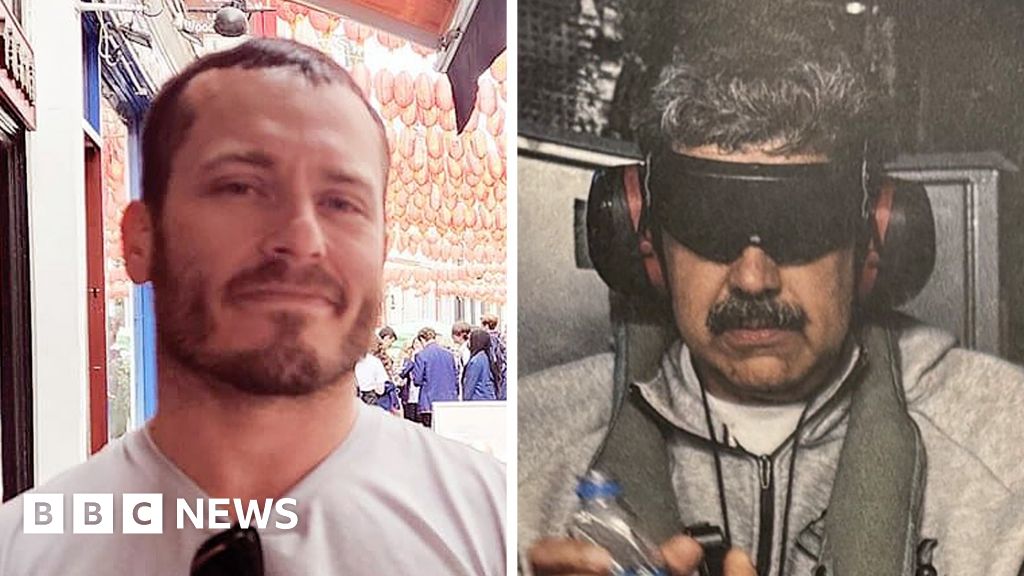
ShareSaveAdd as preferred on GoogleNardine SaadandKayla Epstein,In court in New YorkGannon Ken Van Dyke/Facebook/RealDonaldTrump via ReutersGannon Ken Van Dyke/Facebook/RealDonaldTrump via ReutersThe US special forces soldier who made thousands of dollars betting on the removal of Venezuelan President Nicolás Maduro has pleaded not guilty to charges that he used classified information to profit.
Gannon Ken Van Dyke, 38, was arraigned in New York federal court on Tuesday after being accused last week of betting on Maduro's January capture before the information was publicly available.
The US government contends that he allegedly made trades on Polymarket, a crypto-powered platform, on the basis of classified information, winning more than $400,000 (£296,000).
A federal judge released him on a $250,000 bond and ordered that he surrender his passport and restrict his travel.
His attorneys did not immediately respond to the BBC's requests for comment.
The soldier was arrested and charged last week after the US Department of Justice (DOJ) alleged that Van Dyke used his access to classified information about Operation Absolute Resolve to personally profit.
He has been charged with unlawful use of confidential government information for personal gain, theft of non-public government information, commodities fraud, wire fraud and making an unlawful monetary transaction.
His case marks the first such case filed by the DOJ regarding insider trading charges involving a prediction market.
Van Dyke rose rank of master sergeant at Fort Bragg, North Carolina, where he signed non-disclosure agreements to deal with classified operations, including - prosecutors allege - his role in the seizure of Maduro in early January.
According to federal charging papers, Van Dyke used his knowledge of top-secret operations on Maduro's removal to trade on Polymarket. The removal involved a covert military operation which prosecutors allege that Van Dyke helped plan and execute within the US military.
Between 27 December and 2 January, the US Army officer purchased about $33,934 worth of bets related to Maduro and Venezuela, the indictment unsealed last week says.
He place at least 13 bets, which predicted when US forces would go into Venezuela and when Maduro would be unseated, among others, according to the filing.
In a separate civil lawsuit brought by the Commodity Futures Trading Commission, an independent US federal agency, he is also accused of insider trading.
Van Dyke has been an active duty soldier in the US since 2008 and has been a master sergeant with the US Army Special Forces since 2023, according to the indictment.
The federal court filing did not set out in detail Van Dyke's day-to-day duties or his exact role in the Maduro operation, which included air strikes, a network of on-the-ground spies and a massive military presence that had been built up over months in the region.
Scrutiny of the use of Polymarket, a crypto-powered platform, and other blockchain-powered prediction markets has intensified as concerns mount over US government officials using non-public information to place bets.
Speculation and backlash abounded in early January, when online sleuths got wind of someone making nearly half a million dollars on Maduro's seizure.
Polymarket flagged the suspicious activity and notified the government, the platform's CEO Shayne Coplan has said.
It was unclear initially who placed the bet because the anonymous account had a blockchain identifier of letters and numbers.
However, Van Dyke allegedly used a personal email address to set up his Polymarket account and, according to prosecutors, once news reports highlighted the bet, Van Dyke took steps to conceal his identity and delete the account.
According to the Department of Justice, he allegedly withdrew his winnings - about $409,881 - and transferred the bulk of the funds to a foreign cryptocurrency "vault" that generates interest. It is alleged that he changed his email address on his cryptocurrency exchange account to a new one he had created. Then on 16 January, he allegedly transferred the funds and their accumulated interest - approximately $444,209 - to a newly created brokerage account.