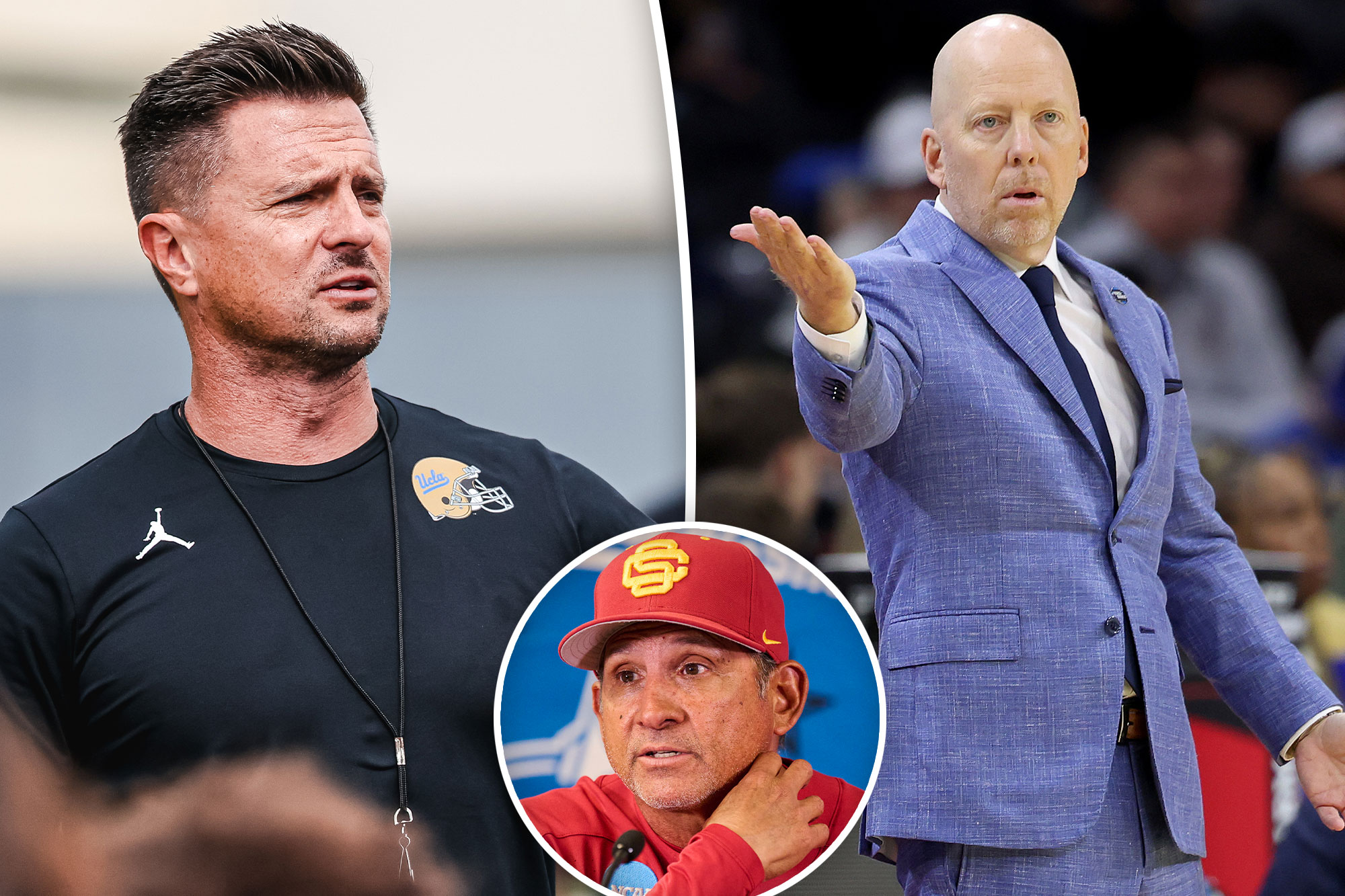
A proposed revolutionary change to college athlete eligibility is being widely hailed by UCLA and USC coaches, so long as they receive one thing.
“I’ve talked to 15 head coaches this week,” UCLA men’s basketball coach Mick Cronin told the California Post. “We are all the same, we just want to know what the rules are so we can do our job.”
Under the so-called 5-in-5 rule under consideration, college athletes would have five years of eligibility from the time of their high school graduation or their 19th birthday, whichever comes first.
That’s a drastic change from current rules that give athletes five years to play four seasons, with additional eligibility granted via waivers and redshirt seasons.
The age-based rule would eliminate redshirts and waivers with just a handful of exceptions such as religious missions, military service or maternity leave.
It would also potentially create mayhem if implemented immediately for athletes who have exhausted their eligibility.
ESPN reported on Monday that NCAA President Charlie Baker said his organization’s Board of Directors would recommend not to grandfather in those athletes whose eligibility has expired, preventing a host of potential problems.
Many college basketball coaches have already set their rosters for next season, signing transfers and allocating money.
What happens if the seniors who just departed are allowed to come back? Where would the money come from to sign them? And would those who didn’t enter the transfer portal before it closed be confined to playing for their previous school?
There’s a similar conundrum facing college football coaches.
Would their seniors who entered the NFL draft be allowed to come back? How would they manage scholarship limits and how would those players whose starting spots might be taken by players unexpectedly returning feel?
“Guys that went into the draft and didn’t make it — can they reclassify and come back down here?” UCLA football coach Bob Chesney asked. “That’s all part of the questions that need to be answered.”
With his roster seemingly set and coaches formulating plans based on who’s already in place, Chesney suggested that the age-based rule might need to be enacted down the road.
“I just think it’s a little complicated if you do it now,” Chesney said. “You know, do you need a little more lead time? How do you go about it? You can’t hold at 105 [players] anymore or even think about that, I guess. There’s too many variables in there for me to fully understand.”
A proposal that would spark the biggest upheaval in eligibility rules since freshmen were allowed full participation in 1972 could be voted on by the NCAA’s Division I Cabinet in May, with implementation starting as soon as the following month.
The movement has obvious benefits for the NCAA, which presumably would like to reduce the number of eligibility lawsuits it has faced in recent years. But refusing to grandfather in players whose eligibility just expired might spark a new round of lawsuits.
Current eligibility rules allow for extra seasons to pile up, creating situations in which 18-year-old freshmen are competing against players 26 and older.
Take Penn State defensive tackle Siale Taupaki. He spent seven seasons at UCLA before becoming a Nittany Lion with remaining eligibility.
In 2019, Taupaki took a redshirt season. The 2020 season did not count toward his eligibility clock because of the COVID-19 pandemic. The 2021 and 2022 seasons did not count because Taupaki received injury waivers. Taupaki played in 2023, 2024 and 2025, giving him one more season of eligibility.
Several local coaches who spoke with the Post said they liked the level playing field created by the proposed rule.
“I think you eliminate a lot of the guys that are playing at 24 or 20-whatever years of age, right?” USC baseball coach Andy Stankiewicz said. “Out of high school, your clock starts and you’ve got five years to play five.”
John Savage, coach of the top-ranked UCLA baseball team, said he didn’t think the rule change would have as big of an impact on college baseball as other sports.
“We don’t really have a lot of high-end players that play five years here; usually, they play three because of the draft, people go up and draft them,” Savage said, referring to Major League Baseball teams. “But, you know, I do like the cap on it, I like the window – I think it’s fair, it does away with all the rigmarole of medical [excuses] or was he really hurt? There’s no more conniving of redshirts.”
Eventually, most individual records would be broken by athletes granted five seasons of eligibility as opposed to four. There would also be increased pressure for first-year athletes to play immediately — rather than redshirt for development purposes — to fully capitalize on their extra season of eligibility.
Imagine all of the roster possibilities — and headaches — should the NCAA or the court system grant additional eligibility to seniors who thought their time in college was coming to an end.
In the case of Cronin’s team, it would — in theory, at least — provide another season of eligibility for recently departed seniors Tyler Bilodeau, Donovan Dent and Skyy Clark. But would those players want to return and would the coaching staff want them back?
Clark entered the transfer portal, signaling his intentions to play elsewhere should he be granted another season of eligibility. Dent’s return might upset Trent Perry, who was expecting to be the team’s primary point guard next season.
The return of Bilodeau — the team’s leading scorer last season — might satisfy all parties, but would the Bruins have enough money to bring him back at market rate?
Clarity on the situation would help, and the sooner the better.