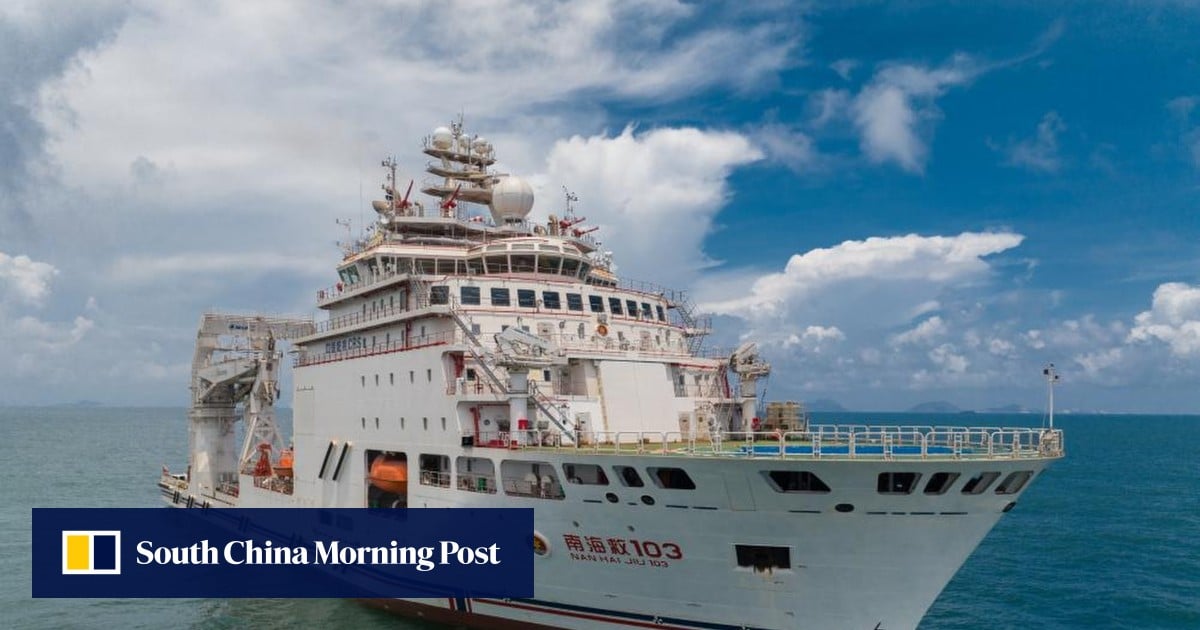
Body responsible for strategically sensitive South China Sea completes ‘formal transition’ after extensive deepwater training
2-MIN READ2-MIN ListenMeredith ChenPublished: 7:00pm, 28 Apr 2026Updated: 7:56pm, 28 Apr 2026China’s maritime rescue authorities have expanded their ability to carry out deep sea search and rescue operations beyond 4,000 metres (13,100 feet), according to state media.
People’s Daily, the Communist Party mouthpiece, credited the development of hi-tech equipment for the shift, which it described as “marking the formal transition of China’s transport rescue and salvage forces” to being able to carry out practical operations at such depths.
It also said some of its equipment such as underwater drones and deep-towed systems – which are typically equipped with sonar or cameras – could operate at depths of up to 6,000 metres.
The South China Sea has an average depth of 1,212 metres and reaches a maximum depth of 5,559 metres, according to official Chinese data.
China has been upgrading its search and rescue operations as it extends its maritime presence into deeper and more distant seas.
“Particularly in deep and remote waters exceeding 100 metres in depth, traditional search methods such as diver-led probes are difficult to carry out efficiently, significantly increasing search and rescue risks,” the rescue bureau told People’s Daily.