Some social media users have claimed the alleged destruction of a climate research center in the United Arab Emirates caused intense precipitation in Iran. But those claims are misleading.
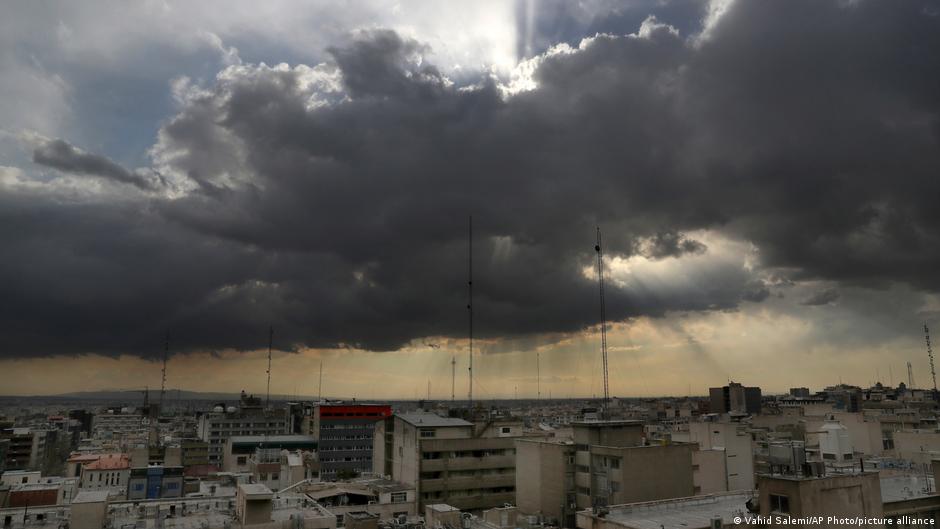
https://p.dw.com/p/5CleGIran experiences periods of intense rainfall despite being one of the world's most drought-prone countries — a pattern scientists attribute in part to climate changeImage: Vahid Salemi/AP Photo/picture allianceAdvertisementBack in 2018, an Iranian general put forth a theory about the country's drought: Israel was stealing Iran's clouds. He later walked back on the comments after Iran's own meteorological organization contradicted him, according to state media reports.
Now, a similar claim has reemerged during the Iran war, and it has gone beyond the musings of a single general.
Social media posts with millions of views referencea "weather war" and point to dams being filled and highways blanketed in snow as proof of climate interference in the region.
The viral conspiracy theory focuses on a technology called cloud seeding and a facility in the United Arab Emirates called the Research Program for Rain Enhancement Science.
So what's the truth? Can a country really make it rain across borders? DW Fact Check consulted physicists and engineers to break down how the technology works.
Claim: "Wow, Iran bombed the 'Cloud-Seeding' radars in the UAE and suddenly the temperature shifted by 5 degrees in Tehran (unheard of) and it now it's raining and snowing," an X user wrotein a post viewed 3.4 million times, along with a video of a mosque covered in snow. Similarclaimsappearedall over social media.
This claim seems to have originated from a since-deleted post from the Iranian embassy in Afghanistan. No archived version of that post exists, but a major Iranian newspaper reportedthe embassy wrote: "After Iran destroyed the UAE's secret climate change center, the region's weather patterns completely changed. Iraq and Iran are now experiencing heavy weekly rainfall and a 5-degree drop in temperature."
There are several issues with this claim — there's no evidence this research center was attacked in the first place, and scientists told DW this is a complete misrepresentation of how cloud seeding technology works.
First, a weather report: A forecast from the World Meteorological Organization said to expect, "moderate / locally heavy rain and thunderstorms (flash floods / landslides possible) in NW & W Islamic Republic of Iran on 18-21 Apr."
Videos of overflowing dams and elevated rivers are consistent with that forecast.
As for the snow, that would genuinely be strange in Tehran in April. However, the video in question doesn't show Tehran, but the Imam Reza shrine in Mashhad, Iran. That town sits at an elevation of nearly 1,000 meters (about 3,280 feet) in between two mountain ranges. Snow in April is not uncommon there, according to the Weather Atlas' historical data.
It's also not uncommon for drought-stricken Iran to receive periods of intense precipitation — and climate change is exacerbating the severity of these droughts and extreme rainfall events. In December 2025, Iran experienced severe flash floods and river overflow, according to the United Nations Office for the Coordination of Humanitarian Affairs.
The UAE does have a center called the Research Program for Rain Enhancement Science (UAEREP). But it's not a "secret climate change center," as allegedly claimed in the Iran embassy's deleted post.
According to its website, UAEREP has been around since 1990 and "is at the forefront of advancing rainfall enhancement research and driving innovations that strengthen global water security."
They both fund research from around the world and pilot their own cloud seeding operations.
"I'm very familiar with it," said Armin Sorooshian, a University of Arizona researcher who studies the effects of aerosol particles on clouds. "For people who study atmospheric physics, aerosol cloud interactions, this is an opportunity that has existed for many years for funding, where people write proposals to this program."
A Google News search showed no results about the center being targeted in an Iranian strike; nor did any wire service, which consistently cover attacks on civilian infrastructure in the region.
UAEREP did not return DW calls or emails for official comment by the time of publication. But its official X feed has been posting updates well after it was allegedly destroyed, celebrating Earth Day and toutingits participation in a global conference.
The technology dates back to the mid-20th century and is called cloud seeding. Scientists discovered a technique to encourage rain from clouds that might already be on the verge of precipitation.
They do this by releasing agents like silver iodide or sodium chloride into clouds using planes, or ground-based launchers.
Manmade rain in the desertTo view this video please enable JavaScript, and consider upgrading to a web browser that supports HTML5 video
"The key thing here is it doesn't make rain out of nothing," Edward Gryspeerdt, a professor in atmospheric physics at Imperial College London, told DW. "You can't have a clear sky, suddenly seed it, and get clouds and rain appearing. You need these clouds to exist already on the edge of raining, and you're just kind of tipping them over the edge."
Because the clouds already have to be prone to precipitation, it can be hard to measure how effective the technique is. It's typically deployed in small-scale environments, like increasing snowpack over a ski slope, Gryspeerdt said. In the UAE, the goal is combating water stress.
To date, the cloud seeding technologies cannot affect weather patterns across an entire region.
"Even if they worked, they would still be at a very small scale," Gryspeerdt said. "They're not at the scale where they can change atmospheric flow patterns, for example, and shift rain far across the planet."
The current scientific literature suggests cloud seeding can increase precipitation by 5-20% on a micro scale.
"Maybe that precipitation can last longer and fall somewhere else, but the scale of what we're talking about — of weather patterns and increased precipitation in Iran — is so much larger than what can be accomplished with a seeding facility," said researcher Armin Sorooshian.
"It just doesn't make sense," he added, calling it a "very large scale mismatch."
Emad Hassan, Alima de Graaf and Ardit Toca contributed to this report.