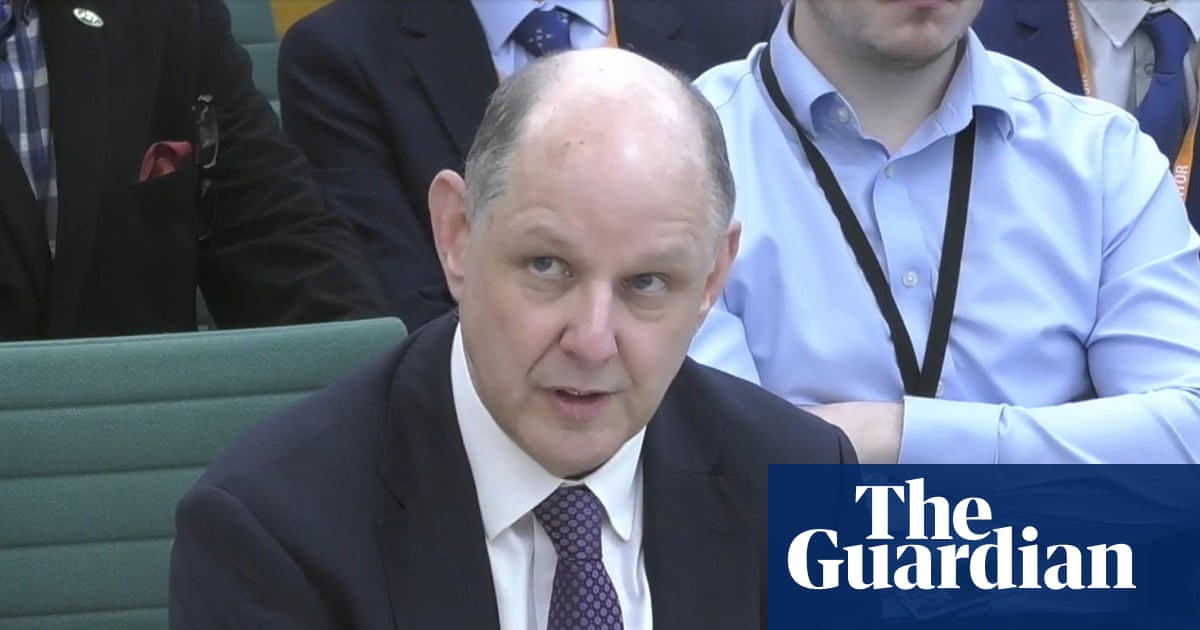
Sir Philip Barton appearing before the foreign affairs select committee. Photograph: House of Commons/UK Parliament/PAView image in fullscreenSir Philip Barton appearing before the foreign affairs select committee. Photograph: House of Commons/UK Parliament/PAEx-FCDO chief tells MPs he had concerns over Mandelson’s Epstein linksPhilip Barton says there was pressure over pace of vetting from No 10, which he says was ‘uninterested’ in process
The former Foreign Office chief has said he was concerned about Peter Mandelson’s links to Jeffery Epstein – and said there was “absolutely” pressure from Downing Street over the pace of vetting.
Giving evidence to the foreign affairs select committee, the former Foreign Office permanent secretary Sir Philip Barton said Number 10 seemed “uninterested” in the vetting process around Mandelson’s appointment as US ambassador, and said there were no avenues for him to express his concerns.
Asked if he was under pressure to get the vetting done quickly, Barton said: “Absolutely … I don’t think anyone could have been any doubt in the department working on this, that there was pressure to get everything done as quickly as possible.”
But Barton denied that he had received any phone call from Keir Starmer’s former chief of staff Morgan McSweeney – long rumoured – which had asked him to “just fucking approve it”.
Barton, who left the Foreign Office in January, said he was unaware of Number 10’s intention to appoint Mandelson until a day before the announcement. “I wasn’t involved, I wasn’t told a decision was coming,” he told the committee. McSweeney is expected to give evidence later on Tuesday morning.
Read moreBarton told the committee he believed his concerns about Epstein were shared by the national security adviser, Jonathan Powell.
But he said the “die was cast” and that there was no possibility of advising against the appointment. He told the committee that it was unusual to announce the appointment before vetting had been completed. “The normal order is vetting then announcement,” he said.
Barton said he had been in discussions with the former ambassador Karen Pierce about extending her appointment in the US, but he was presented with the Mandelson appointment “and told to get on with it … There was no space for dialogue.”
Barton said he was well aware of the “toxic” nature of the Epstein connection from his time in the US and his understanding of American politics. “I didn’t know anything that wasn’t in the public domain. Now we know a lot more about Mandelson’s links to Epstein.
“But I had a concern that a man who, demonstrably from the public record at the time … had a link to Epstein. [I knew] that Epstein, through the presidential election campaign in the US and more generally in US politics, had been and was a controversial figure, and I was worried that this could become a problem in future.”
He said there was “no space or avenue or mechanism for me to put that on the table” even though he said he was aware of tweets from those close to Trump reminding the incoming president about Mandelson’s negative comments about Trump.
Powell’s own concerns were outlined in documents released in the humble address files – where he said he had discussed them with Barton. The former Foreign Office chief said that those were concerns about the Epstein links.
“Obviously I didn’t know what was actually going to happen, [but] because Epstein was such a toxic hot potato subject in US policy itself, including in the election campaign. That is what I recall thinking at the time. I can’t prove what Jonathan was thinking when he said it last September, but my instinct is that’s what it refers to.”
Asked if he would have been expected to be consulted on the appointment, Barton said it would be “reasonable for the head of the Foreign Office to be involved in thinking around what is our major top bilateral ambassador post”. But he said he accepted it had been a “political matter”.
“I was told a due diligence process was being carried out, and as I think this is known now as the prime minister had been made aware of the risks and had accepted those risks and decided to proceed,” he said.
Barton also confirmed evidence given by his successor at the Foreign Office, Olly Robbins, that the Cabinet Office believed Mandelson was a “fit and proper person” who did not require vetting because he was a member of the House of Lords. He said he believed it was “odd and insufficient”.
“I’d been deputy ambassador in Washington and therefore occasionally chargé [d’affaires, a diplomat who acts as the head of a diplomatic mission in the absence of an ambassador] and I knew very well to do the job effectively, you have to be party to some of the deepest secrets that the UK, government holds. But I also recognise that the situation was unusual,” he said.
Asked if Number 10 was “dismissive” of the vetting, Barton said: “The word I would use is uninterested. I think people wanted to know that all the practical steps required for Mandelson to arrive in Washington on or around the inauguration date. It needed to be completed at pace.”
But he said McSweeney did not call to insist he approve the appointment. “It’s been floating around the media since last September. There’s different versions, sometimes involving swear words, sometimes not. And I’ve really racked my brains and I cannot recall Morgan McSweeney swearing in a meeting at me or indeed in general.”