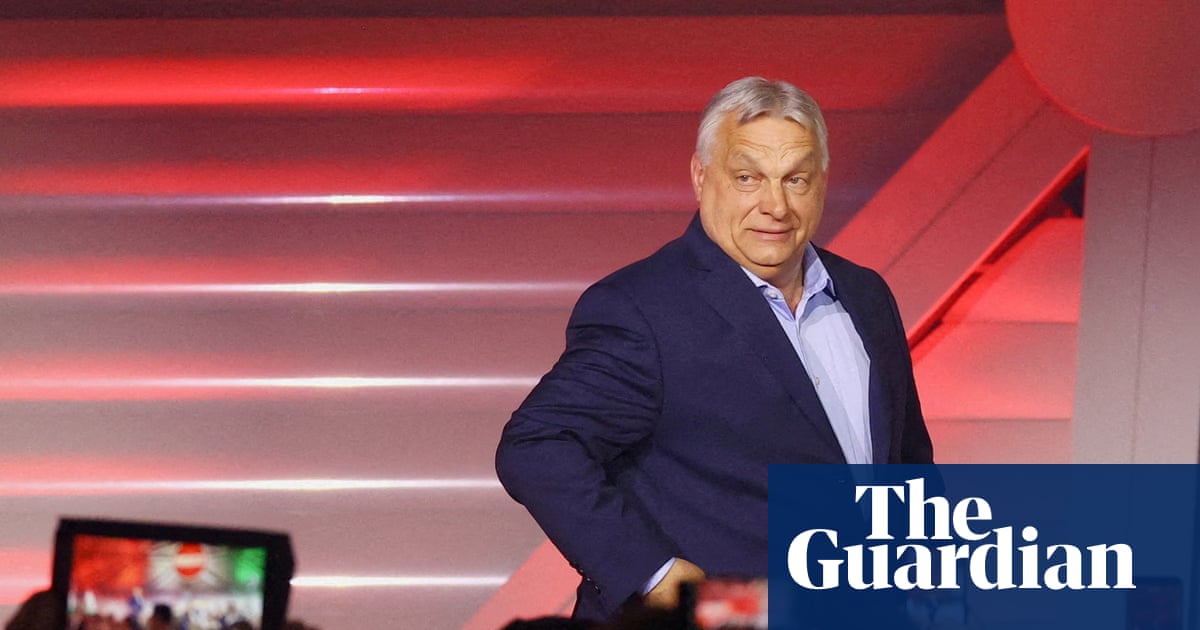
Viktor Orbán with supporters at Hungary’s election this year. The report cites Hungary as a key example of concentrated ownership that can capture political media. Photograph: Bernadett Szabó/ReutersView image in fullscreenViktor Orbán with supporters at Hungary’s election this year. The report cites Hungary as a key example of concentrated ownership that can capture political media. Photograph: Bernadett Szabó/ReutersMedia freedom ‘under sustained attack’ across EU as public trust drops, report findsJournalists face rising threats while media ownership is concentrated in fewer hands, leading civil liberties group warns
Journalists in the EU face increasing levels of harassment, threats and violence, while news outlets are owned by a shrinking number of proprietors and public trust in the media has plummeted, a report has found.
The Civil Liberties Union for Europe (Liberties) said the findings of its fifth annual media freedom report, released on Tuesday, should place EU officials “on high alert”, with media freedom and pluralism “under sustained attack” across mainland Europe.
Europe’s leading civil liberties group also warned public media independence was being steadily eroded by political interference and budget cuts, and journalists were being increasingly hampered by restrictions on free expression and access to information.
“A healthy, pluralistic media system is a litmus test and mirror of democracy,” said Eva Simon, Liberties’ senior advocacy officer. “Where the rule of law weakens – through deliberate government action or neglect – media freedom is undermined.”
Journalist safety in particular reached what the report called “a crisis point” in Europe in 2025, with reporters and media workers facing “extreme physical violence and systemic legal harassment”, including bomb attacks targeting investigative reporters.
In Athens, a device containing fivekg of TNT was thrown at the Athens home of Yannis Pretenteris, the editor of the weekly newspaper To Vima. In Italy, a device exploded under the car of Sigfrido Ranucci, a leading investigative journalist.
In total, 118 attacks against journalists were recorded in Italy last year, 15 of them involving physical violence. Twenty Italian journalists – mainly investigating organised crime – live under police protection, the highest number in Europe.
Read moreThe Netherlands recorded an increase in attacks on journalists for the third year in a row last year, with 106 threats, 67 incidents of intimidation and 55 cases of physical violence.
Online harassment also grew. A record 377 serious online attacks, including death threats, targeted journalists in 2025, while in Malta, Hungary and Romania, politicians launched smear campaigns labelling news outlets “forces of darkness” or “foreign propaganda machines”, the report found.
State surveillance of journalists, such as Francesco Cancellato and Ciro Pellegrino of the investigative outlet Fanpage in Italy and Victor Ilie and Luiza Vasiliu in Romania, was an issue in several countries, while abusive lawsuits remained a growing threat, it said.
Slapps, or strategic lawsuits against public participation, are still being widely used to silence journalists and media outlets despite the existence of an EU anti-Slapp directive that has yet to be effectively implemented in several member states.
Liberties also expressed alarm at the continuing concentration of media ownership, and lack of ownership transparency, across the EU last year.
It highlighted Hungary, where a foundation backing outgoing prime minister Viktor Orbán controls a majority of media outlets, and France, where a few billionaires, including the conservative Vincent Bolloré, own much of the country’s media.
But concentration was also a growing concern in countries such as the Netherlands, Greece, Germany, Spain and particularly Slovakia, it said, where the Penta group’s acquisition of Nový Čas means it now controls both the country’s biggest tabloids.
Public TV and radio had suffered “severe systemic political interference, budget cuts, and structural changes that jeopardised their core mission” across the bloc in 2025, the report said, with full “state capture” evident in some EU member countries.
Pro-government airtime hit a record 73% in Hungary last year in the run-up to the 12 April elections this year, which Orbán lost to challenger Péter Magyar. In Slovakia, too, Slovak Television and Radio (STVR) was “at this point … subject to direct political control”, the report said.
Financial instability was an increasing threat to public media, it added, with proposals in France to merge all public outlets, Germany closing 16 radio stations and two TV news channels, and Belgium’s public broadcaster facing major budget cuts.
The report also highlighted declining public trust in Europe’s media, with only three of 22 EU countries surveyed, including Germany and Ireland, reporting “relatively high” trust levels and some, notably Greece, Romania and Bulgaria, “critically low”.
The report said many EU member states were failing to adequately implement relevant EU legislation, including the anti-Slapp directive and the European Media Freedom Act.
EMFA aims to address major threats including journalist protection, media ownership transparency and the threatened independence of public service media and regulatory bodies, but is being translated into national law far too slowly, it said.
“EMFA really needs to be transposed, and more importantly enforced, as quickly and as strongly as possible across all member states,” Simon said.