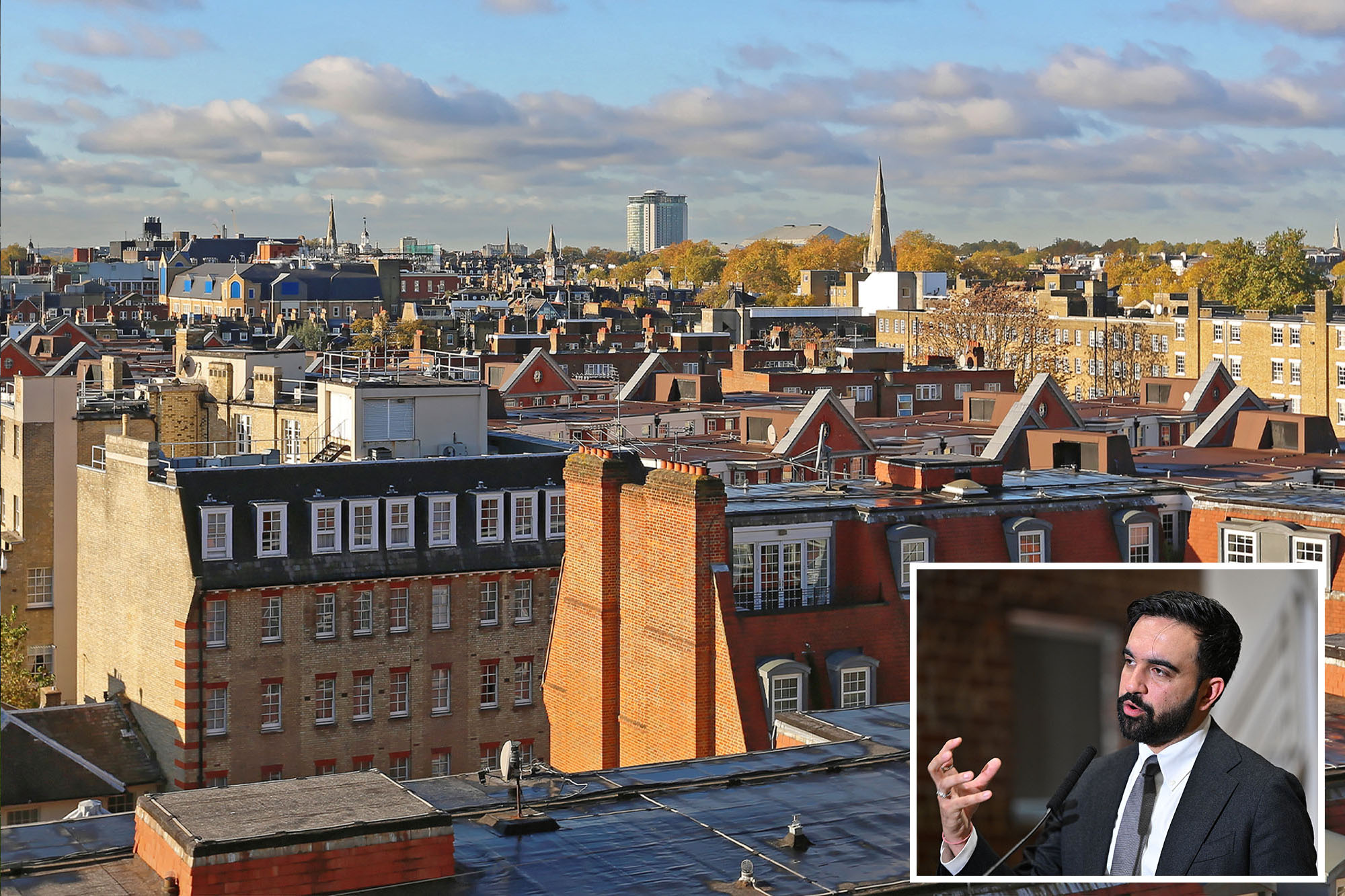
London’s battered luxury housing market is emerging as a cautionary tale for New York, as far-left Mayor Zohran Mamdani pushes a pied-à-terre tax that critics warn could trigger a similar exodus of wealthy homeowners.
A wave of taxes on second homes in the British capital has already cooled what was once a red-hot market, with property values dropping more than 20% since 2015 as wealthy buyers pulled back and landlords exited, shrinking supply and pushing rents to record highs.
The exodus has been especially pronounced among international buyers, who once made up nearly half of homeowners in prime London neighborhoods but are now looking to lower-tax markets like Dubai and Barcelona, with new buyer registrations falling to their lowest levels since 2008.
The impact is already being felt on the ground, according to London-based property journalist Charlotte Duck.
“Oh my god — yeah, a hundred percent,” she told The Post when asked whether the taxes have driven buyers out.
“You really regularly see people that bought in, say, 2017, 2018, now having to sell for a loss,” she added.
The numbers show just how sharply the high-end market has tanked.
Sales transactions across prime London — the city’s most expensive neighborhoods, including elite enclaves such as Kensington, Chelsea and Mayfair — plunged 31.2% in February compared to a year earlier, while average prices fell 10%, the steepest decline since the global financial crisis, according to property analysts LonRes.
Transactions for homes priced above $6.8 million collapsed nearly 55% year-over-year, while the number of properties on the market rose nearly 10%, forcing sellers to cut prices — with more than half of homes selling only after reductions and at average discounts of more than 13%.
Duck said the pressure is coming from multiple fronts.
“There’s like three different ways” second-home owners are taxed, she said.
Those include higher purchase taxes, doubled local levies and stricter rules that have made it less profitable for landlords to hold onto properties.
That pressure has also squeezed the rental market.
“There’s less supply, because a lot of landlords have sold up,” she said.
Rents have remained elevated despite recent fluctuations.
While average rental values dipped slightly over the past year, they are still more than 30% higher than pre-pandemic levels, even as letting activity surged and more properties returned to the market, according to LonRes.
New York City could experience a similar fate if the pied-à-terre levy championed by Mamdani and Gov. Kathy Hochul is implemented.
Critics warn the proposal rests on shaky fiscal ground, with wildly divergent estimates of how much money it would actually generate.
While New York City’s Independent Budget Office and the city comptroller have projected closer to $200 million to $300 million annually under similar frameworks, the governor’s office has floated a far more ambitious $500 million target — a gap driven largely by differing assumptions about how wealthy property owners would respond.
Business groups also warn the city may be overestimating how much revenue would remain after those effects play out.
The Partnership for New York City has cautioned that declining valuations and fewer high-end transactions could offset much — or even all — of the projected gains.
“Pied-à-terre properties already generate substantial property and transfer tax revenue while consuming comparatively little in city services,” the group said in a statement last week.
“A surcharge that discourages high-end nonresident purchases or causes those buyers to bid lower could erode property assessments and transfer tax receipts citywide, potentially offsetting much or all of the projected $500 million gain.”
Opponents argue those behavioral changes are exactly the problem.
Industry groups including the Real Estate Board of New York say the tax would ultimately shrink the luxury housing market, as buyers either pull back, shift purchases below the $5 million threshold or move their money elsewhere — a dynamic that could depress property values and ripple across the broader economy.
“If someone has the choice to live anywhere in the world, then they might choose somewhere with a favorable tax environment,” Duck told The Post.
The Post has sought comment from Mamdani and Hochul.