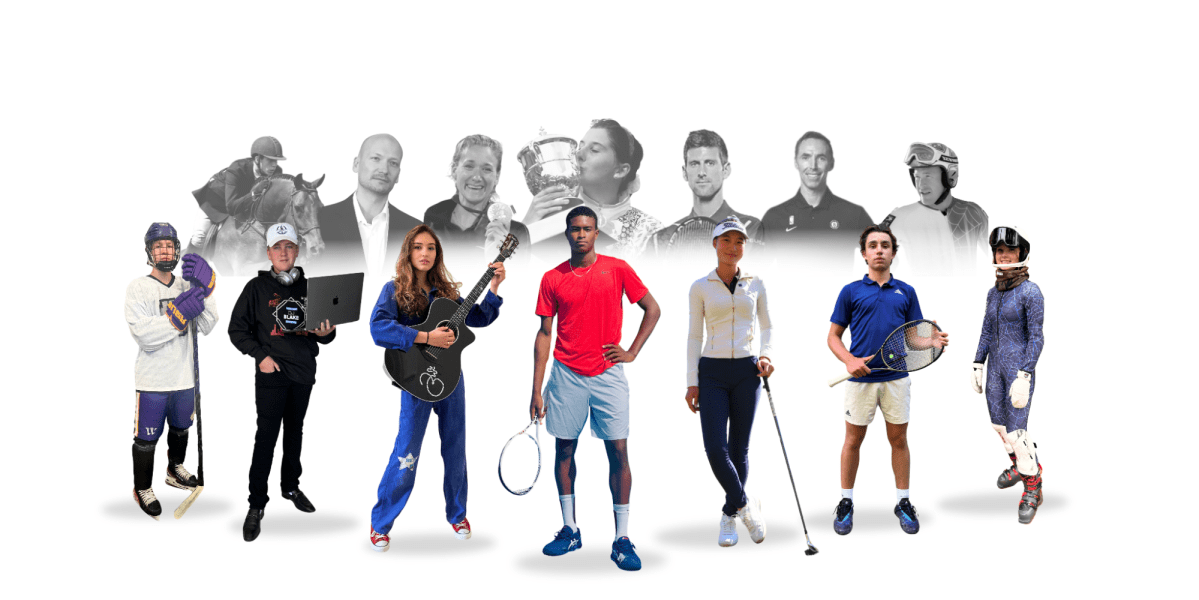
ICL Academy ICL Academy reflects a broader global shift in how young talent is developed, contributing to evolving approaches in digital and hybrid K–12 education. Positioned at the intersection of academia, athletics, and the rapidly expanding creator economy, ICL has evolved far beyond a traditional accredited school into a dynamic, fast-scaling platform serving high-performing athletes and performers across the world. What began as a practical solution to scheduling conflicts has evolved into a more integrated model, where academics, mentorship, content creation, and monetization opportunities are designed to complement one another.
Iva Jovic is proof of what that ecosystem can produce. A 12th grader at ICL and a rising force on the WTA Tour, Jovic’s story captures the academy’s evolution in vivid terms. The rigid architecture of traditional schooling couldn’t keep pace with the demands of her athletic ascent, so she sought a model built from the ground up for high-performance individuals. At ICL, academics don’t compete with ambition—they’re engineered around it. Immersed in a global community of driven, like-minded peers, Jovic found exactly what she needed: the flexibility to compete at the highest level and the environment to grow alongside others who refuse to settle. Today, ranked #16 in the world, she reflects a shifting model of the student-athlete—one in which athletic performance and academics can develop alongside each other.
Kirk Spahn, a fourth-generation educator with over two decades in digital education, recognized the real crisis: “We’ve built a system that treats talent as a scheduling problem instead of recognizing it as a young person’s most important asset.”
Spahn, who previously co-founded Dwight Global, understood that online schools had solved delivery, but hadn’t solved relevance. So in 2019 he evolved ICL Academy into a fully online, WASC-accredited institution serving grades 5 through 12, built from the ground up for ambitious students.
As further acknowledgment, ICL Academy students are admitted to an impressive range of colleges and universities, with students being admitted to Stanford, Harvard, Yale, Princeton, Brown, Northwestern, and Vanderbilt, among others. Niche.com ranks it among the best Private Online High Schools in America with an A+ rating. For families across six continents, the real measure is much simpler: Does the ICL Academy approach actually work? Early indicators suggest it may be effective.
What distinguishes ICL Academy fundamentally is its Champion Mentor Program, which centers on knowledge-sharing from individuals who have reached the highest levels in their respective fields. The program brings together accomplished figures from sports, business, and the arts, among others, who contribute to shaping the curriculum.
Rather than relying solely on traditional instruction, students engage with curated insights drawn from real-world experience. Lessons on topics like resilience, competitive pressure, and reinvention are framed through the perspectives of high-performing professionals, offering a more applied and experiential approach to learning. Through the Impact Learning Model, these insights become searchable curriculum addressing real challenges students face such as: How do you maintain perspective during defeat? How do you manage the identity conflict between professional achievement and being a teenager? How do you decide when the stakes are real?
“When a student learns resilience from someone who has lived it at the highest levels,” Spahn explains, “something fundamental shifts.”
Behind ICL Academy’s academic architecture is Avery McGlenn, Head of School. With nearly two decades spanning independent boarding schools, charter networks, and virtual education, McGlenn observed something critical: every institutional model fails the same way, because they treat students as interchangeable.
“I kept seeing brilliant young people forced into the same timeline, same assessment structure, same everything,” McGlenn recalls. “There is a better way.”
At ICL Academy, each student’s background, gifts, and identity matter more than institutional convenience. This means flexible assessment scheduling, courses designed for specific populations — including dedicated Sport Psychology and Sports Management offerings — faculty trained as coaches, and counselor-to-student ratios that allow genuine relationships. Scholarships are available for both merit and need, ensuring that motivated students from diverse backgrounds can access the program.
ICL Academy’s teachers don’t manage classrooms; they coach individuals. They’re subject-matter experts providing 1:1 support, helping to ensure that every student feels genuinely known. This isn’t accommodation. It’s design.
What seems impossible — flawless personalization across dozens of time zones, wildly different needs, genuinely individual attention — works because ICL’s COO Dayton Hansen engineered it to work.
Hansen’s operational infrastructure is meant to help reduce the challenges around complex systems. One student takes an exam in the late afternoon because of a morning competition. Another submits work while traveling internationally. A third calibrates her entire course sequence around external performance opportunities.
“When operational systems work,” Hansen explains, “they disappear. You see your daughter thriving athletically and academically, you don’t see the infrastructure. Seamlessness equals success.”
While ICL built its reputation around student-athletes, a parallel revolution emerged: young artists face the identical impossible choice. A budding recording artist can’t go on tour without consequences. A filmmaker with professional opportunities loses them to school calendars.
Joseph Itaya, Head of Creative and Marketing, started ICL Creative Arts, a community of young creatives reimagining how creative development integrates with rigorous academics. ICL’s origins began here: the school was first accredited in 2015 as a hybrid institution in Los Angeles focused specifically on performing arts students.
As the digital landscape continues to evolve at a rapid pace, Itaya developed the Digital Creator Playbook for Digital Creators —a course designed to equip the next generation of creators with both the creative and business tools needed to succeed. “We want to equip our students not just as content creators, but as digital entrepreneurs,” Itaya explains.
Building on this vision, a comprehensive suite of Creator-focused courses will begin rolling out in Fall 2026, covering key areas such as personal branding, Name Image Likeness (NIL), video production, and digital entrepreneurship. Together, these initiatives aim to bridge the gap between creativity and commerce, preparing students to thrive in an increasingly competitive and opportunity-rich digital ecosystem.
For university admissions, ICL Academy has reframed the entire conversation. Rather than treating passion as competing with academics, the school positions it as a primary advantage through Impact Projects, substantive work completed in real-world contexts.
A student-athlete conducts sports science research while training. An entrepreneur develops business strategy while building her company. A performing artist studies the business and psychology of creative work while actively performing. By application time, these students compete with demonstrated mastery, professional credibility, and real-world context, not just academic metrics. ICL’s deep understanding of what elite universities actually recruit for, beyond test scores, has become a decisive advantage for families who refuse to compromise in either direction.
The persistent criticism is inevitable: won’t students be isolated? ICL Academy builds intentional community around shared ambition. Through passion pod collaborations, student-led clubs, live virtual events, and summer abroad programs, students from 50 countries engage authentically — not as random online classmates, but as peers who understand what serious excellence actually demands. Students report more meaningful relationships, not fewer. And something more valuable: more time for their craft, their academics, and their families.