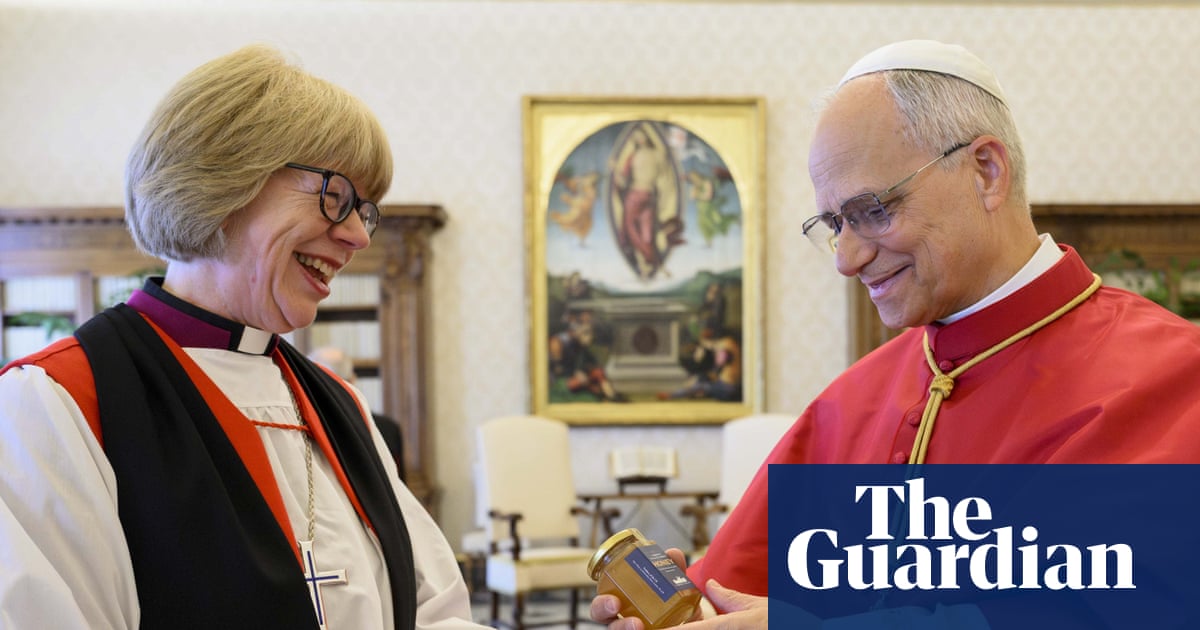
Sarah Mullally, the archbishop of Canterbury, with Pope Leo at the Vatican on Monday. Photograph: Vatican Media/Catholic Press Photo/ipa-agency.net/ShutterstockView image in fullscreenSarah Mullally, the archbishop of Canterbury, with Pope Leo at the Vatican on Monday. Photograph: Vatican Media/Catholic Press Photo/ipa-agency.net/ShutterstockArchbishop of Canterbury praises Pope Leo for speaking powerfully on injusticeSarah Mullally hails pontiff for addressing the ‘many injustices in our world’ after private meeting at Vatican
The archbishop of Canterbury has praised Pope Leo for speaking “powerfully about the many injustices” in the world, in an apparent reference to the pontiff becoming more outspoken in recent weeks, particularly in his criticism of the US-Israeli war on Iran.
Sarah Mullally, who in March became the first woman to lead the Anglican church, arrived in Rome on Saturday for a visit aimed at reinforcing relations with the Vatican. Mullally had a private meeting on Monday with Leo, the first US-born leader of the Catholic church, at the Apostolic Palace, the pope’s official residence.
This month Donald Trump took aim at Leo over his criticisms of the war in Iran. In a lengthy diatribe on social media, the US president accused Leo of being “weak on crime and terrible on foreign policy” and said he should “focus on being a great pope, not a politician”.
Read moreLeo on Friday returned from a 10-day tour of Africa, during which he continued to speak out against war and injustices.
Mullally said: “Your Holiness, you have spoken powerfully about the many injustices in our world today, but you have spoken even more powerfully about hope. Your pilgrimage to Africa was full of life and joy. The world needed this message at this time – thank you.”
She added the trip “reminded us that despite our sufferings, people long for life in all its fullness and countless people are working each day for this vision of the common good”. She said that while there was “inhuman violence, deep division and rapid societal change” in the world, “we must keep telling a more hopeful story”.
View image in fullscreenLeo arrives in Bata, Equatorial Guinea, during his 10-day trip to Africa this month. Photograph: Alberto Pizzoli/AFP/Getty ImagesThis month Mullally said she stood alongside Leo in his “courageous call for a kingdom of peace”.
The pair lead Christian denominations that split acrimoniously in 1534 and which only began to reconcile in earnest in the 1960s. In October, King Charles made history by becoming the first reigning British monarch to pray publicly with a pope since Henry VIII severed ties with Catholicism owing to the Vatican’s refusal to annul his marriage to Catherine of Aragon. King Charles and Leo prayed together in the Sistine Chapel during the monarch’s state visit, an event that symbolised further reconciliation between the two churches.
Still, despite being aligned on various Christian teachings, significant differences remain, the main one being that the Church of England ordains women while the Catholic church reserves the priesthood for men.
Mullally said before being ordained she was a nurse, an experience “that continues to shape my ministry”, adding that she hoped to be “a shepherd … who encourages hospitality despite our differences”.
While the late Pope Francis made strides in boosting the female workforce in the Vatican during his 12-year papacy, including appointing several women within the top echelons of its governance and giving them voting rights in synods, he said women should never become priests.
Although Leo vowed on Monday to continue working towards overcoming the differences between the two churches, saying that “the divisions among Christians weakens our capacity to be effective bearers of peace”, he has not signalled any move towards changing Catholic doctrine to enable women to be ordained.
Marco Politi, a Vatican journalist and author, said: “The cordial nature of the meeting and Mullally’s support for Leo’s position on the US-Israeli war on Iran cannot hide a historical fact. That is that the Catholic church is now the only Christian community in the west that denies women access to its highest office.”