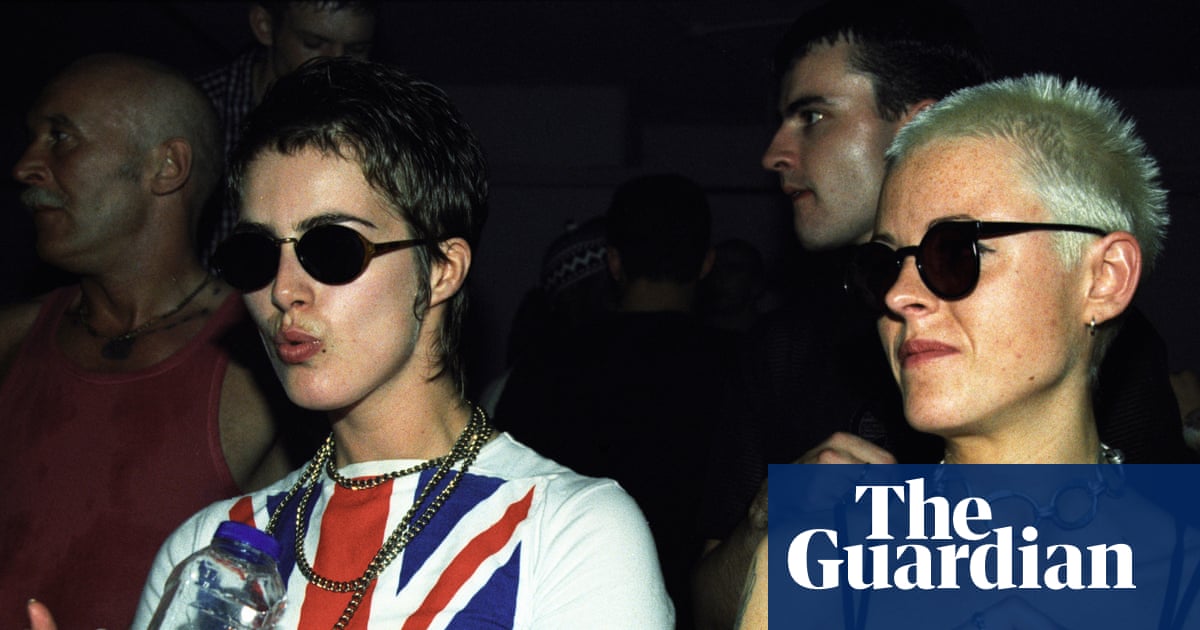
Jon Shard's Flesh at The Haçienda, 1996. Photograph: Jon Shard/British Culture Archive/PAView image in fullscreenJon Shard's Flesh at The Haçienda, 1996. Photograph: Jon Shard/British Culture Archive/PABack to the 90s: Tate exhibition will explore decade’s art and fashionThe show, curated by Edward Enninful, will highlight the era’s ‘do it yourself’ attitude and work outside the dominant Cool Britannia narrative
Steve McQueen’s first major film, a tribute by Chris Ofili to Doreen and Stephen Lawrence, and images of young people at club nights including the Haçienda will be exhibited at Tate Britain as part of its 90s exhibition.
The show will explore art and fashion during a decade that reshaped Britain’s cultural identity and “established conditions that are still with us”, said Edward Enninful, the former editor of British Vogue who is curating the exhibition.
Set to launch this autumn, The 90s: Art and Fashion will feature work from nearly 70 artists, photographers and designers, from the Young British Artists to Alexander McQueen and Damien Hirst.
It will spotlight young artistic talent that emerged during the period and give audiences the opportunity to reconsider the time as a turning point in British art. The exhibition will include artists whose work drew attention to those largely excluded from the dominant Cool Britannia narrative of the time.
View image in fullscreenYoung Pink Kate, London (1998). Photograph: Juergen Teller/PAAmong the work featured is Steve McQueen’s first major film, Bear (1993), a cinematic portrayal of an intimate face-off between two men; Ofili’s Turner prize-winning painting No Woman, No Cry (1998), which he made in tribute to the Lawrences; and video by Keith Piper reflecting on sport and national identity.
Tate said the exhibition would open with an exploration of the period’s “do it yourself” attitude, with photography by Corinne Day, Nigel Shafran and Juergen Teller – who were at the forefront of defining the “anti-fashion” grunge style – for publications including i-D and Dazed & Confused.
Barbara Walker, Jenny Saville and Gillian Wearing, who used real people as muses, will also feature, as well as Tracey Emin, Sam Taylor‑Johnson and Sarah Lucas, who captivated the public with their anarchic spirit and frank work tackling agency, identity and class.
The decade’s youthful attitude will be captured in film and photography, from Mark Leckey’s 1999 film Fiorucci Made Me Hardcore to images documenting young people at club nights including the Haçienda in Manchester and Bagley’s in London.
The exhibition will also explore its conceptual movements, including Hamad Butt’s response to the impact of the Aids crisis and Hirst’s formaldehyde-filled sculptures.
View image in fullscreenAn Alexander McQueen fashion show in 1998. Photograph: Guy Marineau/Vogue/Conde Nast/PAThere is work from visionary designers who blurred the lines between art and fashion, from Alexander McQueen’s provocative presentations to Hussein Chalayan’s clothing inspired by everyday objects.
The exhibition will end with artists and designers who reckoned with Britain’s past and future, such as Yinka Shonibare and Maud Sulter, who asked questions of diversity and representation, and Vivienne Westwood and John Galliano, who interrogated style, class and national mythology.
Enninful said the year of 1990 was a “moment of transition”, adding: “London at the time wasn’t the polished global capital it is today – it was raw, unstable and full of possibility. There was a sense that something was shifting, even if we didn’t have the language for it.
View image in fullscreenEdward Enninful, who is curating the exhibition. Photograph: David Levene/The Guardian“What defined that period for me was not a single movement, but an energy – a refusal of hierarchy and a belief that new voices could and should be heard across art, fashion, music and image making.”
He said as a young black man from Ladbroke Grove in London, the moment was also about access and “finding a place within spaces that hadn’t been built with you in mind”.
“The 1990s established conditions that are still with us,” Enninful said. “The merging of high and low culture, the politicisation of fashion and image and the emergence of diversity as a creative force.
“And perhaps, most importantly, it reminds us the questions we were asking then remain urgent now – questions of visibility, access and who gets to be seen.”
The exhibition, Enninful added, was “an invitation, not to look back, but to look again, to reconsider that decade, not as a closed chapter, but as something still unfolding”.