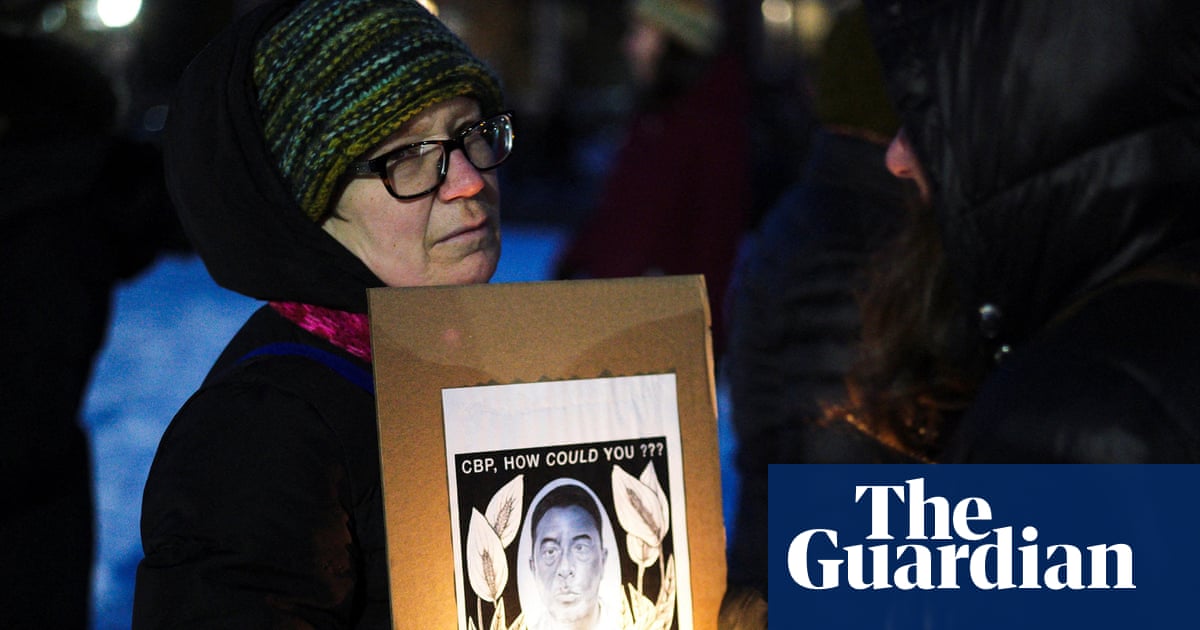
Activists gather in the Elmwood Village neighborhood following the death of Nurul Amin Shah Alam. Photograph: Craig Ruttle/ReutersView image in fullscreenActivists gather in the Elmwood Village neighborhood following the death of Nurul Amin Shah Alam. Photograph: Craig Ruttle/ReutersUS immigration agents left a refugee to die in the cold. His community is demanding justiceBuffalo’s Rohingya community pushes for NY state law to protect immigrants after Nurul Amin Shah Alam’s death
Since Nurul Amin Shah Alam’s death in February, the fear across Buffalo’s East Side has been palpable.
Alam, a 56-year-old Rohingya refugee from Myanmar, who spoke no English and had mental health issues, was dropped by federal immigration officers outside a closed coffee shop in the middle of a brutal winter. He had spent months in custody following a confusing encounter with local law enforcement, then was released – alone, in the cold – far from the Rohingya community hub where he might have found help. Days later, he died.
Two months later, Rohingya refugees are carpooling in groups of four or five to get to work. Assemblyman Jonathan Rivera says he sees the same thing across his district, where immigrant congregations are emptying because people are afraid to leave their homes.
Azimah Jalil, program director and co-founder of the support services hub Rohingya Empowerment Community (REC), said the news triggered memories of military violence in Myanmar. She thinks about her own father, who also struggles with poor vision and limited English. “What if what happened to Amin happened to my dad?” she said.
Yet out of that terror, something new is rising. Historically cautious about confronting state institutions, Buffalo’s Rohingya community is using Alam’s memory as a catalyst – pushing for the New York for All act, which would prohibit local law enforcement from cooperating with federal immigration authorities, and demanding accountability for the systemic failures that cost Alam his life.
REC, officially founded three months before Alam’s death, has become the primary site for this newfound mobilization. In the same room where people might get help signing up for health insurance and new mothers learn to navigate daycare paperwork, community members now gather to sign petitions and prepare for rallies. For a community that learned survival through silence – that spent decades in refugee camps across Bangladesh, Malaysia and other countries without citizenship or legal standing – showing up politically is no small feat.
Jalil’s husband and REC co-founder Imran Fazal describes mobilizing 40 community members to pack an immigration court hearing for Alam while he was still in detention, and coordinating an international letter-writing campaign to support Alam’s case and demand his release. In early March, Fazal stood alongside immigration advocates in Niagara Square to demand the state legislature pass New York for All.
“I cannot sleep, and I cannot stay silent knowing that many of our immigrant, refugee and asylum-seeking brothers and sisters are suffering,” he told the crowd.
The community the REC serves is unlike almost any other. The Rohingya are a Muslim ethnic minority from Myanmar – a people the United Nations has called the most persecuted minority in the world. Since 1982, Burma’s citizenship law has formally excluded them from the country’s list of recognized ethnicities, and they have been denied citizenship in their own country. They have been stripped of the right to work, travel or attend school, and subjected to waves of military violence so severe that international investigators have called it genocide.
Their native tongue is an oral tradition with no single universally accepted written script, which survives in the mouths and memories of the community because they were never permitted to put it on paper. Standard resettlement services, built around documentation and English-language communication, largely fail them.
View image in fullscreenFatimah Abdul-Roshid, the wife of Nurul Amin Shah Alam, with family and supporters. Photograph: Craig Ruttle/ReutersThese communication gaps haunted Alam’s son, Mohammad Faisal Nurul Amin, as the family waited for his father’s release for a year. “They could have called us to tell us they were letting him out,” Faisal says through Fazal’s translation. “They didn’t do that.”
While a CBP spokesperson claimed an officer had communicated with Alam using Google Translate, New York state assembly member Jonathan Rivera said that was impossible. “It’s clear that you cannot,” he says, “because it’s not a language on Google Translate.”
That Rohingya does not appear on the platform is not an accident – it is a consequence of the same decades-long erasure that produced Alam’s predicament in the first place. It’s also the same system the REC is now trying to repair.
Jalil and Fazal fund REC out of their own pockets, including community events and a house mortgaged in their name; their staff are unpaid volunteers. In five months, they have served over 800 clients – not by routing people through paperwork and assessments, but by solving problems directly, in community, often over WhatsApp voice notes sent after dark when people are done with their factory or retail shifts.
“I only take basic information,” says Fazal. “And then in one hour we try to solve their problems and they leave.”
REC is open for a few hours every day in the mornings and evenings, as well as on weekends because the couple have to work part-time jobs to keep the lights on. In those hours, the center fields everything from asylum application paperwork to emergency calls from community members stopped by police.
This work is personal to the couple. Fazal fled Myanmar by boat without a passport or birth certificate at age 23, surviving fifteen days at sea before being detained in an Indonesian refugee camp. When he tried to escape, his boat sank and he ended up in Papua New Guinea, where he spent five years in legal limbo.
“I learned English from scraps of paper I found on the ground and practiced with prison guards,” Fazal said.
Jalil’s path was similarly forged by necessity. Born in Myanmar, she crossed into Bangladesh as a young teenager and took a dangerous boat journey through Thailand to Malaysia, where she interpreted for Rohingya women in medical clinics. When she was resettled with her family in Buffalo in 2015 – one of the very first Rohingya families in the area – the interpreting never stopped.
Among those helping the couple build REC is 28-year-old Ayet Ullah, born and raised in refugee camps in Bangladesh after his parents fled Myanmar in the 1990s.
Growing up in the camps, Ullah learned early that community was the only safety net available – and he’s brought that understanding to Buffalo. Ullah says because clinical therapy is often stigmatized or unaffordable, he organizes community dinners at the center instead.
“You just create that environment, you put them there, you leave them alone,” he said.
Currently, the New York for All act is a central point of negotiation in the delayed state budget, with a growing coalition of lawmakers and advocates demanding its full passage. For Fazal and the Rohingya community in Buffalo, the act represents far more than a legislative line item. It is an attempt to dismantle a pipeline of fear that feels hauntingly familiar to a people who have spent decades fleeing a predatory state.
“As genocide survivors, we have endured immense hardship across multiple countries due to our statelessness,” Fazal said. “We never imagined that we would still have to live in fear – worried about police encounters or feeling confined to our homes.”
Fazal has represented the Rohingya community alongside local organizations at the state capital. He said REC is reclaiming the agency that was stripped from them in Myanmar and in detention centers – and proving that a community once denied a written language is now powerful enough to help write the laws of their new home.
“You have to have these individuals like us at the table when you are designing policy,” he said. “If we are not at the table, you create a program or a policy that will only serve people like you.”