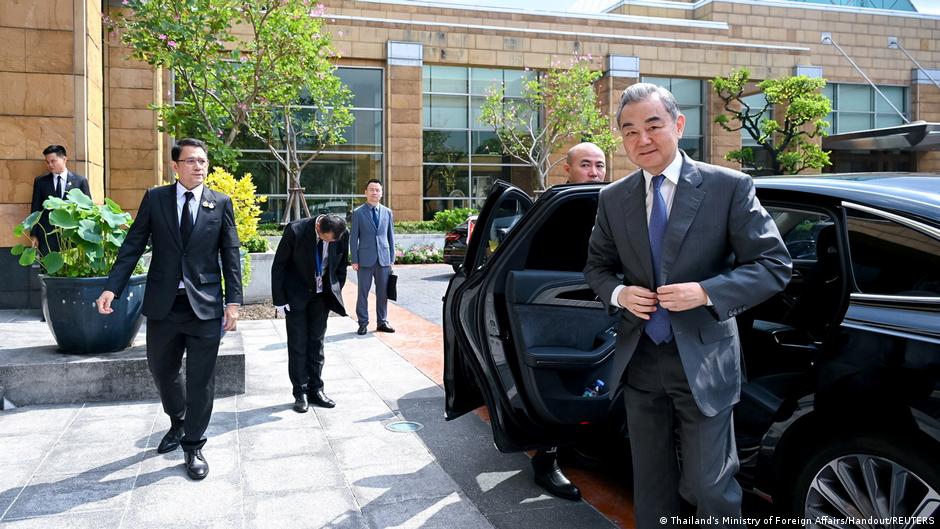
Foreign Minister Wang Yi's visit to Southeast Asia shows how Beijing is trying to present itself as a steady regional partner as Southeast Asia grapples with war, tariffs and doubts over Washington's reliability.
https://p.dw.com/p/5CtGlWang is seeking to strengthen ties in Southeast Asia and present Beijing as a more stable alternative to the United States Image: Thailand's Ministry of Foreign Affairs/Handout/REUTERSAdvertisementChina's top diplomat Wang Yi has used a three-country tour of Cambodia, Thailand and Myanmar to present Beijing as a steady partner in a region unsettled by war, trade tensions and doubts about US reliability.
The five-day visit ended on Sunday as Southeast Asia grapples with fallout from the Iran war, which has driven up energy prices and threatened growth across import-dependent Asian economies.
The conflict has compounded uncertainty from Washington's tariff policy, which Southeast Asian exporters have spent months trying to negotiate around.
Higher fuel and shipping costs are feeding inflation, while a prolonged Middle East conflict is expected to significantly cut regional growth and lead to a major cost of living crisis.
Washington's confrontational approach has also unnerved Southeast Asian governments, many of which have their own territorial disputes, including with China.
By contrast, Beijing has sought to cast itself as the major power defending stability, trade and mutual cooperation.
Enze Han, an associate professor at the University of Hong Kong, told DW that Foreign Minister Wang's visit shows that "China is paying a lot of attention to Southeast Asia, while the region has been ignored by the United States."
A slim majority of Southeast Asian respondents said that they would align with China over the US if push comes to shove, according to this year's State of Southeast Asia, an annual survey published by the ISEAS–Yusof Ishak Institute.
In last year's survey, 52% of respondents said they would prefer to align with the United States.
The same survey found that 55.6% of respondents expect their country's relations with China to improve or improve significantly over the next three years, while trust in China has also increased.
For Beijing, those numbers point to a regional mood it can use. For Southeast Asian governments, they also reflect a hedging strategy in a more unstable world.
"Southeast Asian countries are also keen to strengthen ties with China to prepare for worst-case scenarios of US terminal decline and a more Sino-centric regional order," Hunter Marston, a non-resident adjunct fellow at the Center for Strategic and International Studies (CSIS), told DW.
Cambodia was arguably the easiest stop on Wang's itinerary. Phnom Penh is Beijing's closest partner in mainland Southeast Asia, and the two governments have long described their relationship as an "ironclad" friendship.
But Wang's visit "went beyond routine reassurance and marked a step toward institutionalizing the relationship at a deeper level," Sophal Ear, an associate professor at the Thunderbird School of Global Management at Arizona State University, told DW.
On April 22, Wang and Chinese Defense Minister Dong Jun took part in the inaugural China-Cambodia 2+2 strategic dialogue with their Cambodian counterparts. The format brings together foreign and defense ministers, giving the relationship a more formal security dimension.
"That signals a shift from primarily economic cooperation toward more structured political and security alignment," Ear explained.
Importantly, the visit also put Cambodia's scam industry on the bilateral agenda. Cambodia has been under growing international pressure over online fraud compounds, where victims from across Asia have been trafficked and forced to work for criminal syndicates.
"China's call for the eradication of scam centers indicates that Beijing is not only supporting Cambodia but also shaping parts of its domestic policy agenda," said Ear.
The issue followed Wang to Thailand, where he met Prime Minister Anutin Charnvirakul. Thai officials said both sides agreed to deepen cooperation against transnational crime and cyberscams.
"For China, it's a delicate issue at home and abroad as Chinese nationals have been caught up in scam centers and Chinese crime syndicates are partly responsible for the escalation of the problem," Mark Cogan, associate professor of Peace and Conflict Studies at Japan's Kansai Gaidai University, told DW.
Scam factories in Myanmar: Cyber slavery To view this video please enable JavaScript, and consider upgrading to a web browser that supports HTML5 video
Thailand also gave Wang a chance to step into another regional problem. Cambodia and Thailand have been stuck in a deadly border conflict since last July, when fighting erupted over disputed territory along their shared frontier. Hundreds of thousands of people were displaced, and more than 100 people have been killed.
In October, the Association of Southeast Asian Nations (ASEAN) bloc helped negotiate the Kuala Lumpur Declaration, witnessed by US President Donald Trump, to secure a truce. At the time, the Trump administration threatened to halt tariff talks with both countries unless they stopped fighting.
However, that ceasefire fell apart relatively quickly, leading to a second ceasefire later that collapsed after fighting broke out in December. There has been a lull since then, and Anutin's new government, formed earlier this month, has vowed to find a lasting solution.
"Compared to the United States, China's potential as a mediator in the conflict is far higher," Cogan noted.
"China has nothing to lose by playing the role of peacemaker in the Thai-Cambodia conflict, in contrast to its efforts in Myanmar, where diplomacy was half-hearted and driven by the need to secure its own interests," he added.
Myanmar remains the hardest case for Beijing. Wang visited Naypyitaw after Min Aung Hlaing, the junta leader who seized power in 2021, was sworn in as president following elections that critics widely dismissed as neither free nor fair.
What's at stake for China as Iran war drags on?To view this video please enable JavaScript, and consider upgrading to a web browser that supports HTML5 video
Beijing has been one of the few major powers willing to engage the post-election government. It wants border stability, protection for Chinese projects and progress on the China-Myanmar Economic Corridor, a landmark project.
Beijing "firmly supports Myanmar in safeguarding its national sovereignty, security and territorial integrity," Wang said in Myanmar's capital city, Naypyidaw, according to a Chinese foreign ministry statement.
"This year marks the first year of Myanmar's new government. Both sides should seize this opportunity to carry forward their traditional friendship and open up new prospects for bilateral relations," he added.
China views engagement with Myanmar's post-election government as a way to reinforce its current posture and secure its interests in the country, Ngeow Chow Bing, director of the Institute of China Studies at the University of Malaya, told DW.
Wang's Myanmar stop also focused on scam compounds, border security and Myanmar's efforts to repair ties with ASEAN.