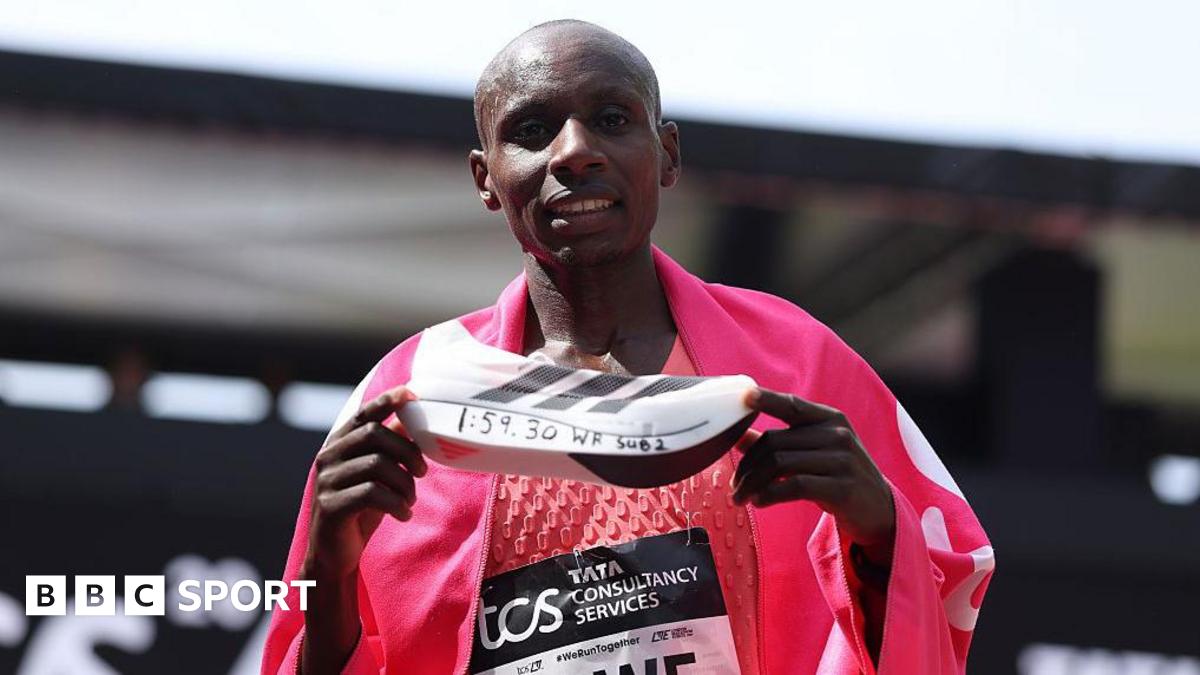
When Sabastian Sawe said last week that it was "only a matter of time" before he would break the late Kelvin Kiptum's world marathon record, few thought that time would come in London on Sunday.
But this was bigger than just setting a new world record. In one hour 59 minutes and 30 seconds, the 31-year-old Kenyan rewrote the boundaries of possibility.
While the great Eliud Kipchoge became the first man to run a marathon in under two hours in 2019, that was not record-eligible as it was held under controlled conditions.
Remarkably, Sawe was joined in the record books by Ethiopia's Yomif Kejelcha, who finished second with an astonishing time of 1:59:40 to become just the second man to finish a marathon in under two hours.
In the women's event, Ethiopia's Tigst Assefa improved her own world record by nine seconds to set a new time of 2:15.41.
In a sport of 'marginal gains', all eyes are on how the trio thrived on a record-breaking Sunday in the capital.
All three athletes wore Adidas' Adizero Adios Pro Evo 3.
The shoe was launched on 25 April, just two days before the world's best took to the streets of London.
It is the third iteration of a hugely popular shoe. Adidas worked with Sawe, Kejelcha and Assefa over the last three years to produce this version of the trainer.
In Sawe's case, it helped him break Kiptum's London course record of 2:01:25 by nearly two minutes.
Sawe thanked Adidas for making what he said were best shoes he had worn, particularly highlighting how "very light" and stable they are.
At 99 grams, the trainer is the first 'super shoe' to weigh under 100g.
That's lighter than a medium-sized apple, a banana or a bar of soap.
In recent years, major improvements in marathon times have been made thanks to the introduction of carbon-plated midsoles. The latest version also integrates carbon more fully into the design.
And in the search for marginal gains, the redesign and reduction in weight have led to an increase in running economy according to the manufacturer.
"At that level, every detail really matters – we were measuring things down to the nearest nanogram," Adidas' VP of running, Patrick Nava, said of the design process.
"It was a long process, but it's led to something we believe genuinely changes what a race-day shoe can feel like."
For the casual runner taking advantage of the technology comes at a financial cost though. A wider release is expected later in the year following on from the initial limited launch, but the shoes are currently priced at £450.
Has Adidas dethroned Nike? When Kipchoge broke the sub-two hour mark wearing the Nike Alphaflys in 2019, the American sportswear brand was undoubtedly the market leader.
Its reputation was enhanced further in 2023, when Kiptum set the previous world record in Chicago wearing the Nike Alphafly 3s.
But just like in racing, boundaries are there to be pushed.
With Sunday's results, Adidas can now boast that the fastest man and woman to ever run a marathon both wore their shoes.
But the battle never stops between the biggest sportswear brands, particularly given the increased popularity in running in recent years. Rivals brands including Asics, Saucony, Hoka, Brooks, and New Balance were also sported by many of Sunday's marathon competitors.
What are the rules behind 'super shoes'? Governing bodies have been trying to keep pace with advances in footwear technology over recent years and World Athletics updated its regulations in January 2022.
It released an 18-page document, external, which stated shoes could not be used unless they were available to "any athletes participating in applicable competitions".
The rules also stated that the maximum 'stack height' must not exceed 40mm and that the shoes must have no more than one carbon plate.
While runners can race in shoes that exceed a stack height of 40mm, athletes will not have their times recorded as the trainers are considered 'illegal'.
So, is it just the shoes? Rapid developments in sport science in the last 20 years have run alongside the technological improvements in racing shoes.
Simply put, we know more than ever how to 'beat the wall' and to keep glycogen levels topped up throughout 26.2miles.
In Sawe's case, a research team from sports nutrition brand Maurten spent 32 days with the Kenyan across six trips in the last 12 months.
Their team, which specialise in hydrogels, worked alongside Sawe to train him to absorb the 90-120 grams of carbohydrates included in the gels within an hour period without feeling distress.
Almost inevitably, when landmark times are set, there are those who raise suspicions.
Ruth Chepngetich, winner of the 2024 Chicago Marathon in a world-record 2:09:56, was hit with a three-year ban for doping in 2025.
In light of his countrywoman's suspension, Sawe and Adidas asked the Athletics Integrity Unit to ramp up his anti-doping testing.
In 2025, Adidas paid $50,000 (£36,800) to increase the drug testing of Sawe in the build-up to the Berlin marathon.