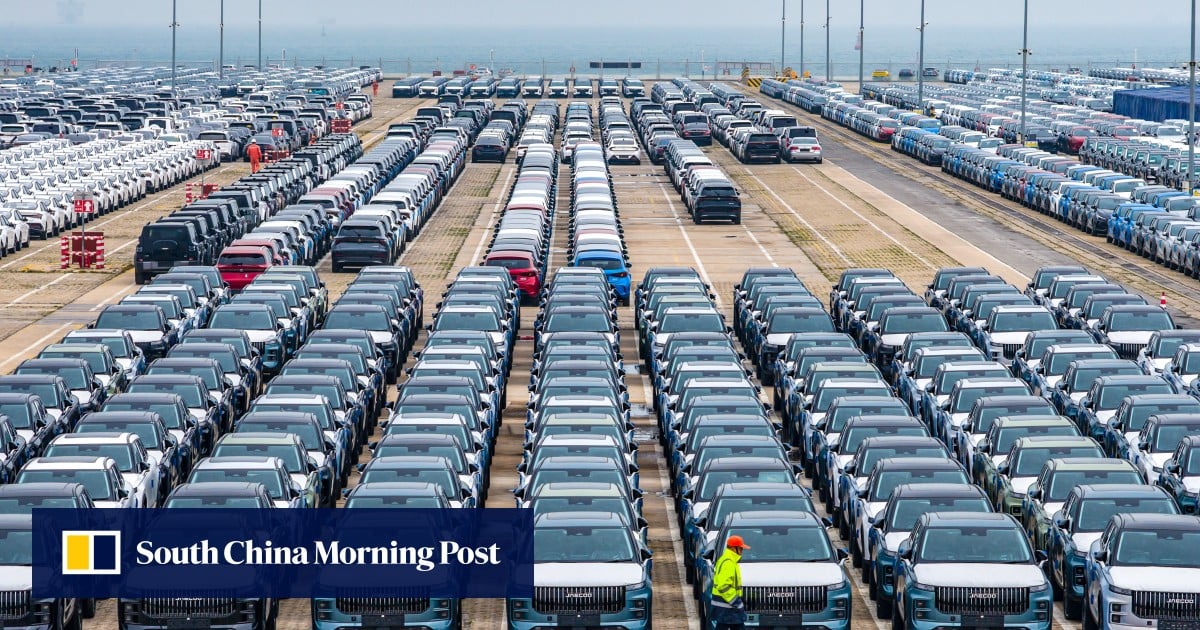
BYD is now one of Korea’s fastest-growing imported EV brands while rivals like Chery look to break into a market long dominated by local giants
3-MIN READ3-MINYeon Woo LeePublished: 10:00am, 27 Apr 2026Electric vehicles (EVs) made in China now account for one in every three new registrations in South Korea, as Tesla’s Shanghai-built models power the surge and Chinese carmakers start to gain traction.The country’s auto manufacturers have further room to expand, analysts said, supported by higher fuel prices linked to the US-Israeli war in Iran and looser restrictions than traditional target markets. Still, tightening subsidy regimes could slow the pace of expansion, they cautioned.AdvertisementSales of China-made EVs in South Korea soared to 25,000 units in the first quarter of 2026, marking a 286.1 per cent increase from a year earlier, according to data from the Korea Automobile and Mobility Association (Kaida). Over the same period, Korean carmakers sold about 51,000 units, but grew at a much slower pace of 126.1 per cent.
The market share of EVs manufactured in China surged from 4.7 per cent in 2022 to 33.9 per cent last year, while that of Korean EVs fell from 75 per cent to 57.2 per cent, according to the data released on Wednesday.
“Most [Chinese] firms have identified overseas expansion as a growth pillar of 2026, in light of slowing EV demand at home,” said Xu Tianchen, senior economist at the Economist Intelligence Unit. “South Korea is certainly one of the target markets.”
As a leader in quality and affordability, Chinese brands are well placed to compete in KoreaTroy Stangarone, Carnegie Mellon Institute for Strategy and TechnologyThat began to change in 2024, as competitively priced, technologically advanced models expanded their presence. Yet the biggest driver of growth for China-made EVs in South Korea is not a Chinese brand but Tesla, whose Shanghai-built models have become increasingly popular, said Troy Stangarone, a non-resident fellow at the Carnegie Mellon Institute for Strategy and Technology.
Tesla sells its models in South Korea with slightly lower specifications – including a shorter driving range and smaller battery capacity than versions made in the United States – while cutting prices by as much as 10 million won (US$6,740).
The company’s sales jumped 311 per cent from 2022 to 2025 to 59,916 units, Stangarone said, citing Kaida data. It was also South Korea’s bestselling imported brand in the first quarter.