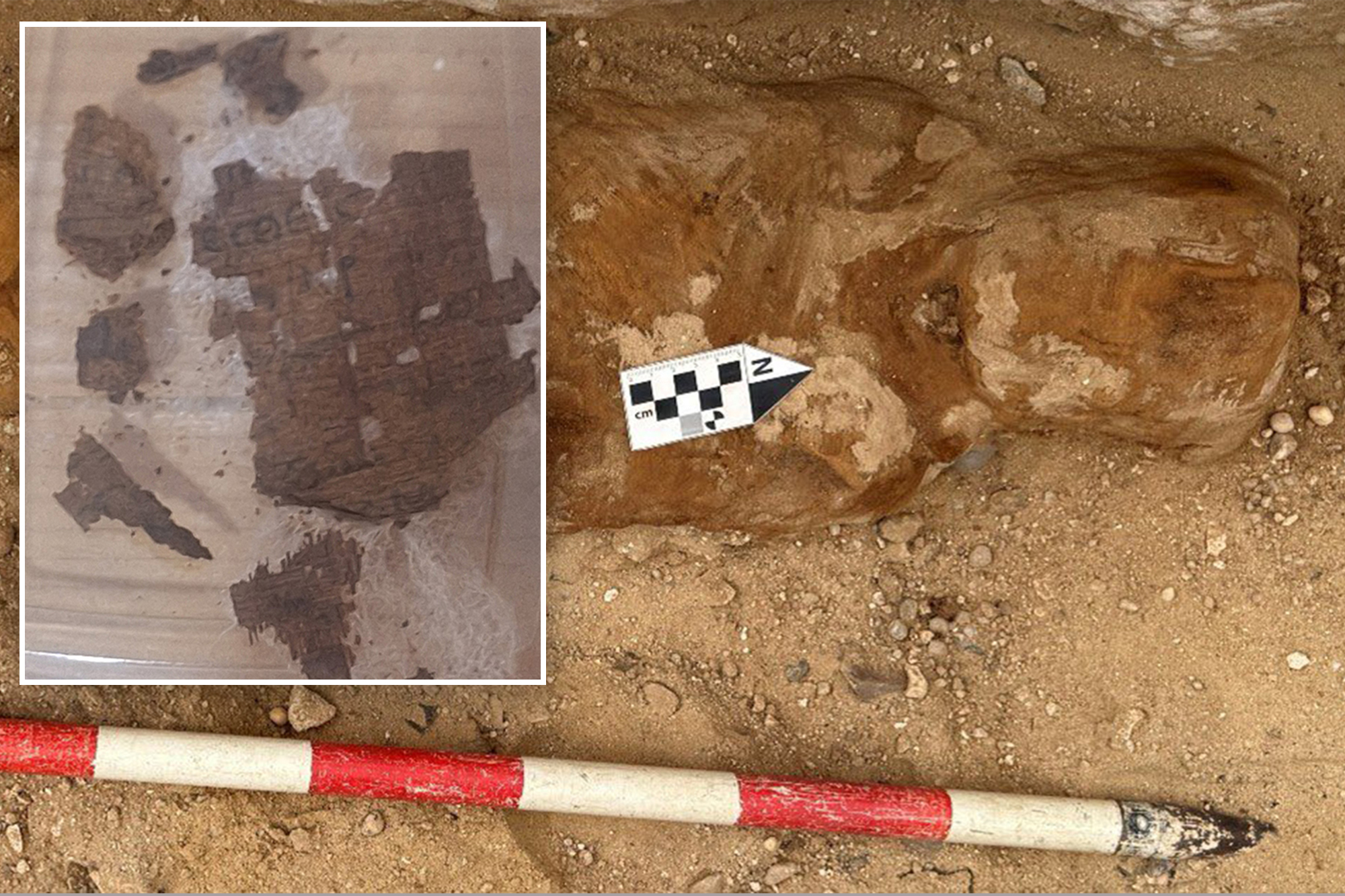
It might have been mummy’s favorite bedtime story.
Archaeologists found part of Homer’s “The Iliad” stuffed inside a 1,600-year-old mummy’s abdomen — a surprising and first-of-its-kind find, experts said.
Researchers from the University of Barcelona said a papyrus fragment written in Greek was discovered during an excavation of a Roman Empire-era Egyptian tomb.
The fragment includes a section of Book Two of the ancient epic, which details the legendary Trojan War, the university said.
The fragment names the famous catalog of ships used against the city of Troy, likely placed inside the mummy’s abdomen during embalming, university researchers detailed.
The discovery, first announced this month, was uncovered by university researchers between November and December 2025 — and is the first time in recorded history that a Greek literary text has been found incorporated into a mummification ritual, scientists said.
The University of Barcelona’s Oxyrhynchus Archaeological Mission had previously documented Greek papyri tucked inside mummies in similar positions, but the text was always magical or ritualistic, according to researchers.
“It is worth noting that, since the late 19th century, a huge number of papyri have been discovered at Oxyrhynchus, including Greek literary texts of great importance,” said Professor Ignasi-Xavier Adiego, who helped lead the research campaign.
“But the real novelty is finding a literary papyrus in a funerary context,” Adiego added.
The male mummy was discovered inside Tomb 65 at the Al-Bahnasa necropolis, the site of ancient Oxyrhynchus, which sits roughly 190 miles south of Cairo.
The same dig also turned up three gold tongues and one copper tongue — objects placed in the mouths of the dead so they could speak to the gods in the afterlife.
Previous excavations at the cemetery had already recovered more than a dozen mummies with gold tongues, but why one received copper instead of gold remains unclear, according to the Ministry of Tourism and Antiquities.