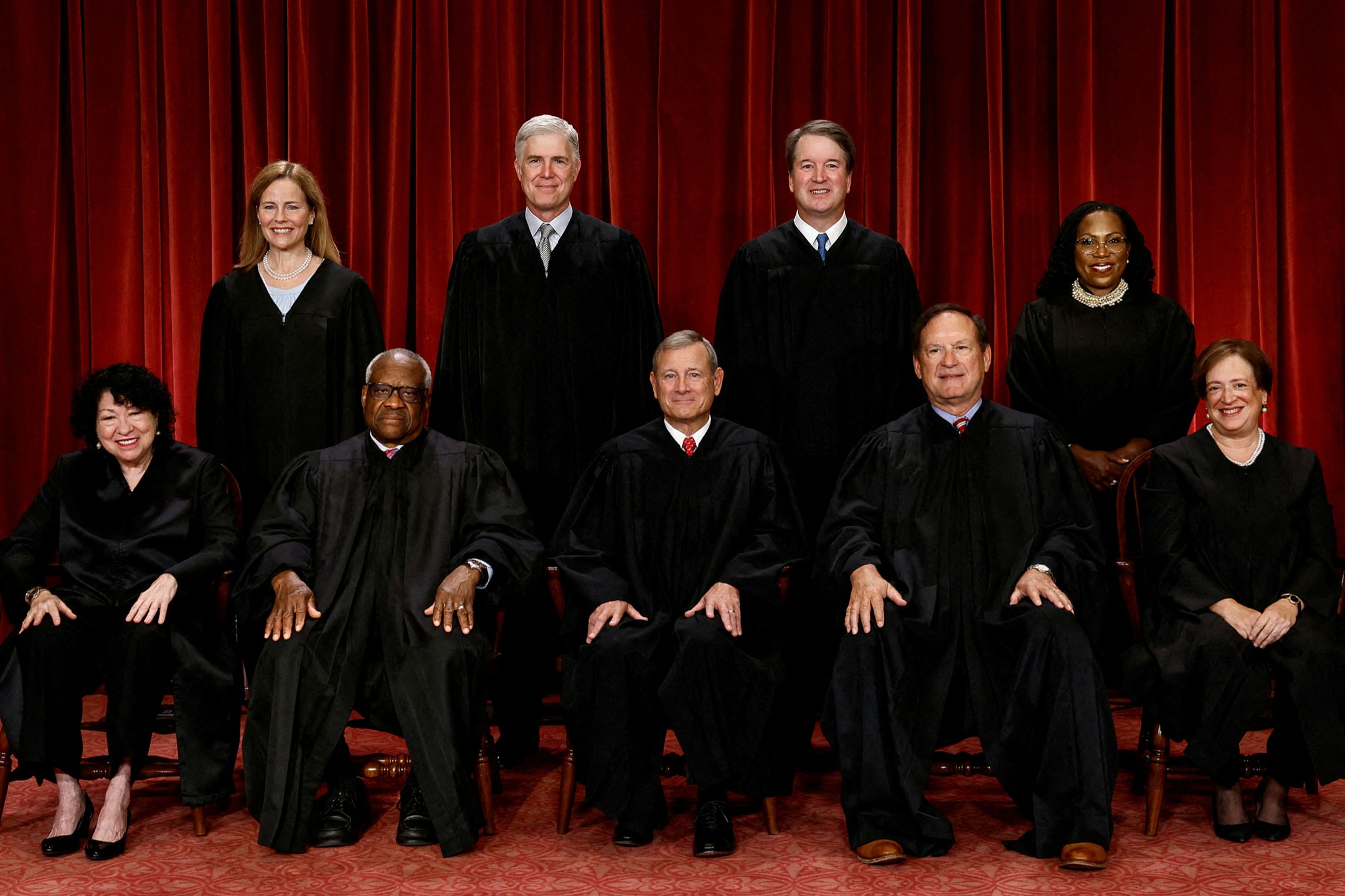
When Justice Samuel Alito arrived at the Supreme Court in 2006, Justice Antonin Scalia jokingly told him he would spend his first five years on the Court wondering how he got there and the rest of the time wondering how everybody else got there.
Though fiercely independent and with differing ideas about how the Court should interpret the Constitution and statutes, most justices put a lot of work into maintaining collegiality. In a tradition instituted by Chief Justice Melville W. Fuller in the late 19th century, the justices greet each other and shake hands before meeting in conference or going out onto the bench.
They take swipes at each other in their opinions and dissents, which they tend to brush off or joke about.
Recently, however, the court’s famed collegiality has been strained by justices wondering out loud about how their colleagues got there.
Earlier this month, Justice Sonia Sotomayor took an extraordinarily personal shot at Justice Brett Kavanaugh, accusing him of being a man who “probably doesn’t really know any person who works by the hour.” Her mean-girl approach was widely condemned.
After Justice Elena Kagan was on the losing end of a few key decisions in recent years, she toured the country impugning the integrity of the Court.
Still, it’s surprising the justices get along as well as they do, given what happened following the leak of Dobbs v. Jackson Women’s Health Organization in 2022.
Alito authored a nearly 100-page draft of the Court’s opinion overturning the controversial Roe v. Wade decision by early February. Dissenting justices were surprised at how thorough it was, but they had five months to work on their dissent by the time the draft opinion was leaked to Politico.
Immediately, the justices who had signed onto Dobbs faced threats to their lives. A decision isn’t final until it’s issued from the bench. If a justice had been murdered, Roe would not have been overturned.
The Alito family had to be moved to a secure location away from braying mobs. Left-wing activists posted the home addresses of the conservative justices. One man was arrested outside of Justice Kavanaugh’s home with a gun, and said he’d wanted to kill three justices.
Back at the Court, the conservative justices were surprised to find the liberal justices were nowhere near done with their dissent. Justice Gorsuch asked if they could speed it up, on account of the threats, but the liberal justices demurred.
Finally, they agreed to get the dissent done a month after the leak. But they included an unnecessary mention of a case that wasn’t coming out until the end of the term, stalling its release even further. The conservative justices had to survive almost two months of threats for Dobbs to be finalized and issued.
Far and away the most introverted justice on the Court, it took nearly two decades being there for people to realize how consequential the quiet Alito is. He left no stone unturned in his opinion that explaining a right to abortion was not hidden in the Constitution, was not deeply rooted in the country’s history, and should be decided by the people through democratic means.
In addition to Dobbs, he wrote the plurality opinion in McDonald v. Chicago, a 2010 case that held that the Second Amendment right to keep and bear arms applies to state and local governments.
His Burwell v. Hobby Lobby decision in 2014 held that family-owned companies can assert religious objections to federal mandates.
The 2018 Janus v. American Federation of State, County and Municipal Employees held that public sector unions may not force non-members to pay fees, which subsidize political speech with which they disagree.
Most justices on the Court are originalists, who believe the meaning of the US Constitution is fixed at the time each provision was ratified and that judges should interpret it according to its original public meaning.
Alito shares that view, but he is much less theoretical than other originalists on the court, such as Justices Neil Gorsuch and Clarence Thomas.
He cares deeply about the facts in each case. Occasionally, that puts him as a lone dissenter on contentious topics he thinks should be handled more practically, such as the case involving the Westboro Baptist Church, which gratuitously insulted the family of a deceased soldier at his funeral.
In a world where many conservatives make pragmatism and principle at odds with each other, Alito is a model showing how they can be blended without conflict. Because Alito is so influential, the media and other left-wing activists have increased their attacks on him in recent years.
Livid over the Dobbs ruling, his consistently conservative record, and his imperviousness to pressure campaigns, he has been on the receiving end of articles falsely accusing him of leaking the result of the Hobby Lobby decision, and alleging a trip he took nearly 20 years ago should have been disclosed differently than it was.
The extensive travel and celebrity hobnobbing of retired Justice Stephen Breyer, deceased Justice Ruth Bader Ginsburg, and Justices Sotomayor, Kagan, and Jackson have received no similar scrutiny.
Start your day with all you need to know Morning Report delivers the latest news, videos, photos and more.
Even Alito’s wife, Martha-Ann, a flag enthusiast, was subjected to a barrage of articles in The New York Times over her flying of an “Appeal to Heaven” flag at her New Jersey beach home.
The Times absurdly claimed the colonial-era flag, which had flown for decades over San Francisco’s Civic Center Plaza, was a coded message for Jan. 6 insurrectionists.
A collegial Court is important to its functioning. The disparity in the public treatment of the justices who more strictly adhere to the Constitution compared to the more liberal justices is a huge barrier to that civility.
For now, we should be grateful justices such as Alito have handled the threats and personal attacks so gracefully, in order to preserve collegiality and strive for impartial justice. The court’s liberal wing is already signaling it won’t behave nearly as well.
Mollie Hemingway is the author of “Alito: The Justice Who Reshaped the Supreme Court and Restored the Constitution” (Basic Liberty), out now.