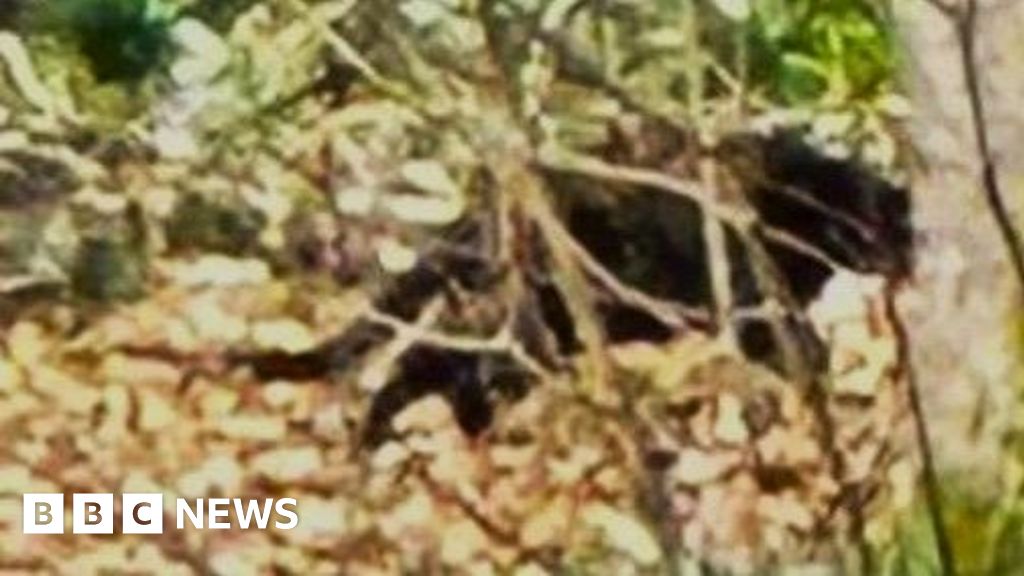
ShareSaveAdd as preferred on GoogleCraig WilliamsBBC ScotlandScottish Big Cat Research TeamThis 2024 image from Dumfries and Galloway is typical of big cat photographsJohn Kirk is clear about what he saw while driving into Grantown-on-Spey with his wife on the evening of Friday 17 April.
"We were going to pick up the grandchildren from a friend's house," he says.
"We came off the roundabout, heading into Grantown, just coming up to the cemetery. And something flashed across the road at a great rate of knots.
"And I thought: 'That's a cat'.
"I turned to my wife and I said: 'Did you see something there?'
"She said: 'Yeah but that was no deer. It was like a cat.'
"It was bigger than my collie. It would have been sitting about two feet high, long tail. It was definitely a cat."
John's not the type who's prone to fanciful notions.
He farmed the Cairngorms for more than 50 years. He knows the landscape, its secrets, and its wildlife.
And - as he says - he knows a cat when he sees one. He believes they saw a black panther that night. He has good reason to be confident about this, because it's not his first.
"I seen one about 25 years ago. It was on the road, and it was a panther. It was a black panther crossing the road in front of me."
When John got to the top of a nearby hill the road was covered in rabbits, running away from the spot where he had seen the big cat.
"It was one of the most amazing sights I've ever seen. I actually had to stop the vehicle to let the rabbits cross the road," he said.
"They had obviously smelt it coming up through the wood and they were heading towards the forest. I had never seen nature do something like that before."
This time, John is not alone. In the past week, five or six others have been in contact to say they too have seen the cat.
"I put it on Facebook just to see what sort of crack would be with it and to see if anybody else had seen it.
"And the response has been absolutely unbelievable. The amount of folk that have seen it around the town, and I know folk personally who have seen it."
Such sightings are nothing new, nor even that rare.
There's a long history in Britain of people encountering big felines that are not native to these islands.
Paul Macdonald runs the Scottish Big Cat Research Team, a network of volunteers dedicated to reporting sightings and protecting the creatures.
He founded the group in 2017, after hearing of an encounter near his home in the Borders. But his interest in the subject was sparked more than 30 years earlier.
Back in the 1980s, Paul was travelling to school on the West Highland rail line when he had his own close encounter.
"Both myself and my friend saw - at very close quarters, in broad morning daylight - a black leopard, casually moving away from the train. It was quite undeniable as to what we were looking at," he says.
"It left us both in a bit of shock. But I think that kind of captured my imagination at the time, to at least understand there was one big cat out there somewhere."
Paul began following big cat reports in the media, reading about livestock kills and sightings across the UK. He realised there was a "bigger picture", which eventually led to him founding the research team.
"I decided to focus on Midlothian and Peeblesshire sightings and realised there were quite a lot. Soon after, I met another fellow who was keen to research and we decided just to go all out and cover all of Scotland."
In nine years, the team has mapped 1,800 sightings dating back as far as 1947. If that's true, there are a lot of big cats out there in Scotland's hills and glens.
Tales of wild big cats have been a staple of the UK media for decades. Some - the Beast of Exmoor, the Surrey Puma - have achieved an almost mythic status.
Scotland has more than its share of cases. In 2025, four lynx - a species which has been extinct in Scotland for at least 1,300 years - were captured near Kingussie in the Highlands.
After being captured, the three female animals were moved to the Highland Wildlife Park, near Kincraig, where they are said to be thriving. A fourth, male, cat died.
Who released them remains a mystery. But it's widely believed that private owners releasing cats into the wild are behind the modern big cat phenomenon.
"Some of the older origin stories go back to 19th Century, relating to private menageries and collections of exotic species," says Paul Macdonald.
"That never fully went away when it came to large estates and those that had the money and means.
"But there was a flashpoint for this activity throughout the whole UK, in 1976, and that was the introduction of the Dangerous Wild Animals Act."
Prior to this, it was possible to buy a pet puma, lynx or leopard.
Today, these are the three species most commonly identified in sightings.
Paul says: "The act only offered owners two options. Either buy the licence and then have your animal kept within a minimum size enclosure, and obviously there's significant cost with that.
"Or bring your animal in and have it put down. So many took a third option of taking them somewhere green enough and releasing them."
Paul believes a "significant" number of animals were released at the time, enough to establish breeding groups across the moors, hills and forests of what is still a sparsely populated country.
A few years after the law changed, a puma was caught in the Highlands. Subsequently named Felicity, she was trapped in 1980 by a farmer frustrated by a series of attacks on livestock.
She went on to live contentedly in captivity. Her condition and relative tameness suggested she had been released into the wild from a private collection. After her death in 1985 she was stuffed and displayed in Inverness Museum, where she remains on show.
Paul Macdonald believes Scotland, with its relatively temperate climate, vast areas of remote countryside and an abundance of wild prey such as deer, is a good breeding environment for big cats.
He believes the cats people claim to see today are descended from the animals released in the wake of the 1976 act.
Sceptics ask why we don't see more of them, and why the photos of big cats cited as evidence are often blurry and ambiguous.
"There are understandable reasons for a relative lack of images when it comes to sightings," Paul says.
"Most sightings are typically five seconds or less. It typically takes around seven seconds or more to deploy a phone or camera from a pocket, switch it on and take a clear image.
"In any case, every encounter is completely unexpected. And the witness invariably is left in a state of shock, awe or fear from what they've just seen."
He says the bones, prints, photos and testimony they've collected leave him in no doubt that big cats are out there.
It's clear many people are having encounters with animals which, at the very least, do not appear to be native species.
NatureScot, the Scottish government's conservation and natural heritage body, defines evidence as "photographs, footprints, hair or tissue samples or freshly killed prey" and publishes instructions on how the public can report any encounters or discoveries.
A statement given to BBC Scotland News on the subject strikes a sceptical note.
"While we receive one or two sightings of big cats a year, none of the reports submitted over the past 34 years have provided sufficient evidence to conclude that big cats were present.
"The last verified sighting of a big cat in the wild in Scotland was in 1980."
That cat was - of course - Felicity the Highland puma.
Paul Macdonald understands public scepticism but he believes the evidence for big cats is clear and we should not be surprised at the thought of them thriving here.
"Leopards and pumas are non-native species that are not supposed to be in our environment. But then, we're not the only country in the world that has non-native big cats," he says.
"Every country in the world has non-native species of some sorts, and cats happen to be the most adaptable creatures. It shouldn't be a surprise that if there was a cause for them being there in the first place - which we can establish there was - then they would naturally thrive."
Back in the Cairngorms, John Kirk is certain of what happened last week. Certain of what he saw. Certain there's a big cat out there near his home.
"There has to be something there because, you know, it's not something you'd exaggerate on. If you do, you're a fool.
"It did cross the road in front of me. I know what I saw, that's for sure."