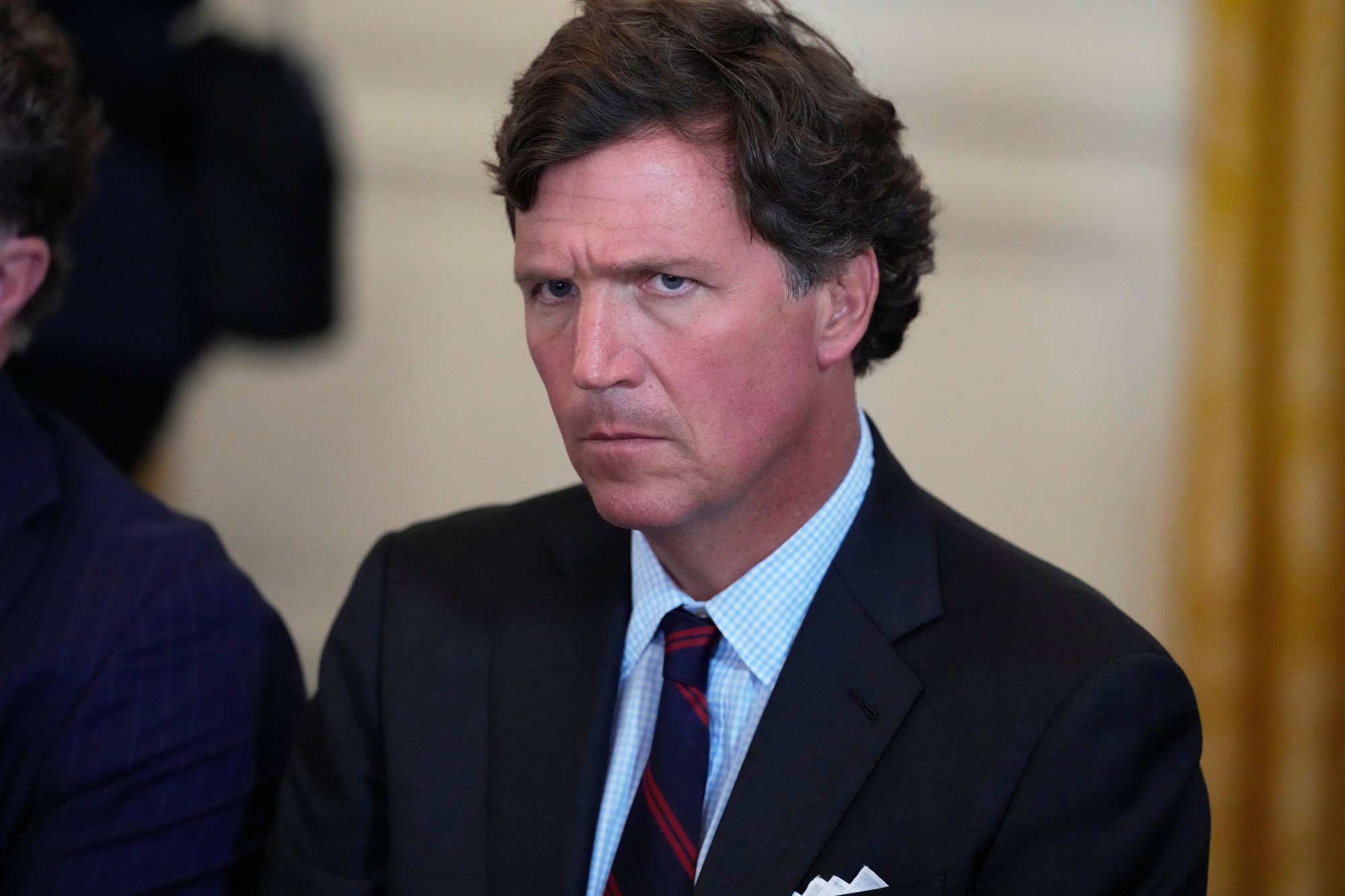
Podcaster Tucker Carlson is "tormented" by US backing Israel, but aid is a smart investment. AP Tucker Carlson is “tormented.”
Not by a policy failure, not by a domestic crisis — by the fact, he said this week, that President Donald Trump backed Israel in a war against Iran.
It’s in line with a grievance the podcaster and former Fox News host has nursed for months.
He’s told his followers that Israel is “a completely insignificant country” with “no resources.”
America gets “nothing” from the relationship, he’s said, repeating a theme that echoes throughout the right-wing influencer world.
Theo Von, the third-biggest podcaster on Spotify, declared on his show: “All of our f—ing money goes to Israel.”
Candace Owens turned such complaints into her brand’s growth engine.
Influencers are political adolescents — especially in this era of grift, when an emotional statement on a visceral topic can achieve instant fame.
But to be fair to Von and those who rightfully question US foreign aid, the idea of giving $3.8 billion a year to a country of 10 million on the other side of the world while Americans struggle at home is genuinely puzzling.
Here’s the truth: It’s the best investment the US government makes.
Most of that $3.8 billion must be spent on American-made military equipment.
That’s not charity — it’s a subsidy for our own defense industrial base.
Israel’s largest purchases flow to Lockheed Martin, Boeing, Raytheon and General Dynamics.
The F-35 program alone — which Israel was the first to use in combat — supports 290,000 American jobs, generates $72 billion in annual economic output and has produced a $173 billion order backlog.
Israel’s real-world combat testing fixed critical glitches engineers couldn’t replicate in a lab, contributing to over $40 billion in export sales.
Then there’s the value of Israel’s intelligence assistance.
The intel Israel provides would cost America “five CIAs” to produce independently, US Air Force Gen. George Keegan estimated decades ago — and that has only compounded since.
The National Intelligence Program budget was $82 billion for fiscal year 2026; even attributing a fifth of that to CIA-equivalent operations, you’re looking at a return that dwarfs a $3.8 billion investment many times over.
Israel also shares daily operational lessons from every American weapons system it fields, saving an estimated 10 to 20 years and potentially billions in research and development.
In 2021, the Pentagon formally moved Israel into US Central Command — institutional recognition that the Jewish state was America’s strategic anchor in the Middle East.
That’s a crucial benefit in a region that sits atop 48% of global oil reserves and straddles the shipping lanes between Asia and the West.
A single Gerald R. Ford-class carrier costs $13 billion to build and up to $8 million per day to operate — and experts have assessed that Israel’s military effectively replaces multiple US aircraft carriers and ground divisions across the Mediterranean, Red Sea and Persian Gulf.
That’s without a single permanent US soldier stationed there, while in Europe we spend $25 billion to $30 billion a year to station 80,000 troops.
Israel’s June 2025 air offensive against Iran — featuring 200 US-made F-35s, F-16s and F-15s — was the most consequential live demonstration of American air superiority in a generation.
It exposed the vulnerabilities of Russian and Chinese air defenses, tilted the global balance of power in Washington’s favor and became the best sales pitch Lockheed Martin could ever ask for.
Beyond defense, Israeli firms are the second-largest source of foreign listings on NASDAQ, and Israeli investment in the United States has tripled to nearly $24 billion.
In New York alone, 600 Israeli-founded companies generated $19.5 billion in output last year and supported 57,000 jobs; bilateral trade tops $49 billion.
Now here’s the part the podcasters can’t engage with, because it requires actually understanding the region.
Political strategists on both the conservative right and the progressive left agree that the US must urgently shift its military resources from the Middle East to the Pacific.
But there’s only one way to do that without ceding the region to Moscow or Beijing: building a coalition capable of defending itself, under American leadership.
And Israel has repeatedly demonstrated its worth as the key to that coalition.
Israel has a permanent structural alignment with American interests.
It has proven, under sustained multifront combat, that its alliance with America can take the worst our enemies can throw at it.
Tucker Carlson delivered his anti-Israel monologue from Doha.
Theo Von posed in Qatari garb and tagged its tourism board before parroting Hamas talking points.
The real grift isn’t $3.8 billion in aid that returns to American factories many times over.
It’s telling millions of listeners that America gets “nothing” from its most productive alliance — and cashing the ad checks while the algorithm rewards the rage.
The podcasters aren’t serious. The numbers are.
Joseph Epstein is the director of the Turan Research Center.