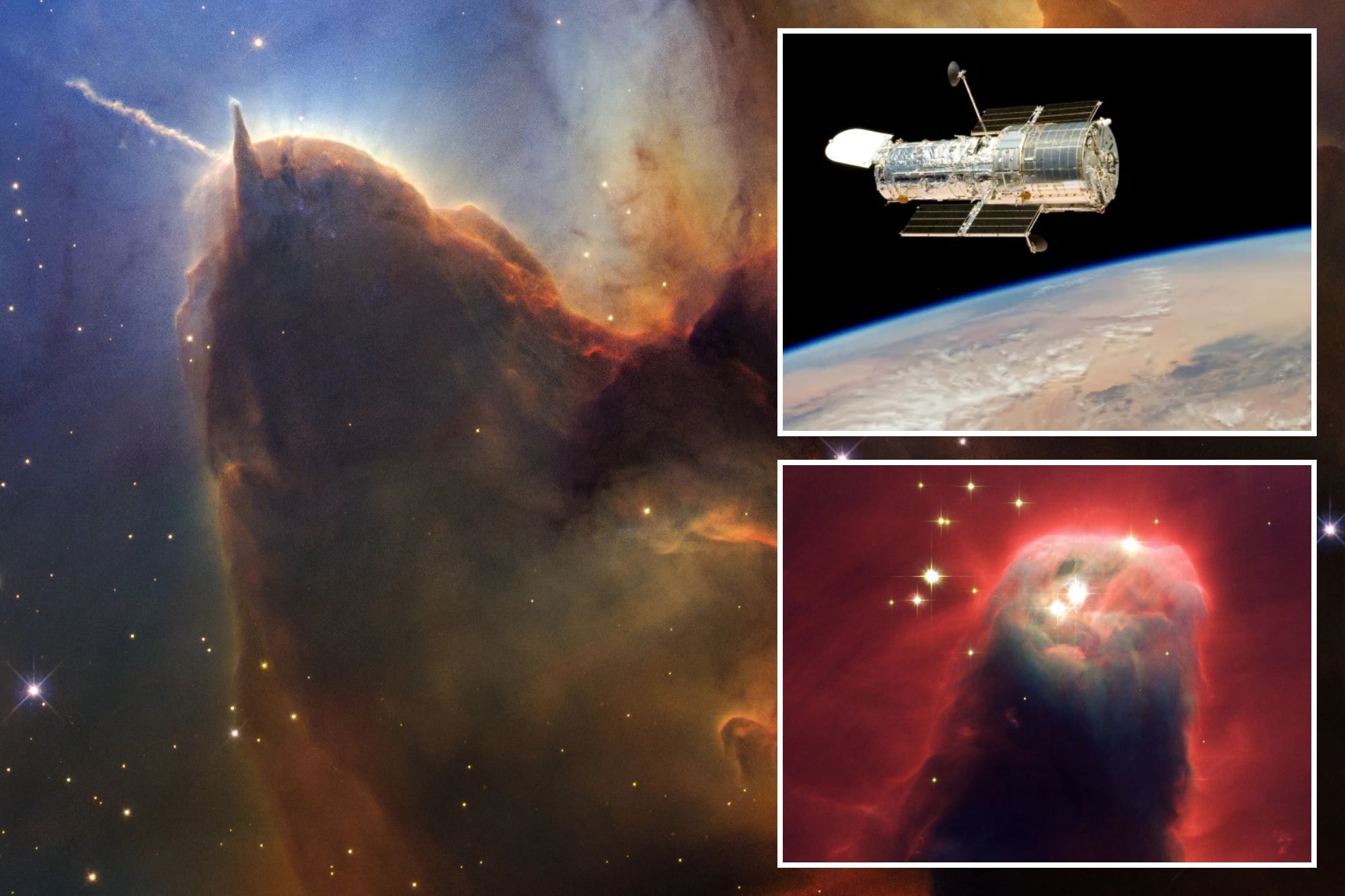
NASA is celebrating the 36th anniversary of the Hubble Space Telescope in Earth’s orbit, sharing a new image of the Trifid Nebula, nicknamed the “Cosmic Sea Slug,” first revealed in 1997.
The school-bus-sized telescope has since made nearly 1.7 million observations, targeting about 55,000 astronomical objects.
Its discoveries have resulted in over 22,000 scientific papers and more than 1.3 million citations, making it one of the most influential scientific instruments ever built.
NASA is celebrating the 36th anniversary of the Hubble Space Telescope with a stunning new look at the Trifid Nebula, a star-forming region about 5,000 light-years away. Powerful ultraviolet light from massive stars has carved out this glowing bubble, triggering new waves of star birth. First imaged in 1997, Hubble revisits this scene nearly 30 years later with sharper vision. The image reveals a structure nicknamed the “Cosmic Sea Slug,” including a jet from Herbig-Haro 399, showing how young stars actively shape their surroundings. NASA/ESA/STScI et al. / SWNS 2 of 16 The first image of the Trifid Nebula taken in 1997. NASA 3 of 16 Hubble Space Telescope in Earth’s orbit. NASA/ESA/Hubble et al. / SWNS 4 of 16 Hubble captured a huge, billowing pair of gas and dust clouds of the supermassive star Eta Carinae. NASA/ESA/Hubble et al. / SWNS 5 of 16 A cosmic sight imaged by Hubble. NASA/ESA/Hubble et al. / SWNS 6 of 16 A mosaic image, one of the largest ever taken by Hubble of the Crab Nebula, is a six-light-year-wide expanding remnant of a star’s supernova explosion. NASA/ESA/Hubble et al. / SWNS 7 of 16 Planetary nebula IC 418 lies about 2,000 light-years from Earth in the direction of the constellation Lepus. NASA/ESA/Hubble et al. / SWNS 8 of 16 A glittering cosmic geode, a trio of dazzling stars blaze from the hollowed-out cavity of a reflection nebula. NASA/ESA/Hubble et al. / SWNS 9 of 16 A cosmic sight imaged by Hubble in its 36 year orbit. NASA/ESA/Hubble et al. / SWNS 10 of 16 Hubble trained on NGC 6302, known as the “Butterfly Nebula,” to observe it across a more complete spectrum of light, from near-ultraviolet to near-infrared, helping researchers better understand the mechanics at work in its technicolor “wings” of gas. NASA/ESA/Hubble et al. / SWNS 11 of 16 A cosmic sight imaged by Hubble in its 36 year orbit. NASA/ESA/Hubble et al. / SWNS 12 of 16 A cosmic sight imaged by Hubble in its 36 year orbit. NASA/ESA/Hubble et al. / SWNS 13 of 16 A cosmic sight imaged by Hubble in its 36 year orbit. NASA/ESA/Hubble et al. / SWNS 14 of 16 A cosmic sight imaged by Hubble in its 36 year orbit. NASA/ESA/Hubble et al. / SWNS 15 of 16 A cosmic sight imaged by Hubble in its 36 year orbit. NASA/ESA/Hubble et al. / SWNS 16 of 16 A cosmic sight imaged by Hubble in its 36 year orbit. NASA/ESA/Hubble et al. / SWNS