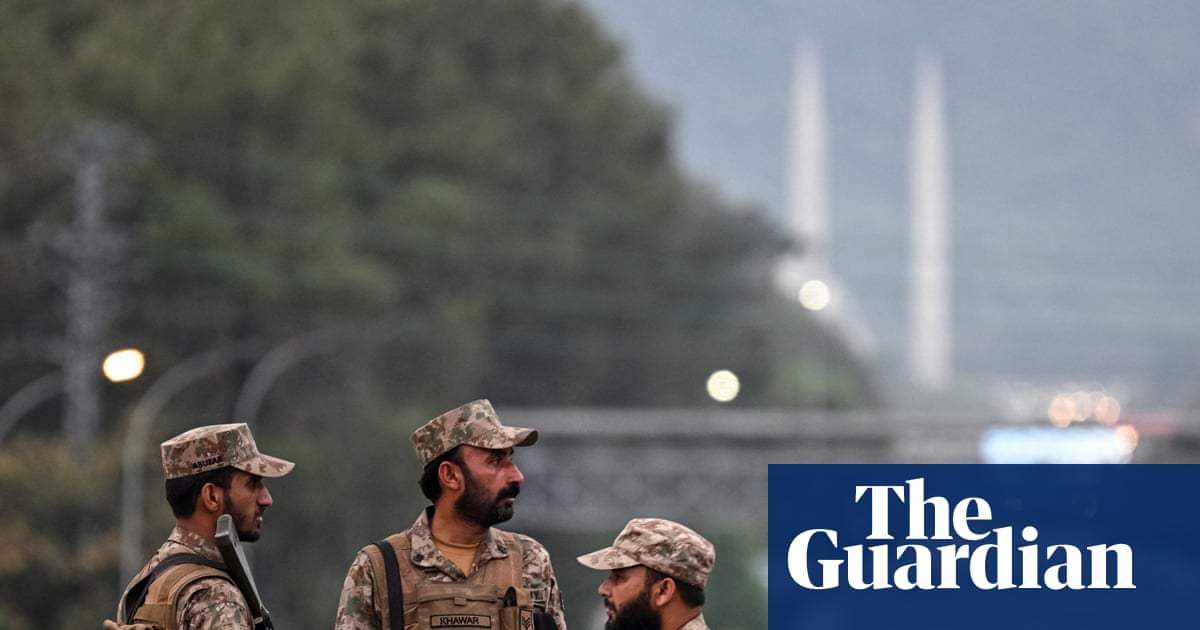
Pakistani soldiers stand guard amid tightened security measures in Islamabad ahead of expected US-Iran peace talks. Photograph: Farooq Naeem/AFP/Getty ImagesView image in fullscreenPakistani soldiers stand guard amid tightened security measures in Islamabad ahead of expected US-Iran peace talks. Photograph: Farooq Naeem/AFP/Getty ImagesIran foreign minister to embark on three-nation tour as US peace talks remain stalledAbbas Araghchi to visit Pakistan, Oman and Russia to see if talks can be reopened, with both sides still in stalemate
The Iranian foreign minister, Abbas Araghchi, is planning a tour of Pakistan, Russia and Oman in an effort to see if there is a basis to reopen peace talks that can end with a permanent US-Israeli commitment to cease its attacks on Iran, now one of Tehran’s key demands.
Araghchi is also likely to discuss a potential permanent new arrangement on governing the strait of Hormuz with Oman, which oversees the south of the strait.
Islamabad had been hoping that Araghchi’s visit would result in the restart of bilateral talks with a US negotiating team led by the vice-president, JD Vance, but neither side, both claiming time is on their side, appears ready to back down from its demands. Pakistan has been acting as mediator, but is struggling to find common ground.
Araghchi is expected initially to talk with Pakistani mediators, but American officials were briefing that the US negotiators Jared Kushner and Steve Witkoff were also flying to Islamabad. Mohammad Bagher Ghalibaf, the leader of the Iranian negotiating team in the first round of talks, is not attending at this stage.
Iran says it will not restart talks until the US lifts its blockade of Iranian ports, whilst the US is demanding verifiable assurances that Tehran will end its nuclear programme and lift its own crippling blockade of the strait.
Footage purportedly shows Iranian forces seize two vessels in the strait of HormuzIn one new idea being canvassed, Iran is considering parcelling up its 400kg stockpile of highly enriched uranium, and agreeing to dilute sequentially the enrichment level of each parcel in return for the lifting of specific sanctions. Iran is also still looking to see if China can be drawn in as a guarantor of any agreement.
When Araghchi visits Moscow, Russia is likely to revive its offer to Iran to take some of the stockpile, something it has done in the past.
The Iran foreign ministry spokesperson, Esmail Baghaei, speaking on Iranian TV, said the main subject in the negotiations was no longer the nuclear issue, but instead “ending the war in a way that secures the country’s interests. We accept the ceasefire only if it is the first step to bringing the war to an end on all fronts. With respect to the country’s demands, issues such as compensation, the strait of Hormuz, lifting sanctions – all these issues are critical to the country’s future.”
He stressed commitments to non-aggression were required not just from the US, but also from Israel, which has not been party to the talks. Donald Trump has extended the ceasefire in Lebanon, a move that had been resisted by Israel.
Read moreBaghaei said the lifting of the US blockade had, in Iran’s view, been part of the original ceasefire agreement. “If you do not fulfil your minimum commitments in the ceasefire how can there be trust in you for the implementation for a comprehensive settlement?” he asked.
At a Pentagon briefing, the defence secretary, Pete Hegseth, said Trump had said the US “had all the time in the world and we are not anxious for a deal”. He said a total of the 34 ships had been turned back as part of the US blockade of Iran’s ports, adding that a second aircraft carrier would be joining the blockade next week. The blockade, he said, had gone global. “No one sails from the strait of Hormuz to anywhere in the world without the permission of the United States navy.”
The Iranians were acting like pirates with flags, he said, by trying to stop ships crossing the strait and by laying mines. “If there’s attempts, recklessly and irresponsibly, to lay more mines, we’re going to deal with that. It’s a violation of the ceasefire.” The US navy would without hesitation shoot and kill anyone in boats laying mines, he said, comparing the exercise to the targeting of drug boats in the Caribbean.
He also took another swipe at Europe over countries’ refusal to intervene militarily: “We’re not pinning our hopes on Europe, but they need the strait of Hormuz far more than we do. Maybe it’s time for Europe to talk less and stop holding fancy conferences – perhaps they should just hop on a boat and come over. This is their fight more than ours.”
Iran has so far attacked five ships and captured two in its effort to enforce the blockade. Hegseth said some transit was occurring through the strait: “There are paths that are open. Transit is occurring, much more limited than anybody would like to see and with more risk than people would like to see, but that’s because Iran is doing irresponsible things with small, fast boats.”
Dan Caine, the chair of the joint chiefs of staff, said the US military was on standby to resume major combat operations as soon as an order was issued by Trump.
Anwar Gargash, the United Arab Emirates diplomatic adviser, claimed Iran’s callous behaviour toward the Gulf states meant it would take decades to restore trust and predicted more countries in the region would want to open political communication with Israel, since they now regarded Iran as the strategic threat. “Relations are bound to come back at some stage, but trust and confidence are different. Iran will be seen as the strategic threat for the region for many decades to come.”
He also claimed there was political jockeying inside Iran between the military and political wings, with no possibility of the old cohesive political order being recreated
The UAE has always been one of the Gulf states closest to Israel. It is in its interests to drive Saudi Arabia in particular towards closer relations with Israel off the back of the Iranian attacks on Gulf states.
Gargash also predicted the stalemate in the strait of Hormuz could last another fortnight, but said it was in the interests of both Iran and the US to reopen talks. “The tug of wills in the strait will take some time, but cannot go on forever,” he said.